
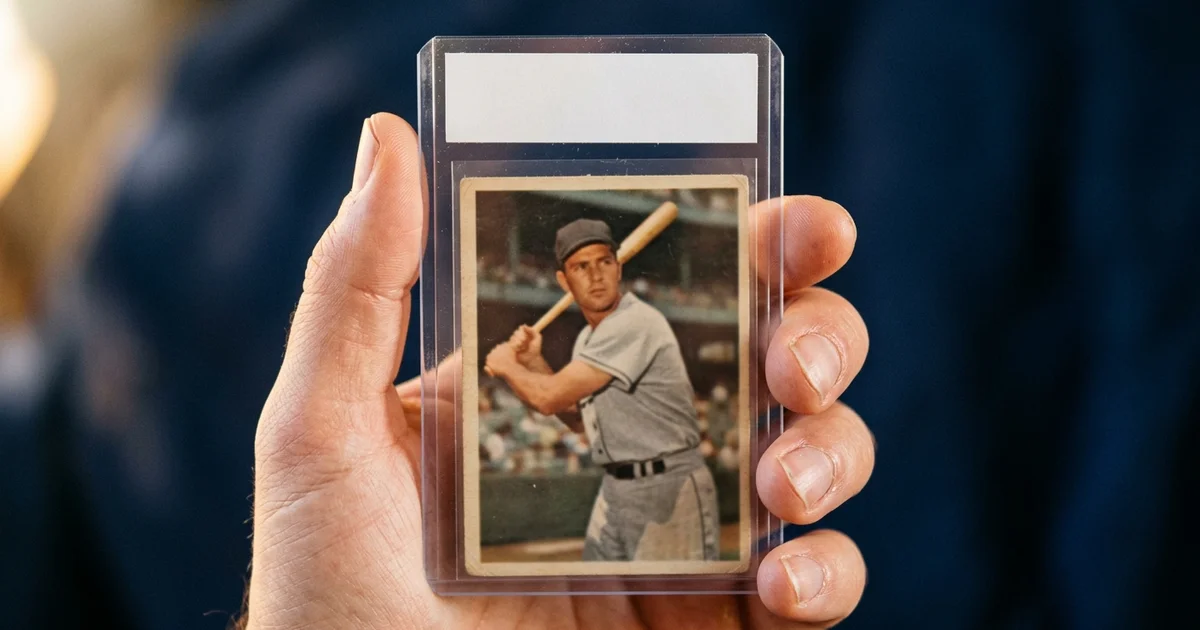
PSA runs a free public lookup at psacard.com/cert. Type in the serial number printed on the label, and the database returns the item that number was issued to. If the record matches what you’re holding, the number is real.
That’s the whole mechanic, and it takes about thirty seconds.
The part worth your attention is what happens after a clean result. PSA says on its own site that verifying a certification number does not eliminate risk, because criminals counterfeit grading inserts using real certification numbers pulled from public sources. A clean lookup proves the number exists in PSA’s database. It does not prove the label in front of you is the one that number belongs to.
So the lookup is step one of two. Here are both steps.
As an Amazon Associate we earn from qualifying purchases. This post contains affiliate links, and we may earn a commission at no extra cost to you.
Where the cert number actually is
On a graded card, ticket, or unopened pack in a PSA holder, the serial number sits at the bottom right of the front label. Since December 2015, that same serial number and its barcode are repeated on the reverse of the label, inside a white bar sitting directly beneath the embedded PSA holograms.
That repetition is useful and most buyers ignore it. Two printings of the same number, front and back, on one piece of paper. They have to match. A forger working from a single photograph of a slab front has no reason to know what the back is supposed to say.
On a PSA/DNA autograph, the number lives on the tamper-evident sticker applied to the item, and it’s repeated on the letter or certificate that shipped with it. Sticker and paperwork have to agree. If the item arrived without paperwork, that’s not automatically a problem, plenty of stickered items get separated from their letters over the years, but it removes one of your cross-checks.
Running the lookup
Three ways in, all free.
The web tool at psacard.com/cert takes the number directly. You can also reach a record by URL, in the form psacard.com/cert/[number], which is handy when you want to send a link to someone rather than a screenshot.
PSA’s cert verification phone app scans the barcode instead of asking you to retype eight digits. On newer slabs there’s a QR code on the reverse of the label that goes straight to the database record. Scanning beats typing, mostly because transposing one digit gives you a “no record found” that sends you into a panic over nothing.
Whichever route you take, read the returned record against the item, not past it. Year. Set. Player or subject. Card number. Grade. Every field has to line up. A record that comes back for the right player but the wrong year is a red flag, not a rounding error.
One record you’ll hit eventually reads “this cert is currently in a user’s private set registry inventory.” That’s not an error and it’s not a warning. Someone has added the card to a private collection in PSA’s Set Registry, so the public detail is hidden. The cert is real. You just can’t see the full record.
The record also links through to PSA’s population report for that card, which tells you how many examples exist at each grade. That’s a valuation input rather than an authenticity one, but it costs nothing to glance at. A card claiming a grade where the population is one or two deserves a much harder look than a common PSA 9.
What a clean result does not prove
This is where most cert-check advice stops, and stopping here is how people lose money.
The scam that matters right now works like this. Someone photographs a genuine graded card listed on eBay, reads the cert number off the label in the listing photo, and prints a counterfeit label carrying that exact number. The fake label goes into a fake holder around a low-grade or counterfeit card of the same player and set. The buyer types the number into psacard.com/cert, gets a clean record describing a real PSA 10 of exactly that card, and feels reassured.
The database was never wrong. The number really was issued. It was just issued to somebody else’s card.
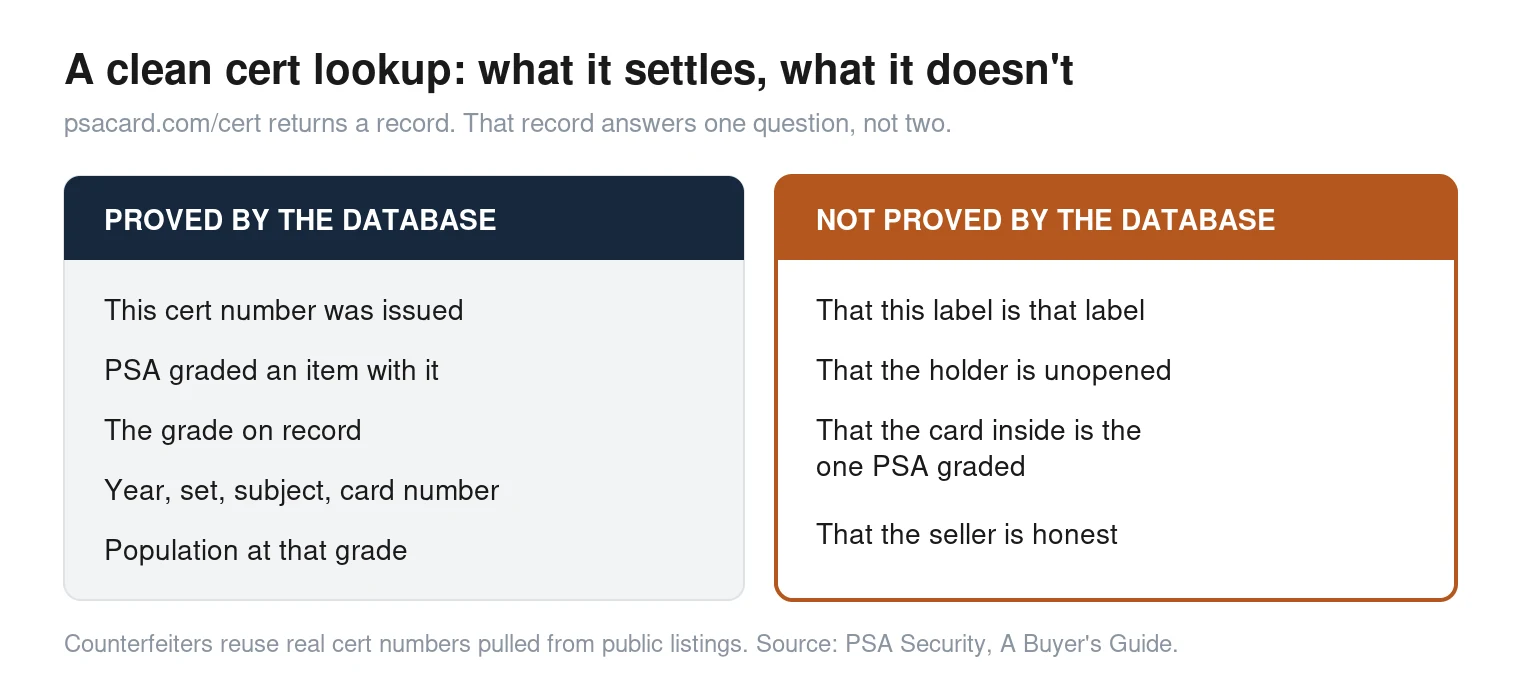
There’s a nastier version where a genuine high-grade label is cracked out of a real slab and re-encased with a cheaper card in a counterfeit holder. Now the label itself is authentic, so the label-specific security features pass too. That one is hard, and it’s the reason the seller matters as much as the slab.
PSA’s own buyer’s guide makes the same point in plainer language, and adds one piece of advice worth repeating. If a seller is confident in what they’re selling, they should have no objection to making the deal contingent on PSA reviewing the item. Hesitation there tells you a lot.
The physical checks that close the gap
A cert lookup and a two-minute look at the holder catch far more together than either does alone.
The weld. PSA holders are sealed with a sonic weld, which the company describes as tamper-evident rather than tamper-proof. A broken weld leaves evidence. Look for frosting along the edges, a cloudy haze in plastic that should be clear, and in worse cases small fractures. Flex matters too. Before welding, the plastic is mildly flexible. After, it’s close to rigid. A holder that gives noticeably when you press an edge has been opened, and glue doesn’t restore the weld.
The see-through test. Hold the slab up to a lamp and look through the label, front to back. On a genuine PSA label you should be able to make out the text on the opposite side. Not read it word for word, just see it. A forger who prints a fake face and lays it over a real label adds a layer of paper, and the label stops being translucent. PSA describes this exact trick and this exact test.
The tilt. Angle the label left and right under a light. PSA’s Lighthouse feature makes the PSA logo hide and reveal the Collectors Universe “NASDAQ: CLCT” ticker in the background pattern as the angle changes. Static printing can’t do that.
UV. Hit the lower left of the label’s reverse with a 365nm light. The PSA logo there fluoresces into a field of smaller PSA logos. This is a covert feature, invisible in normal light, and it’s the single fastest way to sort a printed imitation from the real thing.
One caveat that matters. These features arrived in stages. The embedded hologram and the duplicated barcode both landed in 2015, and the Lighthouse label with its UV and fugitive-ink features came in 2017. Older slabs carry older labels and won’t have all of them. Absence of a Lighthouse effect on a 2009 slab means the slab is old, not fake. Know what era of label you’re looking at before you call anything.
If the lookup returns nothing
Don’t jump to fraud. In order of likelihood:
You mistyped it. Retype it slowly, or scan the barcode instead.
You’re reading a number that isn’t the cert number. Modern PSA labels carry more than one number, and grabbing the wrong string off the label is common.
It’s a very old cert that predates full digitization, or a service line the public database doesn’t cover.
It’s fake.
Beckett handles the same situation with a documented process. If their verification tool says no record found and you believe that’s wrong, they ask you to email the cert number, an item description, and a photograph so a human can look. PSA’s contact channels work similarly. Exhaust the boring explanations before you accuse anyone.
The other lookups worth knowing
PSA is not the only company with a public database, and the one you need depends on whether you’re checking a signature or a grade.
For autographs, the big three authenticators each run their own free lookup.
- PSA and PSA/DNA: psacard.com/cert
- JSA: spenceloa.com/verify-authenticity
- Beckett Authentication: beckett-authentication.com/verify-certificate
Beckett’s authentication certification is a six-character alphanumeric string found on the item’s label or on the letter, which is a different format from PSA’s numeric serial. If a seller hands you a “Beckett number” that’s eight digits, something is off before you even run it.
For graded cards, the other slab companies keep separate databases from their autograph arms, and this trips people up constantly.
- SGC: gosgc.com/cert-code-lookup
- Beckett grading, which covers BGS, BVG and BCCG: beckett.com/grading/card-lookup
Beckett running two unrelated lookups under one brand is the single most common reason a cert “won’t verify.” A BGS grading serial typed into the Beckett Authentication tool returns nothing, and the buyer panics over a card that was fine all along. Match the tool to the service before you conclude anything.
For the wider question of which certificate is worth paying for and which ones are worthless, we covered the tiers separately in what an autograph certificate of authenticity is actually worth.
Two tools that make the physical check possible
Neither of these authenticates anything on its own. They let you see the features PSA built specifically so buyers could check them.
Wavelength is the part that matters on the light. The cheap 395nm units sold as “blacklights” throw enough visible violet to wash out a faint fluorescent response, which is exactly the response you’re trying to read on the back of a label.
For Reading the Label’s UV Features

ALONEFIRE SV003 10W 365nm UV Flashlight
- 365nm is the wavelength that makes the PSA logo on the label’s reverse fluoresce into smaller repeating logos
- Toughened black filter lens cuts the visible violet spill that washes out a faint reaction on 395nm lights
- USB rechargeable, battery and charger included
The downside: 10W is strong enough that prolonged exposure fades ink and paper, so use it in short bursts and never as a display light. You still need a dark room. The packaging is aimed at pet urine detection and resin curing, so it arrives looking nothing like a hobby tool.
Check current price on AmazonWe go deeper on wavelength choice in the UV flashlight guide, on safe exposure in longwave vs shortwave UV, and on interpreting what you see in reading a UV light result.
A loupe covers the other half, the part UV can’t show you. Print quality on the label, and the weld edge where a reopened holder gives itself away.
For Label Print Quality and Weld Edges

Nikon 10x Jewelry Triplet Loupe
- Triplet correction keeps the whole field sharp, so a counterfeit label’s halftone dot pattern reads as dots rather than blur
- 13mm lens, retracting case protects the optic in a pocket at a show
- Doubles for inspecting the sonic weld edge for frosting and hairline fractures
The downside: it costs several times what a no-name triplet costs, and a cheap one gets most people to the same answer on a label. The narrow field means you inspect a signature in sections. No built-in light either, so it wants a lamp or the UV light above.
Check current price on AmazonMore on what magnification reveals in what a jeweler’s loupe reveals on a forged signature.
Related guides
- Best UV Flashlight for Spotting Fake Autographs and Card Restoration (start here)
- Longwave vs. Shortwave UV: Which One Is Safe to Use on Autographs Over and Over
- Reading a UV Light Result: Original Ink vs. Restoration
- What a Jeweler’s Loupe Reveals on a Forged Signature
FAQ
Is PSA cert verification free?
Yes. The web lookup and the phone app both cost nothing, and there’s no account or login required.
How many digits is a PSA cert number?
PSA displays them as eight digits on its own site, zero-padded for older low-numbered certs. Read the number off the bottom right of the label rather than assuming a length.
Can I look up a PSA/DNA autograph the same way?
Yes, same tool. PSA’s verification covers PSA and PSA/DNA certification numbers together, including cards, autographs, tickets, comics and video games.
What if the cert number matches but the card looks wrong?
Trust the card. A matching number with a mismatched item is the exact signature of a cloned cert, and it’s the reason PSA warns that verification alone doesn’t eliminate risk. Stop the transaction.
Does a QR code on the label mean the slab is genuine?
No. A QR code is trivial to print, and it can point anywhere. What matters is whether it lands on psacard.com and returns a record matching your item. Check the domain in the URL bar before you trust the page.
Can a cert number tell me when the card was graded?
Roughly. PSA has issued certification numbers in sequence since 1991, so a low number means an early slab and a high one means a recent submission. Collectors have built timeline guides that map number ranges to years. Treat those as approximate. They’re useful for spotting an obvious mismatch, like a seven-figure cert number on a slab styled like a 1990s flip, and not much more than that.
Should I crack a slab open to inspect the card?
No. Breaking the holder destroys the grade and the tamper-evident seal, which is the thing giving the item its value. If you have real doubts, PSA will review the item, and any seller worth buying from will accept that as a condition of sale.