Category: Jersey Display & Preservation

  • Humidity Control for Signed Jerseys vs. Cards: Why One Rule Doesn’t Cover Both

    Humidity Control for Signed Jerseys vs. Cards: Why One Rule Doesn’t Cover Both

    As an Amazon Associate we earn from qualifying purchases. This post contains affiliate links, and we may earn a commission at no extra cost to you.

    Collectors ask “what humidity should I keep my collection at” like it’s one number for everything. It isn’t. A signed jersey and a signed card fail in different ways when moisture gets involved, so the fix for one is close to the opposite of the fix for the other.

    Get this backwards and you can do real damage. Sealing a jersey in plastic the way you’d seal a card in a toploader is one of the more common mistakes we see, and it’s the kind of mistake that shows up as mildew a year later, not immediately.

    Why humidity matters at all

    Moisture is the thing that turns a stable collectible into a slowly deteriorating one. Too much humidity and you get mold, mildew, and fabric or paper that stays damp long enough to weaken. Too little and materials dry out, fabric gets brittle, adhesive on some cards can crack. Most guidance lands on 40-50% relative humidity as the target range, and that part is genuinely the same for both jerseys and cards.

    Where it splits is what you do to hold that range.
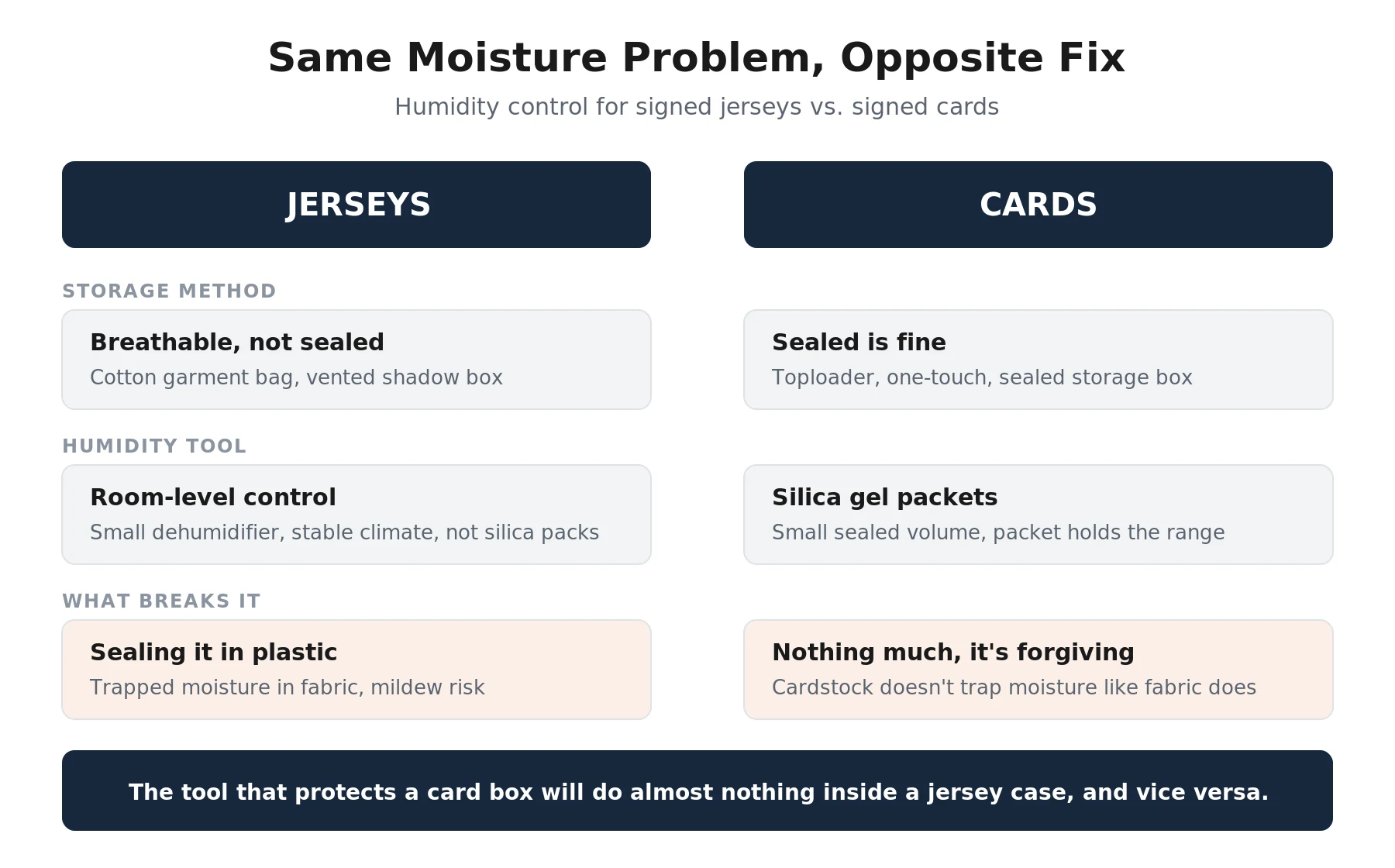
    Comparison showing jerseys need breathable, vented storage while cards do well sealed with silica gel packets for humidity control

    Jerseys need airflow, not a seal

    Fabric traps moisture against itself. Fold a jersey and seal it in plastic, even good plastic, and any humidity already in the fabric has nowhere to go. That’s how you get a musty smell or a mildew spot on a piece that was fine when you packed it away.

    The fix is a breathable environment, not a sealed one. A cotton garment bag over a plastic one. A shadow box display case with real air gap behind the acrylic, which is the whole reason a proper jersey display case beats a flat frame or a folded closet shelf. Keep the room itself in a normal, stable range, and skip the attic, garage, or basement, since those swing in temperature and humidity more than almost anywhere else in a house.

    A small room dehumidifier helps in genuinely humid climates. What doesn’t help is stacking silica gel packets into a sealed jersey case and calling it solved. There’s too much air volume in a shadow box for a few packets to do much, and if the case isn’t breathable to begin with, you’ve just recreated the sealed-bag problem inside a nicer box.

    Cards work the opposite way

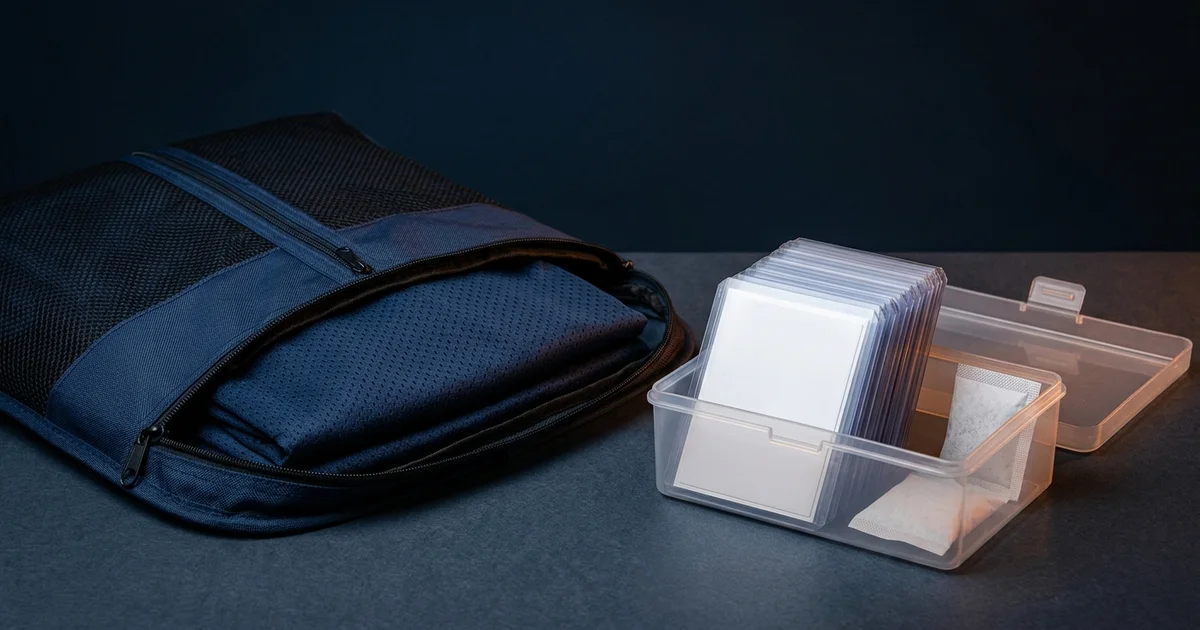
    A card in a toploader or one-touch holder is already close to a sealed environment, and that’s fine. Cardstock and thin plastic don’t trap moisture against themselves the way fabric does. A sealed, enclosed space is actually where humidity control tools do their best work, because the volume is small enough for something like a silica gel packet to meaningfully hold a stable range inside the box.

    For Storage Boxes and Binders

    Premium silica gel desiccant packets for card storage boxes

    Premium Silica Gel Desiccant Packets (100-pack)

    • 2-gram packets, each rated for about 0.14 cubic feet of enclosed space
    • Reusable: reactivate in an oven at 200°F or a microwave on defrost
    • Breathable nonwoven packet, safe in direct contact with cards and sleeves
    Check current price on Amazon

    Good: cheap, reusable for years, small enough to tuck into a card box or binder pocket without taking up real space.
    Not great: no built-in humidity indicator, so you’re reactivating on a schedule rather than a clear visual cue, and at 2 grams each you’ll want several per box rather than one and done for anything larger than a single row of toploaders.

    The same tool, two different results

    Put those silica packets in a sealed card box and they hold the space at a stable range for months. Put the same packets in a jersey shadow box and they’re mostly decorative, because the volume of air is too large and, more importantly, the fabric itself is the thing holding moisture, not the air around it. The packet treats a symptom the jersey doesn’t have.

    That’s really the whole rule. Cards live in small sealed spaces, so a small sealed-space tool works. Jerseys need to breathe, so anything that stops them from breathing works against you, no matter how good the moisture-absorbing material inside it is.
    Related guides

  • How to Display a Signed Jersey Without Ruining the Signature

    How to Display a Signed Jersey Without Ruining the Signature

    A signed jersey is the kind of thing people mean to frame “eventually” and then don’t. It sits folded in a closet for two years, or worse, gets thumbtacked straight to drywall like a dorm-room poster. Both are a good way to end up with a faded, creased, or torn piece of memorabilia instead of the one you paid for.

    As an Amazon Associate we earn from qualifying purchases. This post contains affiliate links, and we may earn a commission at no extra cost to you.

    The short answer is a shadow box display case with UV-protective acrylic, not a regular picture frame and not a thumbtack. Here’s why that specific combination matters, and which cases actually deliver on it.

    Why a regular frame doesn’t work

    A jersey has depth. Stitching, numbers, a folded collar, sometimes a signature sitting right on a seam. Press that under flat glass in a normal frame and you’re crushing fabric that wants room to breathe, which shows up later as permanent creasing across the numbers.

    A shadow box solves this by building in an air gap, usually an inch or more, between the backing and the glass. The jersey hangs or pins flat without getting squeezed. That’s the whole reason “jersey frame” and “picture frame” aren’t interchangeable searches, even though they look similar in a thumbnail.

    The second piece is UV protection. Untreated acrylic or glass lets ordinary window light degrade both the jersey’s colors and the ink underneath a signature over years, the same fading mechanism that shows up in autographed baseballs and photos. A case rated for 98% UV blocking stops most of that before it starts.

    The three cases worth actually buying

    Comparison of three jersey shadow box display cases: Grintus budget pick, IHEIPYE best overall pick, and an aluminum premium case with photo slots

    Best budget pick

    Best Value

    Grintus Jersey Display Frame Case

    Grintus Jersey Display Frame Case

    • Matt black wood frame, UV-protective acrylic door
    • Three display methods: wood hanger, metal hanger, pin board
    • Two anti-theft locks included
    Check current price on Amazon

    This is the one to buy if you just want the jersey protected and off the closet floor, nothing fancier. The build is plain black wood, not a design piece for the wall, but the acrylic and lock hardware are the same core protection as the pricier options. Assembly is straightforward, and the pin board option handles a long-sleeve hockey or football jersey without wrinkling it the way a single hanger would.

    Pros: cheapest of the three, still has real UV-rated acrylic, three ways to mount the jersey.
    Cons: plain finish, no photo or nameplate space, locks are basic and won’t stop a determined thief.

    Best overall

    Our Pick

    IHEIPYE Jersey Display Frame Case

    IHEIPYE Jersey Display Frame Case

    • Shatterproof, high-transparency UV acrylic, felt-lined interior
    • Wood hanger, metal hanger, and pin board, three fitting options
    • Gold-plated anti-theft locks
    Check current price on Amazon

    This is the one most people should buy. Same 31.25″ x 23.25″ footprint as the budget pick, but the felt lining is a nicer touch against the fabric, and the two hanger styles plus a pin board cover basketball, football, and hockey jerseys without needing a different case for each. The locks feel more solid, gold-plated instead of the base hardware on the cheaper option.

    Pros: felt-lined interior, three mounting styles fit almost any jersey shape, nicer lock hardware than the budget pick.
    Cons: still no photo or nameplate slot if you want a fuller display, black finish only.

    Best for a full display

    Premium Pick

    Aluminum Jersey Display Frame Case with photo slots

    Aluminum Jersey Display Frame Case (with Photo Slots)

    • Aluminum frame construction, museum-grade acrylic glazing
    • Built-in slots for two photos and a nameplate
    • 98% UV-protective, fits sizes S through 2XL
    Check current price on Amazon

    Buy this one if the jersey is the center of a bigger display, not the whole thing. The aluminum frame reads as more finished on a wall than the wood cases, and the two photo slots plus a nameplate space mean you can pair the jersey with a game photo and a name or date instead of showing the jersey alone. That’s the difference between “a jersey in a box” and something that actually tells a story on the wall.

    Pros: aluminum frame looks more finished, photo and nameplate slots add real context, still full UV protection.
    Cons: priciest of the three, deeper profile takes up more wall depth, overkill if you just want the jersey protected.

    Mounting mistakes that ruin a signature

    Direct sunlight is the big one. Even a case rated for 98% UV blocking is fighting a losing battle if it hangs across from a south-facing window all day, every day. Put it on an interior wall, or at minimum out of a direct sun path, and the case does the job it’s designed for instead of just slowing down the same fade.

    Don’t skip the pin board for anything with sleeves. A hanger alone lets a long-sleeve jersey sag and wrinkle at the shoulders over months, right where a signature often sits. The pin board holds the fabric flat the way a hanger can’t.

    And if the signature sits on or near a seam, mount it so the seam runs with the frame’s grain rather than fighting the fold. It sounds like a small detail. It’s the difference between a signature you can still read clearly in five years and one that’s cracked along a crease line.

    Bottom line

    Skip the thumbtacks and skip a regular picture frame. Get a shadow box built for a jersey, with real UV-rated acrylic, and pick the size of display that matches what you actually want on the wall: bare-bones protection, a nicer everyday case, or a full photo-and-nameplate display. Any of the three above beats another year folded in a drawer.

    Related guides