

As an Amazon Associate we earn from qualifying purchases. This post contains affiliate links, and we may earn a commission at no extra cost to you.
Three companies matter for sports and entertainment autographs: PSA/DNA, JSA, and Beckett Authentication Services. All three sell the same product, a third-party expert opinion attached to a serial number, and all three price it by who signed the item rather than by what the item is.
That last part is the piece most people get wrong on their first submission. You do not pay a flat fee to have an autograph authenticated. You pay a fee tied to that specific signer, and you look it up on the company’s pricing chart before you ship anything.
What an autograph authentication service actually does
An authenticator does not test the ink in a lab. That is the mental image people arrive with, and it is not what happens.
What happens is comparison. The authenticator has a reference library of known-good signatures from that signer, called exemplars, spanning different periods of their life. Your signature gets examined side by side against those exemplars for stroke order, pen pressure, letter construction, speed, and the small habits a forger copying a picture cannot reproduce. They also examine the object itself, since a signature on the wrong ball, the wrong photo stock, or the wrong era of jersey is a problem regardless of how the letters look.
The output is an opinion, not a proof. Every company words it that way deliberately. What you are buying is the credibility of the name on the letter, plus a serial number in an online database that a buyer can look up.
Two forms that opinion takes:
A sticker or tamper-evident label with a serial number, applied to the item. This is the cheap tier, and it is enough for most items.
A full letter of authenticity, the LOA. A document describing the item and the finding. Both PSA and Beckett issue one automatically once the authentication fee for that signer passes a threshold, and sell it as an upgrade below that threshold.
Encapsulation is a separate thing that gets confused with authentication. Encapsulation means the item is sealed into a rigid holder with the certification printed on the label. Cards and small flats get encapsulated. A signed jersey obviously does not, so it gets a sticker and a letter instead.
The three autograph authentication companies that carry weight
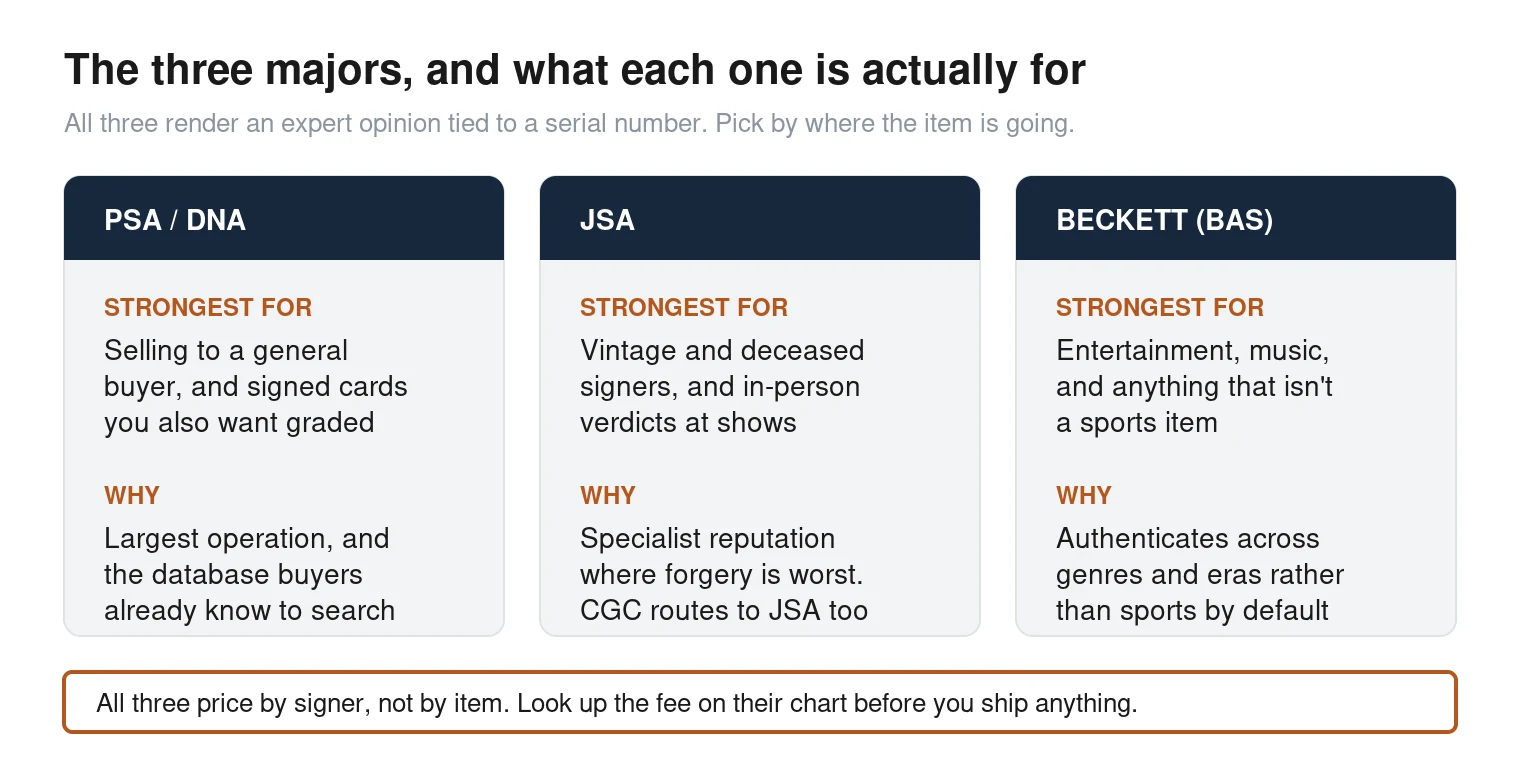
PSA/DNA is the largest, and its database is the one most buyers already know how to search. If you plan to sell on eBay, a PSA cert number is the lowest-friction thing to put in a listing, because the buyer can verify it in ten seconds without learning a new website. PSA also runs the deepest card-side operation, so if the item is a signed card that you also want graded, keeping both jobs under one roof is genuinely simpler.
JSA, James Spence Authentication, is the specialist reputation. Its name carries particular weight on vintage and deceased signers, which is exactly where forgery concentrates. JSA also authenticates on-site at shows, which is a real advantage if you would rather hand your item across a table than ship it.
Beckett Authentication Services, usually written BAS, is the third of the big three and the one most likely to be the right call for entertainment and non-sports material. Beckett authenticates across genres and eras rather than treating sports as the default. Their published turnaround target is 30 business days for authentication, with expedited tiers available at a premium.
Two more names that show up in the same searches and confuse people:
CGC does not run its own autograph authentication arm for signatures. It partners with JSA. If you send a comic or a card to CGC for a signature verdict, JSA is the one rendering the opinion.
SWAU is a witnessed-signing operation as much as an authenticator. Their strongest claim is items signed in their presence, where the chain of custody removes the guesswork entirely. That is a different and stronger form of certainty than any after-the-fact opinion, and it only applies to items that went through their signings.
How much does autograph authentication cost
There is no single number, and any site that gives you one is guessing.
The fee is set by signer. A common modern athlete costs a fraction of what a scarce deceased legend costs, because the risk and the expertise required are not comparable. Both PSA and Beckett publish searchable pricing charts where you type the signer’s name and get that item’s fee. Do that before you budget anything.
The rules that shape the total:
Multi-signed items price off the premier signer. A team ball with twenty signatures is not twenty fees. You look up the biggest name on it, then the chart adjusts for total signature count.
The letter has a threshold. Below a certain authentication fee, you get the small certificate and can pay to upgrade to a full letter. At or above that fee, the full letter is included and the upgrade charge does not apply. PSA and Beckett both work this way, with the upgrade priced separately at each.
Oversized items cost more. Anything needing a jumbo holder carries a surcharge at PSA.
Speed costs a lot. Beckett’s expedited tiers are priced per order and scale with item count, and they are steep relative to the base fee. Standard turnaround at both PSA and Beckett targets roughly 30 business days. If you are not selling next week, wait.
Worth saying plainly: on a common signer, the authentication fee can exceed what the signed item is worth. That is not a scam, it is just the math of paying an expert to look at something cheap.
How do I get my autographs authenticated
The process is nearly identical across all three companies.
1. Look up the signer’s fee on that company’s pricing chart. Do this first, because it decides whether the rest is worth doing. 2. Fill out the submission form on their site, listing each item and the declared value. The declared value affects insurance, not the fee. 3. Pack it properly. Flats go between rigid boards. Balls go in a cube inside a padded box. Nothing gets taped to anything, and nothing sticky touches the signature. 4. Ship insured to the address on the form, not to a general company address. 5. Wait about 30 business days, longer during show season and after major submissions surges. 6. Get the verdict. If it passes, the item comes back stickered, encapsulated, or lettered depending on what you bought. If it fails, it comes back unmarked with no certification, and the fee is not refunded.
That last point is the one that stings. You are paying for the examination, not for a yes.
The other option is skipping the mail entirely. All three companies send authenticators to major shows, and JSA in particular is a regular fixture. Handing the item over in person, getting a verdict the same day, and walking out with it is worth the price of a show ticket if you have several pieces or one item you would rather not ship.
What is the most reputable autograph authentication service
The honest answer is that PSA/DNA, JSA, and Beckett are all accepted by the market, and no one of them is universally the right pick.
What actually decides it:
- Selling on eBay or to a general audience? PSA. Widest recognition, easiest database lookup for a buyer who does not know the hobby.
- Vintage or deceased signer? JSA. That is where its reputation is concentrated.
- Entertainment, music, or non-sports? Beckett. Broader genre coverage without treating sports as the default.
- Item is a card you also want graded? PSA, purely for logistics.
- Comic book? CGC, which routes the signature to JSA anyway.
What does not decide it is which company has the nicest website or the loudest marketing. All three render opinions, all three have publicly disputed calls in their history, and none of them guarantees a correct verdict. That is the nature of an opinion service.
Steer clear of the fourth category entirely, which is the dealer-issued COA. A certificate printed by whoever sold you the item is not third-party authentication, it is the seller vouching for themselves. A certificate of authenticity is only as good as the name on it, and an unknown name on it is worth nothing.
What to check yourself before you pay for a submission
Authentication fees are per item and non-refundable. Spending twenty minutes with the item first can save you from paying an expert to tell you what you could have seen.
Two tools do most of the work, and neither requires any expertise to use.
A 10x loupe shows you the thing that separates a real signature from a printed one instantly. Ink sits on top of the surface, pools at direction changes, and varies in density where pen pressure changed. A print is a uniform dot pattern with no relief, no pooling, and no pressure variance. That difference is invisible at arm’s length and obvious at 10x.
Ink vs. Print, Settled in Seconds

Nikon 10x Jewelry Triplet Loupe
- 10x triplet optics, the standard magnification authenticators use for surface and ink inspection
- 13mm lens, 25mm focusing distance, close enough to read pen pressure and ink pooling
- Lens retracts into the housing, so it survives a pocket or a show bag without scratching
What’s good: triplet optics correct the color fringing and edge distortion that make cheap doublet loupes tiring to use, and 10x is the magnification the hobby actually standardized on, so what you see matches what an authenticator describes.
What’s not: it is expensive for what it is. A generic triplet loupe does the same job for a fraction of the price, and the Nikon name is carrying part of the cost here. The narrow 13mm lens also means a small viewing window, which takes practice to aim, and the short focusing distance puts your eye uncomfortably close to the item. If you only ever check one signature a year, buy cheaper.
A 365nm UV flashlight covers the other half. Paper and card stock are usually treated with optical brighteners that fluoresce, and areas that have been restored, patched, or cleaned fluoresce differently from the original surface. It will not tell you a signature is real. It will show you that the photo underneath it has been worked on, which is worth knowing before you pay to authenticate the signature on it.
Surface and Restoration Check

ALONEFIRE SV003 10W 365nm UV Flashlight
- True 365nm LED, the wavelength that makes fluorescence readable instead of drowning it in visible purple
- Black filter lens cuts the stray visible light that washes out subtle surface differences
- USB rechargeable with an included battery and charger, so it is not dead the one time you need it
What’s good: 365nm is the wavelength that actually works for this, and most cheap “UV” flashlights are 395nm, which floods everything in purple light and hides the exact differences you are trying to see. The filter lens on this one is the reason it reads cleanly.
What’s not: it is a 10W emitter and it gets warm on long runs, which is a nuisance when you are working through a stack of items. UV exposure is also cumulative on inks and dyes, so this is a tool for short looks, not for leaving trained on a signature while you study it. And it produces evidence you then have to interpret, which is a skill. A clean look under UV is not a pass, it is just the absence of one particular red flag.
Neither tool replaces an authenticator. What they do is catch the obvious failures, the preprints and the reworked surfaces, before you spend a non-refundable fee on them.
When authentication is not worth the money
Skip it when the fee approaches or exceeds the item’s value. On a common current player, it usually does.
Skip it when you obtained the signature yourself and have no intention of selling. You already have the only certainty that matters, which is that you watched it happen. A letter adds nothing to your own knowledge.
Skip it when the item already carries a cert from one of the big three. Re-authenticating with a second company is a thing people do when they dislike a verdict, and it rarely ends well.
Get it when you plan to sell, when the signer is deceased or scarce, when the item is worth several times the fee, or when you bought it from anyone whose word you would not stake the purchase price on.
FAQ
How much does it cost to have an autograph authenticated? It depends entirely on who signed it. Fees are set per signer and looked up on the company’s pricing chart. Multi-signed items price off the premier signer with an adjustment for signature count, and oversized items carry a holder surcharge at PSA.
How long does the authentication process take? Both PSA and Beckett target roughly 30 business days for standard authentication. Beckett sells expedited tiers priced per order. Show-season backlogs push all of these longer.
How do I get my autographs authenticated? Look up the signer’s fee, fill out the company’s submission form, pack the item rigidly with nothing adhesive touching the signature, ship insured, and wait. Or bring it to a show where that company has authenticators on site.
What happens if my item fails? It comes back with no certification and no marks on it. The fee is not refunded, because you paid for the examination rather than for a favorable verdict.
What does encapsulated mean? The item is sealed into a rigid tamper-evident holder with the certification printed on the label. It applies to cards and small flats. Larger items get a sticker and a letter instead.
Can I choose where the certification sticker goes? Submission forms generally allow a placement request, and authenticators try to honor it. Treat it as a request rather than a guarantee.
What I’d actually do
Look up the fee first. That single step decides most submissions before any other consideration matters, and it is free.
If the fee clears, pick by where the item is going rather than by which company sounds most prestigious. PSA if a general buyer needs to verify it, JSA if the signer is vintage or gone, Beckett if it is not sports.
And spend twenty minutes with a loupe before you spend the fee. The cheapest authentication in this hobby is the one that tells you not to bother.
Related guides
- Best UV Flashlight for Spotting Fake Autographs and Card Restoration (start here)
- PSA Cert Verification: How to Check a Cert Number
- What an Autograph Certificate of Authenticity Is Actually Worth
- Longwave vs. Shortwave UV: Which One Is Safe to Use on Autographs Over and Over
- What a Jeweler’s Loupe Reveals on a Forged Signature
- Reading a UV Light Result: Original Ink vs. Restoration