
As an Amazon Associate we earn from qualifying purchases. This post contains affiliate links, and we may earn a commission at no extra cost to you.
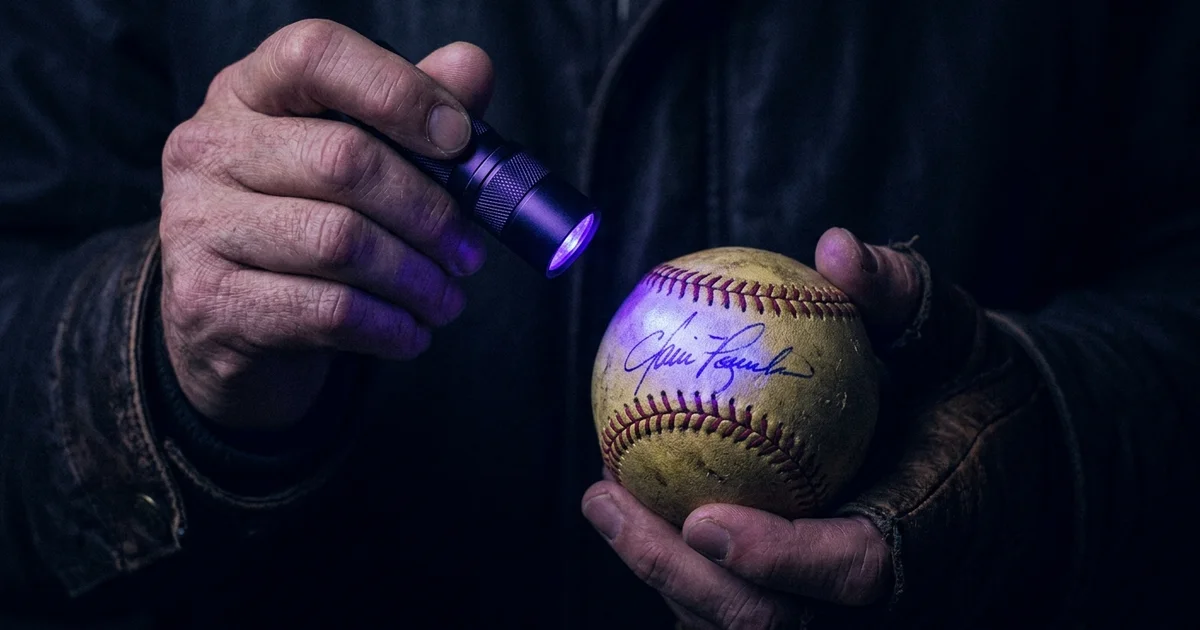
Fresh ink and old ink don’t glow the same way under a 365nm light. Once you’ve seen the difference side by side, you can’t unsee it.
If you already own a 365nm UV flashlight, you have the tool. This is the part nobody explains well: what you’re actually looking at once the light comes on.
Why ink glows under UV in the first place
Most inks, ballpoint, Sharpie, gel, contain compounds that fluoresce under ultraviolet light because of how their pigments and binders absorb and re-emit light outside what your eyes normally catch. Old ink that’s had years to oxidize and settle into paper or a card’s surface fluoresces differently than ink laid down last week. Paper and card stock age the same way.
That’s the whole trick a UV light exploits. Two materials that look identical in daylight age and react to UV differently once you stop trusting your eyes alone.
What original ink looks like
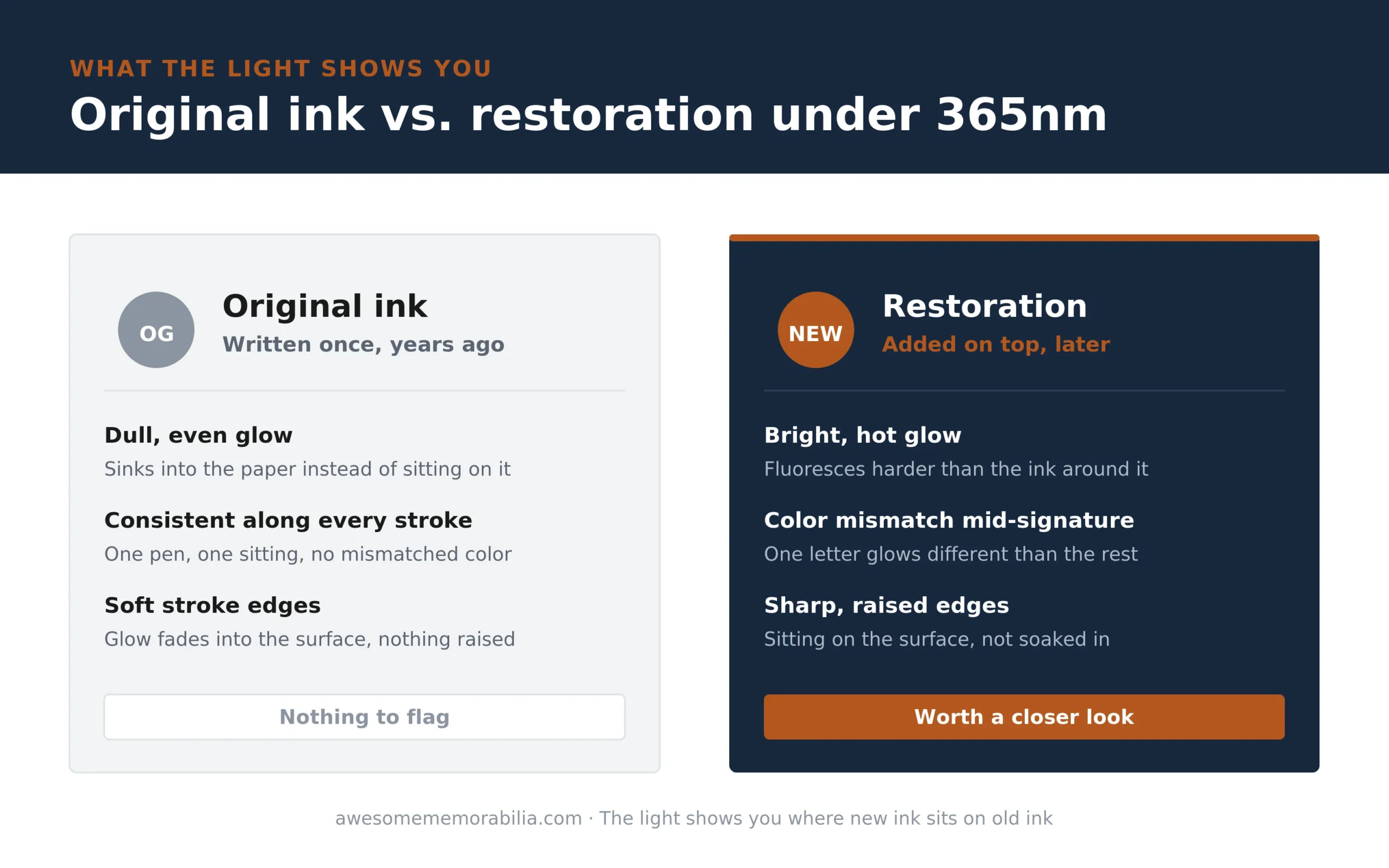
Genuine, aged autograph ink reads dull and even. It sinks into the surface instead of sitting on top of it. Move the light across a real signature and the glow, if there’s any at all, stays consistent along every stroke, because the whole thing was written in one sitting with one pen at one point in time.
What restoration or a forgery looks like
Added ink stands out because it doesn’t share that history. A retraced signature, a “touched up” fade, or ink laid over a printed surface tends to fluoresce brighter, hotter, or a noticeably different color than the material around it. Look for:
- A glow that jumps at the stroke edges. Original ink fades into the paper. Added ink often has a slightly raised, sharper edge because it’s sitting on the surface, not soaked into it.
- Color mismatch inside a single signature. One letter glowing blue-white next to letters that stay dull isn’t a coincidence. Someone touched up part of a fading autograph and left the rest alone.
- A signature that’s uniformly hot everywhere. A whole autograph lighting up bright and even, with none of the natural variation a real pen stroke leaves, points to the entire thing being added at once, not written years ago the ordinary way.
Why autographs fade in the first place
Light exposure is the biggest cause, especially UV from windows and old fluorescent bulbs. It breaks down ink pigment over years, which is exactly why a UV-blocking display case matters if you want a piece to last. A faded autograph isn’t automatically less authentic. It’s just old and poorly displayed.
The problem starts when someone “fixes” that fade with new ink instead of living with it, or disclosing it.
Can a faded autograph be restored honestly?
Conservators can stabilize paper and ink without adding new pigment, and that kind of work doesn’t hide anything under UV because nothing new went on the surface. What actually tanks a piece’s value is undisclosed retracing: someone going over faded strokes with a fresh pen to make it look sharp, then selling it as if that never happened.
The UV light doesn’t care about intent. It shows you where new material sits on old material. What you do with that information is the real authentication step.
One read isn’t enough
A single UV pass tells you where to look closer, not a final verdict. Cross-check anything questionable against a known exemplar of the signer’s autograph. If real money is on the line, get a reputable third-party opinion before you buy or sell.
The light narrows the question. It doesn’t answer it by itself.