Tag: loa

  • Autograph Authentication Near Me- The Honest Answer

    Autograph Authentication Near Me- The Honest Answer

    As an Amazon Associate we earn from qualifying purchases. This post contains affiliate links, and we may earn a commission at no extra cost to you.

    There is almost certainly no autograph authenticator in your town, and searching harder will not produce one. The three companies whose opinion the market actually pays for are PSA/DNA, JSA, and Beckett, and all three run out of a single facility each. What travels to you is a booth at a card show, not an office down the street.

    So “near me” resolves to one of two real answers. Catch one of those three at a show within driving distance, or put your item in a box. Everything else that comes back in a local search is a dealer, a shop, or a store-issued certificate, and none of those carry weight when you go to sell.
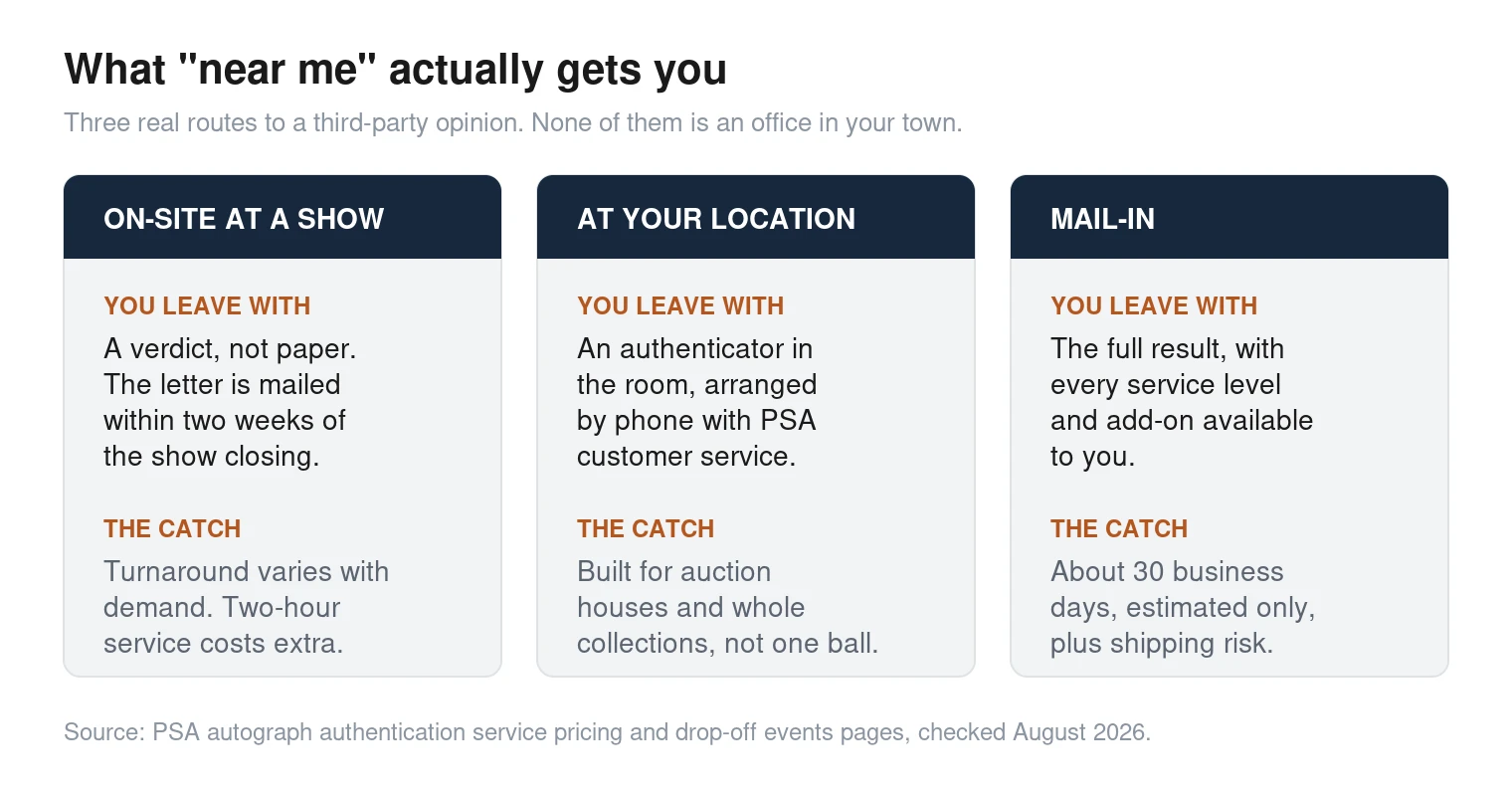
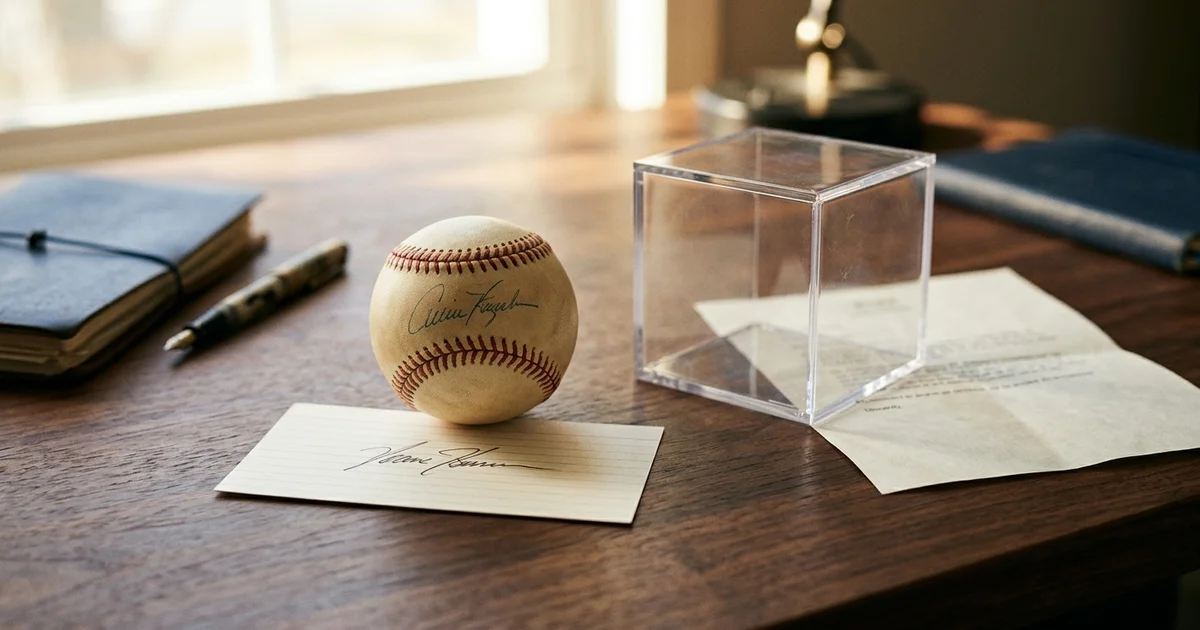
    Three routes to autograph authentication compared, on-site show booth, private on-location visit, and mail-in submission

    Where I can get my autographs authenticated

    Start by narrowing what you are actually looking for, because the search phrase hides three different jobs.

    A third-party opinion you can resell on. That is PSA/DNA, JSA, or Beckett, and nothing else. Auction houses, eBay’s authenticity programs, and serious buyers recognize those three. This is the one most people mean.

    A quick read before you spend money. Several of the majors sell a cheap pre-screen. Beckett’s Signature Review is $10 with an emailed answer, which is the least-used bargain in the hobby.

    Someone local to physically look at it. This is the one that does not exist the way people picture it. A card shop owner with thirty years behind the counter can tell you plenty, and it is worth listening to, but their word does not travel with the item.

    PSA’s own site is unintentionally clear about this. Their navigation has a menu literally labeled “PSA Near Me,” and the only two things under it are drop-off events and shows and a dealer directory. Not offices. Events and dealers. That is the honest shape of local access.

    On-site authentication at shows, and what it actually costs

    This is the closest thing to walk-in service that exists.

    PSA runs on-site autograph authentication at trade shows around the country. You hand the item across a table, an authenticator examines it there, and you get an answer without shipping anything. Beckett and JSA both do the same thing, sometimes at the same shows, sometimes at partnered card shops running a scheduled event.

    Three details from PSA’s own pricing page decide whether this is worth the drive:

    • Turnaround at the show varies with demand. An estimated two-hour service is available for an additional charge, which tells you what the unpaid line looks like on a busy Saturday.
    • The letter does not come home with you. Letters of Authenticity are issued by mail within two weeks after the show ends. You leave with a verdict, not a document.
    • Expedited processing is unavailable during the busiest weeks of the year, specifically the National Sports Collectors Convention in August and the Fanatics Authentic Chicago Show in March and November.

    That last one is worth sitting with. The weeks when the most authenticators are physically closest to the most collectors are exactly the weeks the fast lane closes.

    There is also a fourth option almost nobody knows about. PSA offers private on-site authentication at your location, arranged by phone at (800) 325-1121. That is built for auction houses and large collections, not for one signed ball, but if you inherited a wall of memorabilia it is the call to make instead of packing forty boxes.

    Bring the item in something, not in your hands

    Whichever route you pick, the item has to survive the trip. Show tables are crowded, and a bare signed ball rolling around a tote bag picks up more damage in one afternoon than it does in a year on a shelf.

    For Carrying a Signed Ball

    Ultra Pro clear square baseball cube holder with UV protection and built-in cradle

    Ultra Pro Baseball Clear Square UV Holder

    • UV barriers that reduce light exposure, which is the specific mechanism behind signature fading
    • Built-in cradle holds the ball still instead of letting it roll against the walls in a bag
    • Slide-in bevel closure and a stackable, archival-safe body, so it works for the drive and for the shelf afterward
    Check current price on Amazon

    What’s good: it costs about what a sandwich at the show costs, it stops the two things that actually ruin signed balls (handling oils and light), and the cradle means the ball is not resting on the signature.

    What’s not: it is thin, single-ball plastic, and it is a protector rather than a shipping container. Drop it on concrete and it cracks. It also does nothing for humidity, so a ball that lives in a hot car between shows is still at risk. And the cube has to come off before an authenticator can examine the ball, so plan on opening it at the table.

    For a card, the packaging question has a specific right answer instead of a preference. PSA asks for a clear penny sleeve inside a semi-rigid holder, and their shipping guide states the holder dimension as a measurement rather than a brand, 3 5/16″ by 4 7/8″. Card Saver 1 hits that spec exactly. This matters even at a drop-off event, since the item still enters the normal submission stream once it leaves the table.

    For a Card Submission

    Cardboard Gold Card Saver 1 semi-rigid trading card holders, 100 count

    Cardboard Gold Card Saver 1 (100 ct)

    • Matches PSA’s stated submission dimension, and Cardboard Gold’s own listing names PSA and PSA dealers as the users
    • Slightly oversized on purpose, so a sleeved card loads and unloads without being forced
    • Also takes the larger pre-1957 cards that will not go into a standard 3″ x 4″ holder
    Check current price on Amazon

    What’s good: it is the holder the whole submission process was built around, the per-unit cost at 100 count rounds to nothing, and acid-free polypropylene will not yellow against the card.

    What’s not: it is floppy, and anyone used to toploaders finds that alarming the first time. The lip creases if you are careless, a bent holder can press a corner, and an unbanded stack lets cards slide back out on the drive over. It is also too tall for most storage boxes, which is a real annoyance once the item comes back. There is more on which Card Saver PSA actually accepts if you are choosing between sizes.

    How much does it cost to have an autograph authenticated

    There is no flat rate, and any page quoting you one number is guessing.

    PSA prices by signer. You look up the person who signed it, and the fee lands somewhere on a chart that starts at $10 for a single signature on a common signer and climbs to $500 for the top tier. Multi-signed items price off the premier signer, then adjust for the total count. A 22-signature item with a $20 premier signer comes to $150.

    The numbers worth memorizing before you budget:

    • Under $50 in authentication fees gets you a 3×3 certificate, not a full letter. The Premium LOA upgrade is $15.
    • At $50 and above the full letter is included with no extra payment.
    • A declared value of $1,000 or more triggers a premium item charge, starting at $40 and scaling up from there.
    • Standard turnaround is roughly 30 business days from the day it is scanned in, and PSA is explicit that this is an estimate rather than a guarantee.
    • Expedited runs $75 for 10 business days, $150 for 5, and $250 for 1, each covering one to five items.

    Beckett’s structure is similar with different numbers, and Beckett’s $10 Signature Review is the cheapest way to find out whether full authentication is even worth buying.

    Is it worth getting an autograph authenticated

    Sometimes clearly yes, sometimes clearly no, and the line is easier to find than people expect.

    Run the fee against what the item sells for unauthenticated. A signed common-player ball worth $40 does not survive a $30 authentication fee plus return shipping. A signed ball from a Hall of Famer usually doubles or better with a letter attached, because the buyer stops absorbing the risk.

    The other case for paying is that you already own it and cannot prove where it came from. An in-person memory is worth nothing to a stranger. If you plan to sell, or leave it to someone who will, the letter is what converts your certainty into their certainty.

    The case against is thinner than it looks but it is real. If the item is never leaving your house, the letter buys you nothing except your own peace of mind, and that is a legitimate thing to decline to pay for.

    Screen it yourself before you pay anyone

    The worst outcome is paying a fee, driving to a show, and finding out the signature is printed. That happens constantly with movie posters and mass-market memorabilia, and it is avoidable in about ninety seconds.

    A UV light and a loupe answer two different questions. Magnification tells you whether you are looking at ink or a printed dot pattern, which is the single most common fake. UV tells you whether the surface has been touched up or the ink behaves like something modern on an item claiming to be old.

    Pre-Screening Before a Fee

    ALONEFIRE SV003 365nm UV flashlight with black filter lens and USB charging

    ALONEFIRE SV003 10W 365nm UV Flashlight

    • True 365nm output, which is the wavelength that shows restoration instead of just making everything glow
    • Black filter lens that cuts the visible light bleeding out of the beam, so what you see is the reaction and not the flashlight
    • USB rechargeable aluminum body, small enough to live in a show bag
    Check current price on Amazon

    What’s good: 365nm with a filter is the configuration that actually reveals surface work, and it costs a fraction of one authentication fee. It is also genuinely portable, which matters if you are screening items on a show floor before buying.

    What’s not: it is a screening tool, not a verdict, and treating a UV result as proof is how people talk themselves into bad buys. Reading it takes practice, since plenty of legitimate modern paper is optically brightened and lights up on its own. It is also 365nm, which is safer than shortwave but still not something to shine at your eyes or leave sitting on an item. Short looks only.

    Who can authenticate my signature

    Worth separating, because two different questions share this phrasing.

    If you mean a signature on collectible memorabilia, it is the three companies above, and the answer does not change based on your zip code.

    If you mean a signature on a legal document, that is a notary or a forensic document examiner, and neither one is what PSA does. PSA compares your signature against known exemplars using ink analysis, autograph structure analysis, object evaluation, and side-by-side comparison, sometimes with a video spectral comparator. That is an opinion built for a collectibles market, not testimony built for a courtroom.

    What about local shops and store COAs

    Card shops are useful and mostly honest. A shop owner will often tell you straight that a signature looks wrong, and that free opinion can save you a submission fee.

    What a shop cannot do is issue paper that transfers value. A certificate from the seller is the seller vouching for the seller. That is worth something when you trust the person and nothing at all when you go to resell, because the next buyer does not know them. This is the whole reason third-party authentication exists as an industry, and it is covered in more depth in what a certificate of authenticity actually proves.

    The genuinely useful local play is a shop that hosts scheduled authentication events. Beckett and PSA both partner with shops to run these. You are still getting the major’s opinion, you are just not driving to a convention center for it.

    FAQ

    Are there upcoming authentication events near me? Check the source rather than a directory. PSA lists its schedule month by month on its events page, Beckett publishes upcoming shows on its own site, and JSA lists appearances on spenceloa.com. Local card shops announce partnered events on social media, usually a few weeks ahead, with a cutoff date for dropping items off.

    Can I get an online autograph authentication? For a preliminary opinion, yes. Beckett’s Signature Review runs $10 from photos with an emailed answer. For a certificate or letter, no. The item has to be physically examined.

    What is the difference between a COA and an LOA? On PSA submissions it is mostly a size and price distinction. Items priced under $50 get a small 3×3 certificate, items at $50 and above get a full Premium Letter, and you can upgrade for $15. In the wider market the terms are used loosely, which is exactly why the issuing company matters more than the word printed on the paper.

    Does the authenticator have to see the item in person? For a real letter, yes, every time. That is the entire reason “near me” is a hard question. Anyone offering to certify from photos alone is selling you an opinion, not an authentication.

    What I’d actually do

    Screen it yourself first with magnification and a UV light, since that costs one afternoon and eliminates the printed-signature cases for free.

    Then check whether PSA, JSA, or Beckett is running a booth within a few hours of you in the next couple of months. If yes, go, and expect to leave with a verdict rather than a letter. If no, ship it, because a 30-business-day mail-in from your kitchen table beats a four-hour drive to a shop that cannot issue anything.

    And skip the local search entirely if what you want is resale value. The nearest authenticator whose word counts is a mailbox.

    Related guides

    Sources

  • PSA DNA Authentication – What You Actually Get

    PSA DNA Authentication – What You Actually Get

    As an Amazon Associate we earn from qualifying purchases. This post contains affiliate links, and we may earn a commission at no extra cost to you.

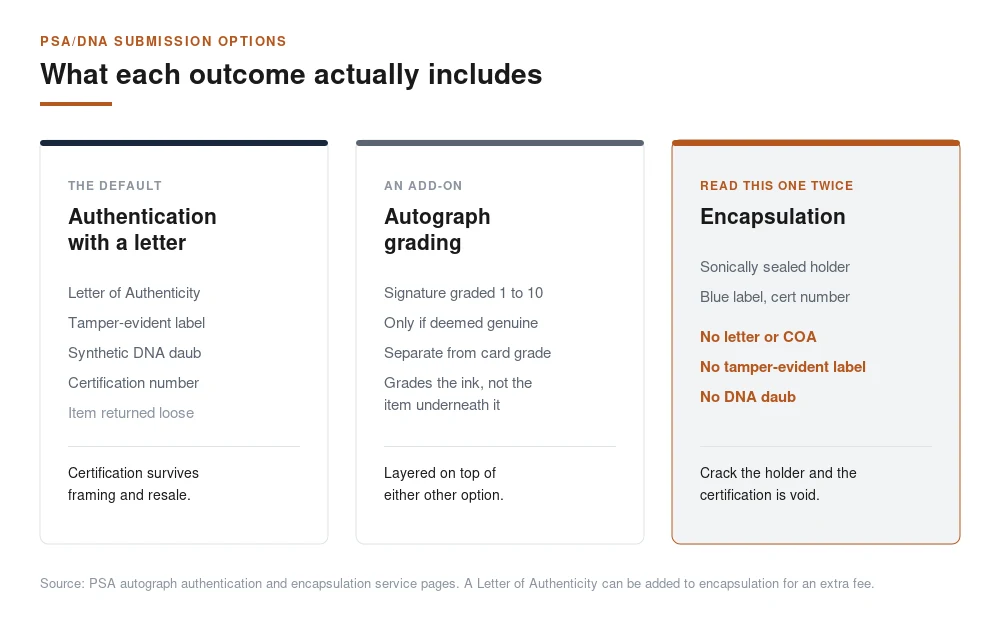
    PSA/DNA is the autograph authentication arm of PSA, short for Professional Sports Authenticator, and it sells three different outcomes that most people assume are one thing. You can get a letter and a tamper-evident label. You can get the item sealed in a holder. You cannot get both without paying extra, and picking the sealed holder deletes the letter, the label, and the DNA mark entirely.

    That tradeoff is written on PSA’s own encapsulation page and almost nobody mentions it before you ship.

    Comparison of the three PSA/DNA outcomes showing what a letter of authenticity, a tamper-evident label and an encapsulated holder each include

    The DNA in PSA/DNA is literal

    This trips up everyone the first time. The name is not a metaphor for genetic-level scrutiny or a branding flourish. PSA marks authenticated items with a synthetic DNA ink, applied as a small invisible daub, readable only under a specific laser frequency.

    It is an anti-counterfeit feature, nothing more. It does not prove the athlete signed the item. It proves PSA touched the item, which is a narrower and more useful claim than it sounds. A forger can copy a sticker and can print a convincing letter. Reproducing a proprietary synthetic DNA strand keyed to one company’s laser is a different category of problem.

    The mark is also invisible to you. You cannot verify it at home, you cannot verify it at a show, and no amount of UV light will bring it up. It is a tool PSA uses to confirm its own work, not a tool you use to confirm PSA’s.

    What PSA actually examines

    The examination is documented on PSA’s autograph authentication page and it is more specific than the vague “our experts review it” language most services use.

    Authenticators run ink analysis, autograph structure analysis, object evaluation, and side-by-side comparisons against known exemplars. For harder calls they bring in a video spectral comparator, which is the same class of instrument document examiners use to separate inks that look identical to the eye.

    PSA states it has certified over 35 million collectibles. That volume is the actual product. An opinion is only worth what the reference library behind it is worth, and a company that has looked at 35 million items has seen more genuine and forged versions of your signer than you ever will.

    What it is not is a guarantee that the signature is real. It is an expert opinion, rendered by people with better tools and a bigger exemplar library than you have. Opinions from PSA get rejected by other authenticators sometimes. That happens across the whole autograph authentication industry, and it is the honest ceiling on what any of these services sell.

    The three outcomes, and why the third one cancels the first two

    Here is the part worth reading twice before you fill out a submission form.

    Authentication with a letter. The default. PSA examines the item, and if it passes you get a Letter of Authenticity carrying a certification number, a tamper-evident label applied to the item, and the DNA daub. The item comes back to you loose, exactly as you sent it.

    Autograph grading. An add-on, not a separate service. If the autograph is deemed genuine, you can elect to have it graded 1 to 10, with 10 being best. This grades the signature itself, the boldness and placement and condition of the ink, and it is separate from any grade on the card or ball underneath it.

    Encapsulation. PSA seals the item in a sonically sealed holder with a blue label carrying the certification number. Autographed trading cards, photographs, checks, index cards, postcards and cuts are eligible, as long as the item fits a PSA holder. Non-licensed, replica and custom trading cards are not eligible.

    Now the catch. PSA’s encapsulation page states that encapsulated items do not receive an LOA or COA, a PSA tamper-evident label, or a DNA daub. You may request a Letter of Authenticity in addition to encapsulation for an additional fee. Jumbo holders carry their own surcharge.

    Read what that means for resale. An encapsulated autograph with no separate letter is authenticated only as long as the holder stays sealed. Crack it and the certification is void, because the label and the DNA mark that would have traveled with the item were never applied. There is no way to prove the item was ever certified.

    That is a real decision, not a formality. If the item lives in the holder forever, encapsulation is clean and displays well. If there is any chance it gets removed, framed, or re-graded later, pay for the letter alongside it or skip encapsulation entirely.

    What PSA/DNA will look at

    Broad. Signed sports cards, baseballs, jerseys, photographs, bats, helmets, index cards, checks, cuts, and signatures well outside sports in history and entertainment. If a person signed it, there is usually a submission path for it.

    Encapsulation is the narrower service. Only items that fit a PSA holder qualify, which in practice means autographed trading cards, photographs, checks, index cards, postcards and cuts. A signed jersey or a signed bat can be authenticated with a letter and a label, but it is not going into a slab. Non-licensed, replica and custom trading cards are excluded from encapsulation entirely.

    PSA also runs a pre-certified service aimed at auction houses and prospective bidders, which is worth knowing exists if you are buying from an auction rather than submitting your own item.

    PSA/DNA is not PSA card grading

    Two different services, two different labels, one very confused market.

    PSA card grading evaluates the physical condition of a trading card and returns a 1 to 10 grade in a red-labeled holder. PSA/DNA evaluates a signature. A signed card can go through both, and the autograph grade and the card grade are separate numbers.

    The practical version: a PSA 9 on a slab says nothing about the signature on it unless the label also says the autograph was authenticated. People pay autograph premiums on card grades all the time. Read the label, not the number.

    How it stacks up against JSA and Beckett

    Three services carry real weight with buyers. PSA/DNA, JSA (James Spence Authentication), and BAS, Beckett’s autograph arm. SGC grades cards but is not a factor in autograph authentication the way the other three are.

    None of them universally overrules the others. Auction houses and eBay’s authenticity programs accept all three, and a signature rejected by one is sometimes passed by another, which is uncomfortable but honest. PSA’s advantage is volume and market recognition. BAS built its reputation on individual authenticator accountability, and what a BAS sticker actually proves is worth reading before you assume the two services are interchangeable.

    Pick based on where the item will sell. If a specific auction house or buyer pool prefers one, use that one. Paying to cross-certify an item with a second service rarely returns its cost.

    Verifying a PSA/DNA certification

    Every certified item carries a certification number that can be checked publicly through PSA’s cert verification lookup. It is free and it takes about ten seconds.

    The lookup confirms that the number exists in PSA’s database and what item it was issued against. It does not confirm that the number in front of you belongs to the item in front of you, which is exactly how recycled-certificate fraud works. The full method for reading a lookup result, including what a clean result still fails to catch, is covered in the PSA cert verification walkthrough.

    Before you spend money on any of this, look at the signature yourself under real magnification. A 10x loupe catches the two things that end the conversation early: printed dot patterns under what should be ink, and the shaky, retraced line quality of a slow-copied signature.

    Screen It Before You Ship It

    Nikon 10x jewelry triplet loupe, a pocket round magnifier with a retractable metal case

    Nikon 10x Jewelry Triplet Loupe

    • 10x triplet optic, enough magnification to separate printed halftone dots from real ink laid on a surface
    • 13mm lens with a retracting metal case, so the glass survives a pocket and a show floor
    • Resolves the retraced, hesitant line quality that gives away a traced signature before you pay a submission fee
    Check current price on Amazon

    What’s good: the triplet design corrects color fringing that cheap doublet loupes throw at the edge of the field, which matters when the whole question is what color the ink actually is. Small enough to carry, good enough to settle most preprint arguments on the spot.

    What’s not: it is expensive for what it is, and a bargain-bin loupe will also show you a dot pattern. The Nikon buys edge sharpness and build quality, not a different verdict. It is also 10x, which is the right power for signatures but too weak for the kind of fiber-level work a document examiner does. And no loupe distinguishes a skilled forgery from a real signature. It catches printing and tracing, which is most of what is out there, and then it stops.

    Submitting an item

    PSA publishes a submission form, a price lookup, a shipping cost calculator, and packaging guidelines. Follow the packaging guidelines exactly, because how the item arrives is the part you control.

    Pricing runs by item type and declared value and changes often enough that any number written in a blog post is wrong by the time you read it. Check PSA’s own pricing page. Note also that PSA has at times paused its lower service levels under demand, so confirm which tiers are actually open before you plan around a turnaround estimate. PSA states turnaround times are estimates only, measured from when the order is scanned into the facility, not from when you mail it.

    For autographed cards, ship in a semi-rigid holder, not a toploader. PSA’s shipping guide specifies the semi-rigid dimension, and Card Saver 1 is the holder cut to it.

    The Holder PSA Asks For

    Cardboard Gold Card Saver 1 semi-rigid trading card holders, 100 count

    Cardboard Gold Card Saver 1 (100 ct)

    • Slightly oversized around a standard card, so a sleeved card loads and unloads without force at either end
    • The semi-rigid holder PSA and most PSA dealers use for card submissions
    • Also takes the larger pre-1957 cards that will not go into a standard 3″ x 4″ holder
    Check current price on Amazon

    What’s good: it is the holder the whole grading industry built its handling process around, and at 100 count the per-unit cost stops mattering. Acid-free polypropylene that will not yellow against the card.

    What’s not: floppy, and floppier than anyone expects the first time. The lip creases if you are careless, a bent holder can press a corner, and an unbanded stack lets cards slide back out. It also will not sit in most storage boxes, so it is a shipping and submission holder, not a storage solution.

    A card goes into a clear penny sleeve first, then the sleeved card goes into the semi-rigid. Skipping the sleeve grinds fine wear into the surface every time the card slides against the harder plastic, and surface is one of the things being graded.

    The Layer Underneath

    Ultra Pro ultra clear soft penny sleeves for standard size trading cards, 100 count

    Ultra Pro Soft Card Sleeves, Clear (100 ct)

    • 2 5/8″ x 3 5/8″, sized to take a standard card and still fit inside a semi-rigid holder
    • Fully clear polypropylene, which is what PSA asks for, since opaque sleeves slow processing
    • Acid-free and PVC-free, safe sitting against a signed card face long-term
    Check current price on Amazon

    What’s good: the cheapest protection in the hobby by a wide margin, and the plain clear version sidesteps the opaque-sleeve delay problem completely.

    What’s not: they tear. They are thin by design, they split at the seam if you load a card at an angle, and a torn sleeve inside a holder is worse than no sleeve because you will not see it. Buy more than you need. Skip any sleeve with a pull tab, since PSA lists pull tabs alongside tape and sticky notes as things to keep off a submission.

    Is PSA/DNA worth it

    For an item you intend to sell, usually yes, because the buyer pool for uncertified autographs is small and skeptical and prices accordingly. For an item staying on your shelf, the certification buys you nothing you can see.

    The case against is real. You are paying for an opinion that can be disputed by another authenticator, on a signature that may not be worth the fee, with turnaround times that are estimates rather than commitments. Submit a signature you are already fairly confident in. Authentication is not a way to find out what you have, it is a way to prove what you already believe you have.

    If you want the item to display sealed and never move, take encapsulation and understand what you gave up. If you want the certification to survive the item leaving its holder, take the letter and the label. Do not take encapsulation alone and assume the paperwork is coming with it, because it is not.

    FAQ

    What is PSA/DNA authentication? PSA’s autograph authentication service. Authenticators examine the signature and, if it passes, issue a certification number backed by a letter, a tamper-evident label, and an invisible synthetic DNA ink mark, or seal the item in a holder instead.

    Is PSA/DNA legit? It is the largest autograph authentication service in the market, with over 35 million collectibles certified and the widest acceptance among auction houses and buyers. It issues expert opinions, not guarantees, and those opinions are occasionally disputed by other authenticators.

    How much does PSA/DNA authentication cost? Pricing varies by item type, declared value, and service level, and it changes often. Use PSA’s own pricing lookup rather than any figure quoted elsewhere.

    What is the PSA/DNA certification number? The alphanumeric number printed on the letter and the label, matching each other. It is what you enter into PSA’s cert verification lookup to confirm the record exists.

    Can I remove an item from a PSA encapsulated holder? Physically yes. But encapsulated items carry no letter, label, or DNA daub unless you paid for the letter separately, so removing the item voids the certification with no way to reestablish it.

    Related guides


  • Beckett Authentication: What a BAS Sticker Actually Proves

    Beckett Authentication: What a BAS Sticker Actually Proves

    As an Amazon Associate we earn from qualifying purchases. This post contains affiliate links, and we may earn a commission at no extra cost to you.

    A Beckett sticker means a Beckett expert looked at the signature and formed an opinion that it is genuine. That is the whole claim. It is not a guarantee, it is not a chain of custody, and it is not proof the signer was ever in the room.

    Understanding that gap is the difference between using Beckett Authentication well and overpaying for a small oval label.

    What Beckett actually checks

    Beckett Authentication Services, usually shortened to BAS, is the autograph arm of Beckett. The examination is narrower than most buyers assume.

    Beckett’s own services page describes the process in three parts. Experts analyze the ink and the structure of the autograph. When it helps, they pull exemplars from an internal database and run a side-by-side comparison. If a signature needs a closer look, they reach for a Pro-Scope or a VSC machine.

    Notice what is not on that list. Nobody is checking whether the item itself is real. Nobody is confirming where it came from. The opinion covers the signature and stops there.

    That distinction has a practical consequence. Beckett will encapsulate an autographed trading card even when the card is deemed counterfeit or inconclusive, as long as the signature passes and the card fits the holder. Their FAQ says so plainly, and it says customers will not be contacted first. A real signature on a fake card still gets a BAS cert.

    The label, and why it matters more than the letter

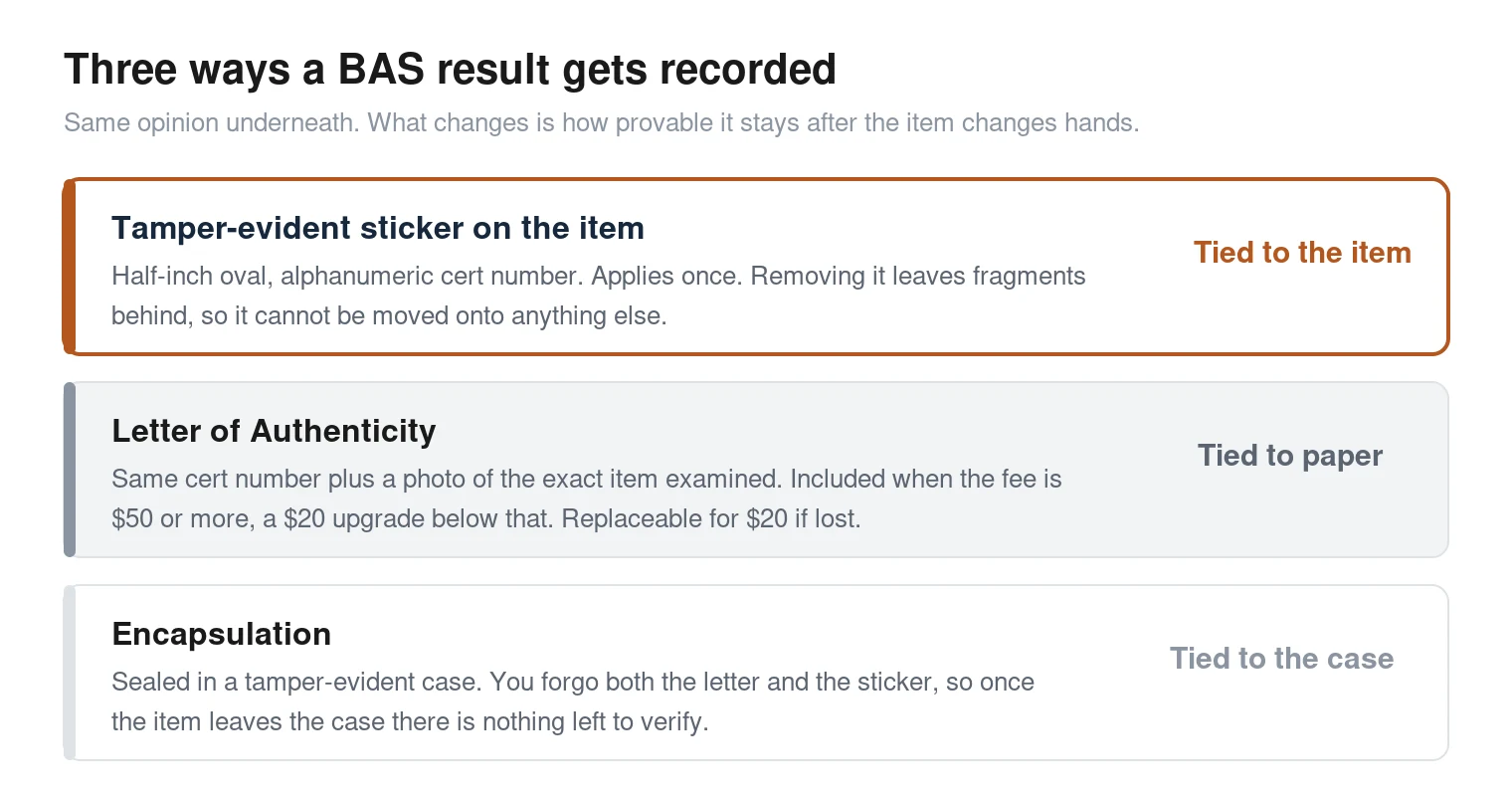
    Once a signature passes, a half-inch oval tamper-evident label carrying an alphanumeric BAS certification number goes onto the item. Beckett notes that the label can be applied once and only once. Remove it and it leaves fragments behind, so it cannot be moved onto something else.

    That one-way design is the actual security mechanism. It ties a specific opinion to a specific physical object.

    The Letter of Authenticity is a separate product. Items with authentication fees under $50 get the sticker on the item unless you pay $20 to upgrade to a full LOA. Beckett has also stopped replacing lost Certificates of Authenticity entirely, though you can still print a certificate straight from their verification page, and a lost LOA can be replaced for $20.

    Worth knowing if you go the encapsulation route: choosing autograph encapsulation means you forgo both the letter and the sticker. Pop the item out of the case and there is no way left to show Beckett ever saw it.

    Three ways a Beckett authentication result can be recorded, comparing the tamper-evident sticker, the Letter of Authenticity and encapsulation

    Witnessed versus authenticated, and why collectors care

    BAS certs come from two different paths, and they are not equally strong.

    Beckett Witness Certification means a BAS representative was physically present when the item was signed. Beckett’s own wording is that this “guarantees it is 100% authentic,” which is language they use nowhere else, because there is no opinion involved. Somebody watched it happen. These items get a special tamper-evident sticker that identifies them as witness certified, and the database reflects it.

    Standard authentication means an expert examined the signature after the fact and gave an opinion. Skilled, informed, backed by exemplars, still an opinion.

    Both carry a cert number and both verify in the same database, so a listing photo will not always tell you which you are looking at. If you are paying a premium specifically for certainty, witness certification is the one that delivers it. For everything else, you are buying a professional judgment call, which is genuinely valuable and genuinely fallible.

    Verifying a Beckett certification number

    The check takes under a minute and costs nothing.

    Find the 6-digit alphanumeric certification number on the oval label, or on the COA or LOA if the label went there instead. Enter it at Beckett’s cert verification page or in the Beckett app. The record should match the item in front of you, not just return a valid hit.

    That last part is where people get burned. A cert number is only meaningful attached to its own object. A number lifted from a real Yogi Berra photo and printed on a different photo still verifies. The lookup confirms the number exists in Beckett’s database and describes what it was issued for. Comparing that description to the item is your job.

    Beckett is blunt about this on the verification page itself. The printed certificate you can generate there carries a disclaimer that it is for display purposes only and is not considered authentication for your item. The database record is the record. The printout is a souvenir.

    If you get “no record found” and you believe the cert is genuine, Beckett asks you to email customer service with the number, a description, and a photograph so they can look into it. Do that before assuming fraud, and before assuming it is clean.

    The same logic applies across every authenticator, which is why verifying a cert number is a separate skill from trusting one.

    What Beckett authentication costs

    There is no flat rate, and any site quoting you one is guessing.

    Fees vary by the signer. For a multi-signed item, you find the fee for the premier signer, then use Beckett’s chart to adjust for the total number of signatures. Their pricing page has a signer lookup, and if a name does not populate, they ask you to email so they can confirm whether they will authenticate that signature at all.

    A few fixed numbers from Beckett’s own pages are worth carrying around:

    • Signature Review runs $10. A quick expert opinion on whether an autograph would likely pass full authentication, with results by email in 24 to 48 hours. This exists for buyers evaluating an item they do not own yet, and it is the single most underused service Beckett offers.
    • The LOA upgrade is $20 on items with fees under $50, and $20 again to replace a lost letter.
    • Items with authentication fees of $50 or more include a Letter of Authenticity at no extra charge.
    • Autograph grading is half the normal authentication rate, charged on top of the authentication fee.
    • A declared value of $5,000 or more triggers a Premium Item Fee.
    • 50 items or more qualifies you to ask about bulk pricing.

    Turnaround is not guaranteed. Beckett says it strives to finish authentication orders within 30 business days and warns that conventions and holidays stretch that. Expedited processing exists for an additional fee.

    Sending items in without wrecking them

    Submissions go to Beckett Authentication Services, 2700 Summit Ave, Ste 100, Plano, TX 75074. If BAS is running onsite authentication at an event near you, taking items in person saves the shipping fee and the shipping risk in one move.

    For autographed cards, ship the way graders expect to receive them. Card in a clear penny sleeve, sleeved card in a semi-rigid holder, holders banded and boxed. This is not Beckett-specific etiquette, it is the handling standard the whole industry built its process around.

    For Shipping Signed Cards

    Cardboard Gold Card Saver 1 semi-rigid trading card holders, 100 count

    Cardboard Gold Card Saver 1 (100 ct)

    • Slightly oversized so a sleeved card loads and unloads without force, which is exactly why graders handle cards in these
    • The semi-rigid standard PSA names in its own shipping guide, and the same holder BAS submissions arrive in
    • Also takes the larger pre-1957 cards that will not go into a standard 3″ x 4″ holder
    Check current price on Amazon

    What’s good: it is the holder every major authenticator built its handling process around, and the 100 count drops the per-unit cost to pocket change against what you are paying for authentication.

    What’s not: it is floppy, and people coming from toploaders are always caught off guard. The lip creases if you are careless, a bent holder can press a corner, and an unbanded stack lets cards slide right out in transit. It also does not fit most storage boxes, which is a real annoyance if you thought you were buying storage. Card savers and toploaders solve different problems, and confusing the two costs cards.

    The Layer Underneath

    Ultra Pro ultra clear soft penny sleeves for standard size trading cards, 100 count

    Ultra Pro Soft Card Sleeves, Clear (100 ct)

    • Fully clear polypropylene, so the signature stays visible without anyone handling the card to see it
    • Acid-free and PVC-free, which matters when the sleeve sits against signed ink for years
    • 2 5/8″ x 3 5/8″, sized to take a standard card and still slide inside a semi-rigid holder
    Check current price on Amazon

    What’s good: the cheapest protection in the hobby, and buying the plain clear version avoids the opaque-sleeve processing delays graders complain about.

    What’s not: they tear. They are thin on purpose, they split at the seam if you load a card at an angle, and a torn sleeve inside a holder is worse than none because you will not spot it. Buy more than you need and discard the damaged ones. Skip anything with a pull tab for submissions.

    Checking an autograph before you pay anyone

    Beckett’s $10 Signature Review exists because buyers keep spending hundreds on items nobody has looked at. That is the right tool for a serious purchase. For everything below that threshold, a look with decent magnification does most of the work.

    Real ink sits on a surface with variable pressure, ragged starts and stops, and pen skips. A printed or stamped signature has uniform edges, a dot pattern under magnification, and no pressure variation anywhere in the stroke. Under 10x that difference is not subtle.

    The same magnification is what lets you read a BAS label properly. Check that the oval is intact, that nothing under it looks disturbed, and that the number on the label matches the number on the letter.

    For Reading Ink and Labels

    Nikon 10x jewelry triplet loupe with retractable lens housing

    Nikon 10x Jewelry Triplet Loupe

    • 10x triplet optics, enough to separate hand-laid ink from a printed dot pattern
    • 13mm lens that retracts into its own housing, so it survives a pocket or a show bag
    • 1.65″ x 0.945″ x 0.63″ closed, small enough to carry to every card show without thinking about it
    Check current price on Amazon

    What’s good: the optics are genuinely good, the retracting housing means it does not get scratched into uselessness, and 10x is the right power for ink structure without the shake problems higher magnification brings.

    What’s not: it costs several times what a generic loupe costs, and a budget triplet will show you a print dot pattern perfectly well. The short focusing distance also means getting close to the item, which is awkward on a framed or encapsulated piece. Buy this if you are looking at signatures regularly. Buy the cheap one if you are not. There is more on what a loupe reveals on a forged signature if you want the technique rather than the tool.

    Is Beckett authentication legit

    Yes, with a caveat that gets skipped in most answers.

    BAS is one of the three third-party authenticators the market actually prices in, alongside PSA/DNA and JSA. Major auction houses and eBay’s authenticity programs recognize it. A BAS cert reliably moves an item’s sale price. That is the practical definition of legitimate in this hobby.

    The caveat is that legitimate does not mean infallible. Every one of the big three has issued opinions that later got argued over, and the collector forums are full of people whose genuine items came back as unable to authenticate. An expert opinion is exactly that.

    Two things follow from it. Do not treat a BAS sticker as the end of your own diligence, and do not treat a failed submission as proof an item is fake. Both are the same mistake in opposite directions.

    If you are still deciding which company to send to, the comparison lives in the autograph authentication services rundown.

    FAQ

    How authentic is Beckett Authentication? Beckett issues expert opinions, not guarantees. Signatures are examined for ink and structure and compared against a database of exemplars, with Pro-Scope or VSC analysis when a case needs it. The opinion is well informed and it is still an opinion.

    How do I check if a Beckett cert is real? Enter the 6-digit alphanumeric certification number from the label or letter at Beckett’s cert verification page or in the Beckett app, then confirm the returned record actually describes the item in your hands. A valid number attached to the wrong object is the common fraud.

    Is Beckett Authentication better than PSA? Neither dominates. Both are recognized by major auction houses and both move sale prices. Beckett’s Signature Review at $10 is a real advantage for pre-purchase checks. Choose based on the signer, the fee for that signer, and which cert the buyers in your category prefer.

    How much does Beckett authentication cost? It depends entirely on the signer, looked up on Beckett’s pricing page, with multi-signed items priced off the premier signer plus a count-based chart. Fixed extras include the $10 Signature Review, the $20 LOA upgrade on items under $50, and a Premium Item Fee on declared values of $5,000 or more.

    What does Beckett authenticate? Autographs across sports, entertainment and historical categories, vintage and modern. Items from 8×10 photographs to trading cards, checks, cuts, index cards, postcards and documents can be encapsulated, and baseballs have their own patented holder.

    Does a Beckett cert mean the item is real? It means the signature is judged real. Beckett will encapsulate an autographed card even when the card itself is counterfeit or inconclusive, so the item and the autograph are two separate questions.

    What I’d actually do

    For an item you already own and intend to sell, look up the signer’s fee first. If the fee is a meaningful fraction of what the item sells for, authentication is not worth it, and that math turns out badly more often than people expect on common signers.

    For an item you are considering buying, the $10 Signature Review is the best value Beckett sells. Ten dollars and two days against a few hundred at risk is not a close call.

    And whichever way you go, verify the cert number yourself and read what the record says. The label is the beginning of the check, not the end of it.

    Sources

    Related guides