
As an Amazon Associate we earn from qualifying purchases. This post contains affiliate links, and we may earn a commission at no extra cost to you.
If the card is going to PSA, buy Card Saver 1. That’s the whole answer, and the rest of this post is why the question keeps getting asked anyway.
The confusion comes from the name. A “2” sounds like a newer, better version of a “1,” the way it works with every other product on earth. It isn’t. The number is a size code, and Card Saver 2 is the smaller one.
The size difference is the entire story
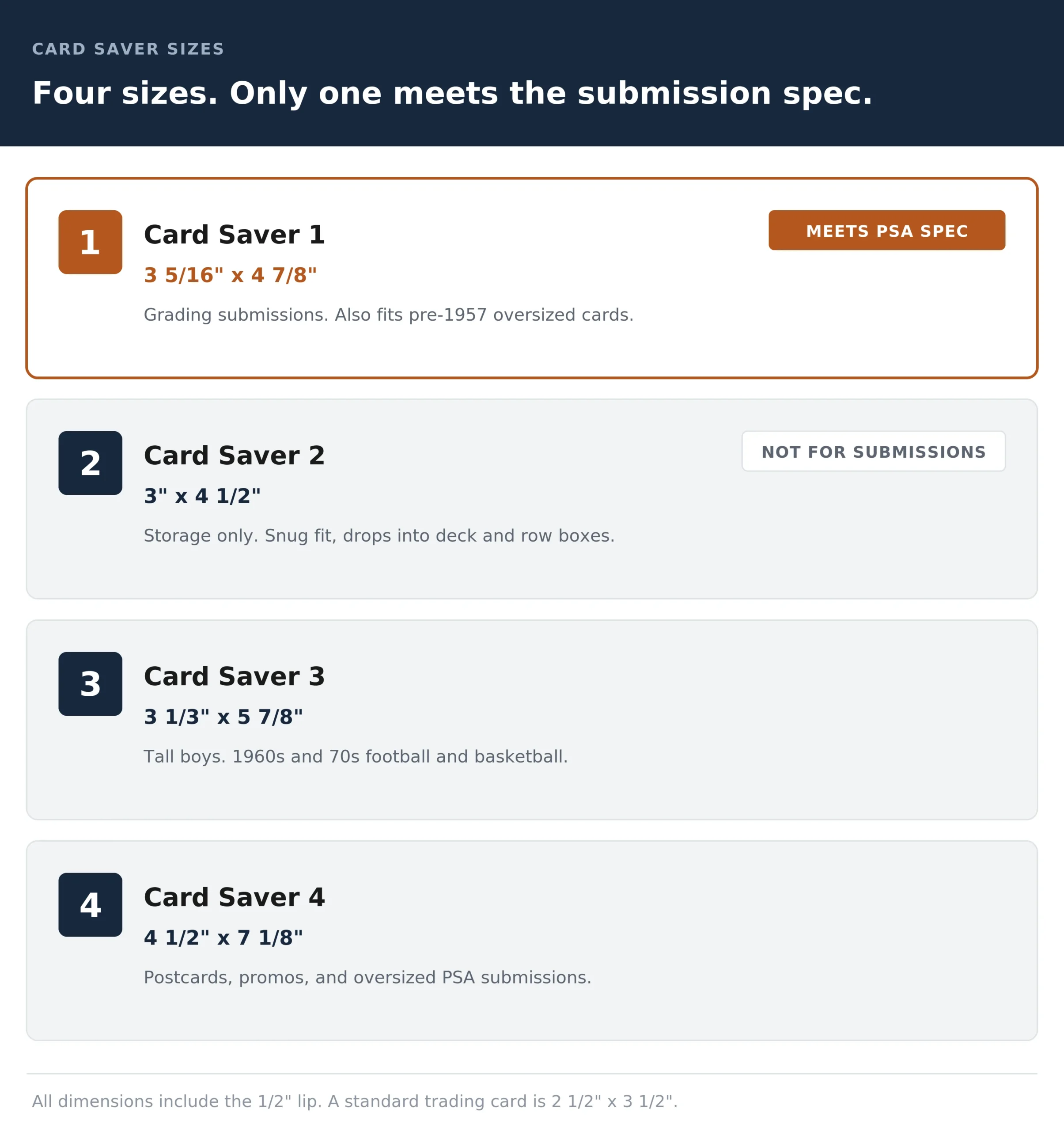
Card Saver 1 measures 3 5/16″ by 4 7/8″, lip included. Card Saver 2 measures 3″ by 4″ plus a 1/2″ lip, so about 3″ by 4 1/2″ overall.
That’s roughly 5/16″ narrower and 3/8″ shorter. Sounds like nothing. It decides everything.
A standard trading card is 2 1/2″ by 3 1/2″. Both holders fit it. But Card Saver 1 is deliberately oversized around that card, which leaves room for a sleeved card to slide in and out under thumb pressure. Card Saver 2 is cut close, so the fit is snug and the card stays put.
Neither one is a defect. They’re solving opposite problems. One is built for a grader pulling hundreds of cards a shift, the other is built for a collector who wants a card to stay where it was put.
Which card saver does PSA recommend?
Card Saver 1, and PSA is specific enough about it that there’s no room to argue.
PSA’s shipping guide states the requirement as a measurement rather than a brand name: for standard trading cards, semi-rigid holders must be 3 5/16″ x 4 7/8″. That is the Card Saver 1 spec to the sixteenth of an inch. Card Saver 2 misses it in both directions.
Cardboard Gold, the company that actually makes these, says the same thing from the other side. Their own product page for Card Saver 2 states plainly that it is not for grading company submissions. When the manufacturer tells you their product is wrong for a job, believe them.
Two more rules from that same PSA page that cost people time every week. Do not use pull tabs, tape, or sticky notes on the holder. And use clear penny sleeves, not solid or opaque ones, because those slow processing down.
Toploaders are off the table completely, which is a separate argument worth understanding on its own. Card savers and toploaders do different jobs, and picking between those two matters more than picking between Card Saver 1 and 2.
For PSA, BGS, and SGC Submissions

Cardboard Gold Card Saver 1 (100 ct)
- 3 5/16″ x 4 7/8″ including the 1/2″ lip, matching PSA’s stated submission dimension exactly
- 9 mil acid-free polypropylene, slightly oversized so a sleeved card loads without forcing
- Also fits the larger pre-1957 cards that won’t go into a standard 3″ x 4″ holder
What’s good: it’s the holder every major grader built their handling process around, the 100 count brings the per-unit cost down to almost nothing, and acid-free polypropylene won’t yellow or leach the way old vinyl pages did.
What’s not: it’s floppy, and people who’ve only handled toploaders are always surprised by how floppy. The lip creases if you’re rough with it, a bent holder can press on a corner, and an unbanded stack will let cards slide right back out. It’s also too big for a lot of storage. Card Saver 1s don’t sit neatly in deck boxes or most row boxes, which is exactly the problem Card Saver 2 exists to solve.
When Card Saver 2 is actually the right call
There’s a real use case here, and it gets buried under all the PSA talk.
Card Saver 2 fits storage containers that Card Saver 1 doesn’t. Deck boxes, smaller row boxes, anything sized around the 3″ by 4″ footprint that toploaders also use. If you’re organizing a working collection rather than prepping a submission, the smaller holder drops into more places.
The snug fit is the other half of it. Thin-stock cards, junk wax era commons, anything that rattles in an oversized holder sits tighter in a Card Saver 2. A card that doesn’t move is a card that isn’t slowly rounding its own corners.
So the honest split: Card Saver 1 for anything leaving your house, Card Saver 2 for cards staying home in a box that Card Saver 1 won’t fit.
For Standard-Card Storage

Cardboard Gold Card Saver 2 (200 ct)
- 3″ x 4″ plus a 1/2″ lip, sized to drop into deck boxes and standard row boxes
- Snug fit that holds thin-stock and vintage commons still instead of letting them shift
- The same semi-rigid material as Card Saver 1, in production since 1989
What’s good: it solves a storage-fit problem that no toploader and no Card Saver 1 solves, and the semi-rigid material still means you’re not prying a card out of hard plastic every time you want to look at it.
What’s not: two real problems. It’s useless for the thing most people are buying a card saver for in the first place, so if you buy it by mistake you’re buying twice. And Amazon stock on Card Saver 2 is genuinely unreliable. Several listings sit unavailable for stretches and the ones that are live tend to be backordered, so check availability before you plan around it. Card Saver 1 is stocked far more consistently.
What about Card Saver 3 and 4?
Both exist, both are size codes, neither is an upgrade.
Card Saver 3 runs 3 1/3″ by 5 7/8″ and exists for tall boys. Vintage football and basketball from the 60s and 70s, Gameboy cards, anything taller than a modern card.
Card Saver 4 is the big one at 4 1/2″ by 7 1/8″, holding items up to 4″ by 6″. Promo cards, postcards, and per PSA’s own guidelines, larger or thicker submissions that a Card Saver 1 can’t take.
If you own standard modern cards, you will never need either. Buy them when you have a specific card that doesn’t fit, not before.
Don’t skip the sleeve underneath
The holder is only half of what PSA asks for. The card goes into a clear penny sleeve first, then the sleeved card goes into the semi-rigid holder.
Skipping it is the most common submission mistake there is. Semi-rigid plastic is still harder than card stock, and sliding a bare card in and out grinds microscopic wear into the surface and edges. Surface is one of four subgrades. That wear is worth real money on a card that would otherwise grade clean.
Load the card into the sleeve, then the sleeve into the holder. Never try to feed a card into a sleeve that’s already sitting inside the holder.
The Layer Underneath

Ultra Pro Soft Card Sleeves, Clear (100 ct)
- Fully clear, which is what PSA asks for, since opaque sleeves cause processing delays
- Acid-free and PVC-free polypropylene, safe for long-term storage against the card face
- 2 5/8″ x 3 5/8″, sized to take a standard card and still fit inside a semi-rigid holder
What’s good: it’s the cheapest insurance in the hobby by a wide margin, and buying the plain clear version sidesteps the opaque-sleeve delay problem entirely.
What’s not: penny sleeves tear. They’re thin by design, they split at the seam if you load a card at an angle, and a torn sleeve inside a holder is worse than no sleeve because you won’t see it. Buy more than you think you need and throw out the damaged ones. Also skip any sleeve with a pull tab for submissions, since PSA lists pull tabs alongside tape and sticky notes as things to keep off the holder.
What I’d actually buy
One box of Card Saver 1 in the 100 count, and a stack of clear penny sleeves. That covers grading submissions and it covers most storage well enough that nothing else is urgent.
Add Card Saver 2 only after you’ve hit the specific wall it fixes, which is a storage box that Card Saver 1 won’t sit in. Add 3 or 4 only when a card physically doesn’t fit anything else.
The mistake worth avoiding is assuming the higher number is the better product. Card Saver 2 is smaller, not newer, and sending one to PSA gets your submission handled slower for no reason at all.