As an Amazon Associate we earn from qualifying purchases. This post contains affiliate links, and we may earn a commission at no extra cost to you.
A certificate of authenticity is a receipt for somebody’s opinion. That’s the whole thing. It isn’t a lab result, it isn’t a legal document, and it isn’t proof.
Which means the paper is worth exactly as much as the person who signed it, and no more. A COA from an authenticator the market trusts can add real money to an item. A COA printed by the same seller who’s asking you for that money adds nothing at all.
Most collectors learn this the expensive way. Here’s the short version instead.
What a COA actually is
Someone looked at a signature and formed an opinion that it’s genuine. The certificate documents that opinion and ties it to a number in a database.
That’s it. There’s no licensing body for autograph authentication, no exam, and no legal standard a company has to meet before printing certificates. Anyone can start an authentication business tomorrow and issue paperwork that looks official.
So the question is never “does it have a COA.” The question is who issued it, and whether anyone else in the hobby cares.
The three tiers, and only one of them matters
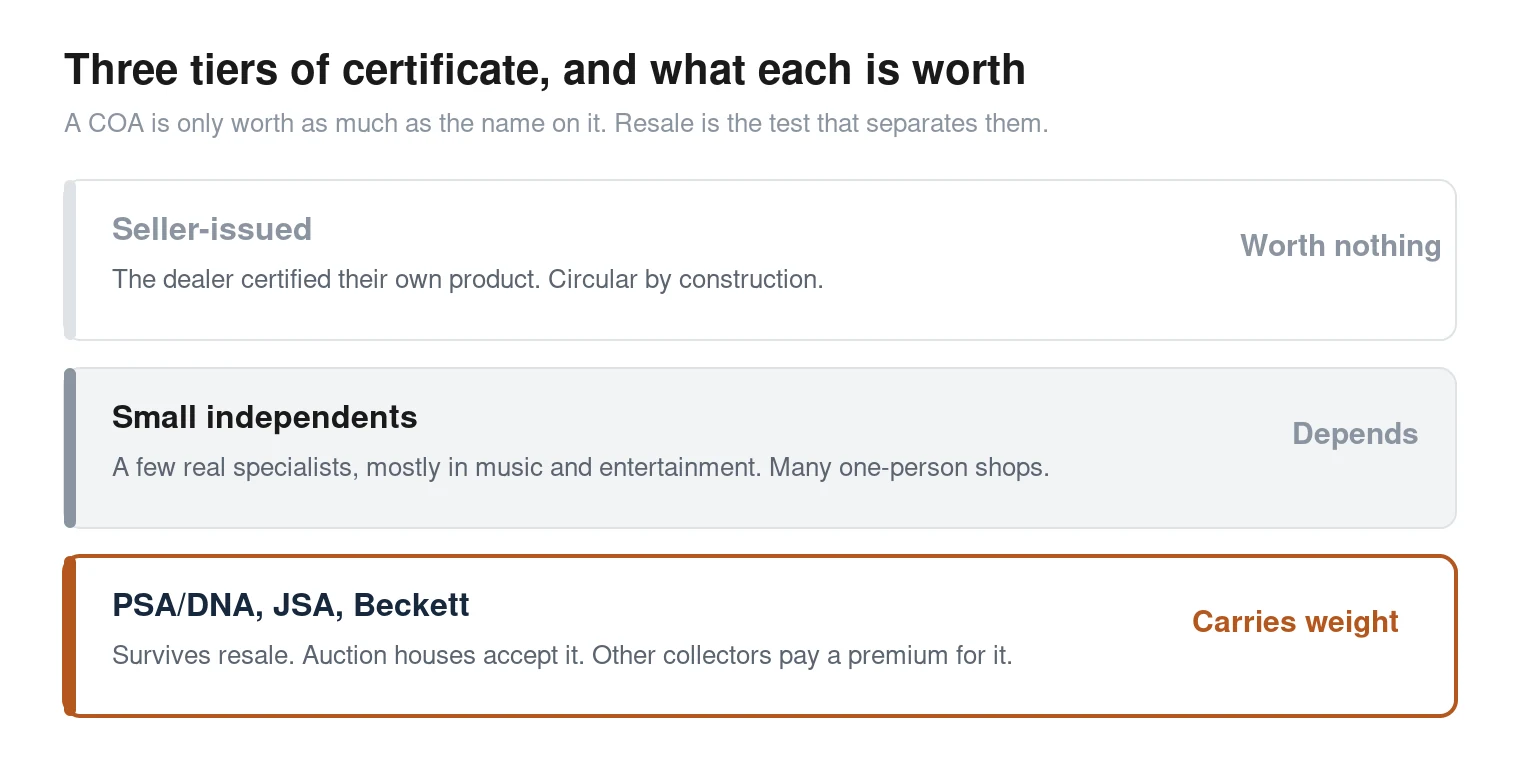
Seller-issued COAs are worth nothing. If the dealer selling you the item also wrote the certificate, they’ve certified their own product. No resale buyer will accept it, no auction house will consign on it, and no grading service will honor it. Some of these are outright fraud. Most are just circular.
Small independent authenticators sit in a gray zone. A handful of specialists have genuine reputations in narrow categories, particularly in music and entertainment where the big firms have thinner reference libraries. But the market is full of one-person operations with a website and a logo. If you can’t find the name discussed by collectors outside that company’s own marketing, treat the certificate as decoration.
Three names carry weight across the whole hobby. PSA/DNA, JSA, and Beckett Authentication Services. These are the certificates that survive resale, that auction houses accept, and that other collectors will pay a premium for.
Is that a monopoly problem? Somewhat, yes. Their opinions are still opinions, they do make mistakes, and they’ve each had public disputes over specific items. But a market needs a shared reference point, and those three are it. Fighting that reality costs you money when you sell.
How the big three actually differ
PSA/DNA is the largest and the one you’ll see most often in card and sports memorabilia listings. Its cert numbers show up in more marketplace listings than anyone else’s, which matters when a buyer is deciding whether to trust yours.
JSA built its reputation on autographs specifically rather than on card grading, and maintains one of the deepest signature reference libraries in the hobby. Strong across sports and entertainment both.
Beckett Authentication Services splits its work into two categories worth understanding before you buy. Witnessed means a Beckett representative was physically present when the item was signed. Authenticated means an expert examined the signature after the fact. Witnessed is the stronger claim by a wide margin, because it removes opinion from the equation entirely. If you’re choosing between two otherwise identical items, that distinction is worth real money.
One change catches people out. In April 2022 Beckett stopped issuing paper COA cards altogether, starting with certification sequence BF and witness sequence WJ. The tamper-evident sticker now carries a QR code that goes straight to the digital record. So a genuine recent Beckett item arrives with no card, and that’s correct, not a red flag. Beckett’s reasoning was blunt and fair. The old cards were generic, carried no item-specific detail, and existed mainly to tell you where to look the number up.
Verify a cert number in about two minutes
Every one of the big three runs a free public lookup. Use it before money changes hands, not after.
- PSA and PSA/DNA: psacard.com/cert
- JSA: spenceloa.com/verify-authenticity
- Beckett: beckett-authentication.com/verify-certificate
Type in the number. The record that comes back should describe the item in front of you. A Hank Aaron baseball, a Star Wars poster, whatever it is. If the number pulls up a different item, or nothing at all, walk away.
Do this while you’re still standing at the table, or before you click buy. A seller who gets impatient while you check a number has told you something useful.
Verifying is not the same as proof
This is the part most guides skip, and PSA says it out loud on their own site. Verifying a certification number does not eliminate risk. Counterfeiters pull real cert numbers from public listings and reuse them on fake labels and fake inserts.
So a number that checks out proves the number exists. It doesn’t prove that this sticker, on this item, is the one that number was issued for.
What closes that gap is the physical detail. Tamper-evident stickers are built to self-destruct when peeled, so look at the edges. Check that the QR code on a Beckett sticker actually resolves to the matching record rather than to a lookalike page. On a slabbed or encapsulated item, examine the seal itself.
None of this makes you an authenticator. It makes you a buyer who is harder to rob.
What a COA doesn’t tell you
A certificate speaks to one question. Is the signature genuine.
It says nothing about condition. Nothing about whether the item has been restored, trimmed, pressed, or repaired. Nothing about market value, which moves with the athlete’s career, the actor’s death, and the general mood of the hobby. And nothing about whether you’re overpaying today.
It also says nothing about the item underneath the signature. A genuine autograph on a mass-produced reprint is still a genuine autograph on a reprint. We rebuilt an entire post on this site around that exact trap, because the listing said “hand signed” and the product turned out to be a printed reproduction.
Checking the signature yourself before you send anything off
Third-party authentication runs anywhere from modest to expensive depending on the item and turnaround, and it takes weeks. Doing a first pass yourself filters out the obvious problems before you spend that money.
Two tools handle most of it.
For Reading the Ink, Not the Shape

Nikon 10x Jewelry Triplet Loupe
- 10x triplet is the hobby standard for judging whether a stroke was laid down in one motion or slowly traced
- Shows how ink behaves where two lines cross, which is where forgeries usually fall apart
- Retracting case protects the optic in a pocket at a show
The downside: it costs meaningfully more than a generic loupe that shows you most of the same things. You are paying for optical quality and a name. A cheaper triplet gets a beginner to the same conclusion on an obvious forgery.
Check current price on AmazonFor Spotting Restoration and Touched-Up Ink

ALONEFIRE SV003 10W 365nm UV Flashlight
- 365nm with a filtered lens is the right combination for memorabilia, cutting the visible violet spill cheap 395nm lights throw
- Restoration, touched-up ink, and paper that is not what the listing claims all stand out clearly
- USB rechargeable, battery and charger included
The downside: the marketing is aimed at pet stains and scorpion hunting, and the manual reflects that. It runs warm during long sessions, normal for a 10W emitter in an aluminum body but it surprises people. Never point it at anyone’s eyes.
Check current price on AmazonNeither tool authenticates anything. They tell you when something is wrong, which is a different and cheaper service than telling you when something is right.
When paying for authentication is worth it
Rough rule. If the item’s value depends on the signature being real, and that value is more than several times the authentication fee, send it in.
Under that line, a self-check and an honest seller are usually enough. Over it, the certificate pays for itself the moment you sell, because the buyer pool for a certified item is far larger than the pool willing to trust your word.
Buying rather than selling? Let the current owner pay for it. An uncertified item should be priced as uncertified, and plenty of sellers price theirs as though the certificate is already there.
FAQ
Is a certificate of authenticity legally binding?
No. It documents an opinion. It isn’t a warranty or a guarantee, and the fine print on most certificates says so directly. Your protection in a bad sale comes from the marketplace’s buyer policy or from consumer law, not from the certificate.
Which is better, PSA or JSA?
Neither is clearly better. Both are widely accepted and both carry roughly comparable weight at resale. PSA appears more often in card and sports listings. JSA has a particularly deep autograph reference library. Collectors argue about this endlessly and the argument rarely changes an item’s price.
Can I get an autograph authenticated online for free?
You can get an opinion for free from collector forums, and a good one is genuinely useful as a first filter. You cannot get a certificate for free. Anything that arrives at a certificate without a fee and without a physical inspection is not worth the file it’s printed to.
My item has a COA from a company I’ve never heard of. Is it fake?
Not necessarily, but assume it carries no resale value. Look up the company independently, outside its own website. If collectors and dealers aren’t discussing it, price the item as though it has no certificate at all.
Does a COA increase what my item is worth?
From one of the big three, usually yes, sometimes substantially. From anyone else, generally not. In some cases a bad COA actively hurts, because it signals a seller who either didn’t know better or hoped you wouldn’t.
—
Verify the number before you pay. That single habit costs two minutes and prevents most of what goes wrong in this hobby.