
As an Amazon Associate we earn from qualifying purchases. This post contains affiliate links, and we may earn a commission at no extra cost to you.
PSA/DNA is the autograph authentication arm of PSA, short for Professional Sports Authenticator, and it sells three different outcomes that most people assume are one thing. You can get a letter and a tamper-evident label. You can get the item sealed in a holder. You cannot get both without paying extra, and picking the sealed holder deletes the letter, the label, and the DNA mark entirely.
That tradeoff is written on PSA’s own encapsulation page and almost nobody mentions it before you ship.
The DNA in PSA/DNA is literal
This trips up everyone the first time. The name is not a metaphor for genetic-level scrutiny or a branding flourish. PSA marks authenticated items with a synthetic DNA ink, applied as a small invisible daub, readable only under a specific laser frequency.
It is an anti-counterfeit feature, nothing more. It does not prove the athlete signed the item. It proves PSA touched the item, which is a narrower and more useful claim than it sounds. A forger can copy a sticker and can print a convincing letter. Reproducing a proprietary synthetic DNA strand keyed to one company’s laser is a different category of problem.
The mark is also invisible to you. You cannot verify it at home, you cannot verify it at a show, and no amount of UV light will bring it up. It is a tool PSA uses to confirm its own work, not a tool you use to confirm PSA’s.
What PSA actually examines
The examination is documented on PSA’s autograph authentication page and it is more specific than the vague “our experts review it” language most services use.
Authenticators run ink analysis, autograph structure analysis, object evaluation, and side-by-side comparisons against known exemplars. For harder calls they bring in a video spectral comparator, which is the same class of instrument document examiners use to separate inks that look identical to the eye.
PSA states it has certified over 35 million collectibles. That volume is the actual product. An opinion is only worth what the reference library behind it is worth, and a company that has looked at 35 million items has seen more genuine and forged versions of your signer than you ever will.
What it is not is a guarantee that the signature is real. It is an expert opinion, rendered by people with better tools and a bigger exemplar library than you have. Opinions from PSA get rejected by other authenticators sometimes. That happens across the whole autograph authentication industry, and it is the honest ceiling on what any of these services sell.
The three outcomes, and why the third one cancels the first two
Here is the part worth reading twice before you fill out a submission form.
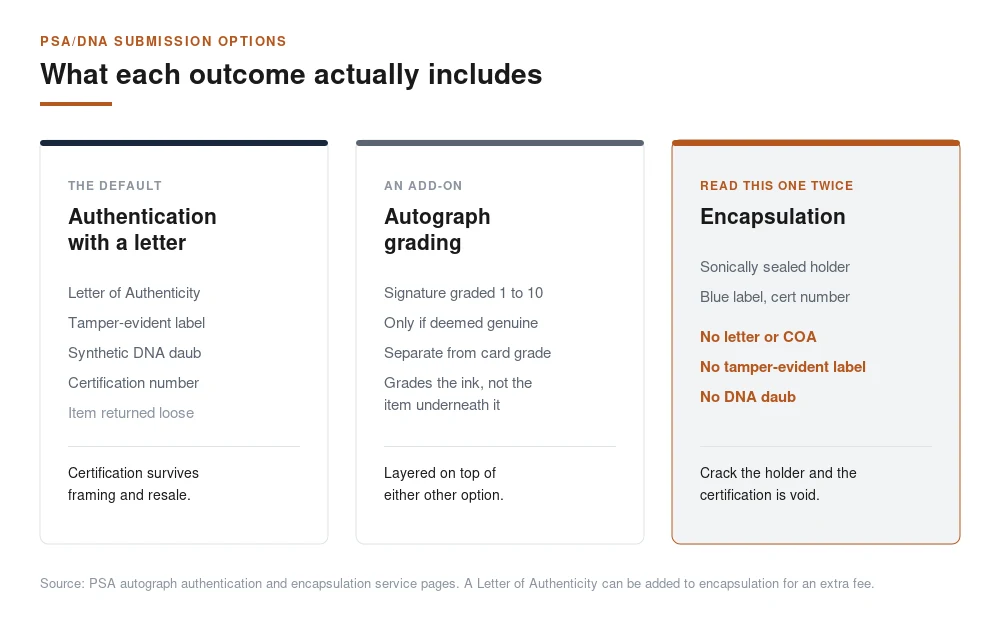
Authentication with a letter. The default. PSA examines the item, and if it passes you get a Letter of Authenticity carrying a certification number, a tamper-evident label applied to the item, and the DNA daub. The item comes back to you loose, exactly as you sent it.
Autograph grading. An add-on, not a separate service. If the autograph is deemed genuine, you can elect to have it graded 1 to 10, with 10 being best. This grades the signature itself, the boldness and placement and condition of the ink, and it is separate from any grade on the card or ball underneath it.
Encapsulation. PSA seals the item in a sonically sealed holder with a blue label carrying the certification number. Autographed trading cards, photographs, checks, index cards, postcards and cuts are eligible, as long as the item fits a PSA holder. Non-licensed, replica and custom trading cards are not eligible.
Now the catch. PSA’s encapsulation page states that encapsulated items do not receive an LOA or COA, a PSA tamper-evident label, or a DNA daub. You may request a Letter of Authenticity in addition to encapsulation for an additional fee. Jumbo holders carry their own surcharge.
Read what that means for resale. An encapsulated autograph with no separate letter is authenticated only as long as the holder stays sealed. Crack it and the certification is void, because the label and the DNA mark that would have traveled with the item were never applied. There is no way to prove the item was ever certified.
That is a real decision, not a formality. If the item lives in the holder forever, encapsulation is clean and displays well. If there is any chance it gets removed, framed, or re-graded later, pay for the letter alongside it or skip encapsulation entirely.
What PSA/DNA will look at
Broad. Signed sports cards, baseballs, jerseys, photographs, bats, helmets, index cards, checks, cuts, and signatures well outside sports in history and entertainment. If a person signed it, there is usually a submission path for it.
Encapsulation is the narrower service. Only items that fit a PSA holder qualify, which in practice means autographed trading cards, photographs, checks, index cards, postcards and cuts. A signed jersey or a signed bat can be authenticated with a letter and a label, but it is not going into a slab. Non-licensed, replica and custom trading cards are excluded from encapsulation entirely.
PSA also runs a pre-certified service aimed at auction houses and prospective bidders, which is worth knowing exists if you are buying from an auction rather than submitting your own item.
PSA/DNA is not PSA card grading
Two different services, two different labels, one very confused market.
PSA card grading evaluates the physical condition of a trading card and returns a 1 to 10 grade in a red-labeled holder. PSA/DNA evaluates a signature. A signed card can go through both, and the autograph grade and the card grade are separate numbers.
The practical version: a PSA 9 on a slab says nothing about the signature on it unless the label also says the autograph was authenticated. People pay autograph premiums on card grades all the time. Read the label, not the number.
How it stacks up against JSA and Beckett
Three services carry real weight with buyers. PSA/DNA, JSA (James Spence Authentication), and BAS, Beckett’s autograph arm. SGC grades cards but is not a factor in autograph authentication the way the other three are.
None of them universally overrules the others. Auction houses and eBay’s authenticity programs accept all three, and a signature rejected by one is sometimes passed by another, which is uncomfortable but honest. PSA’s advantage is volume and market recognition. BAS built its reputation on individual authenticator accountability, and what a BAS sticker actually proves is worth reading before you assume the two services are interchangeable.
Pick based on where the item will sell. If a specific auction house or buyer pool prefers one, use that one. Paying to cross-certify an item with a second service rarely returns its cost.
Verifying a PSA/DNA certification
Every certified item carries a certification number that can be checked publicly through PSA’s cert verification lookup. It is free and it takes about ten seconds.
The lookup confirms that the number exists in PSA’s database and what item it was issued against. It does not confirm that the number in front of you belongs to the item in front of you, which is exactly how recycled-certificate fraud works. The full method for reading a lookup result, including what a clean result still fails to catch, is covered in the PSA cert verification walkthrough.
Before you spend money on any of this, look at the signature yourself under real magnification. A 10x loupe catches the two things that end the conversation early: printed dot patterns under what should be ink, and the shaky, retraced line quality of a slow-copied signature.
Screen It Before You Ship It

Nikon 10x Jewelry Triplet Loupe
- 10x triplet optic, enough magnification to separate printed halftone dots from real ink laid on a surface
- 13mm lens with a retracting metal case, so the glass survives a pocket and a show floor
- Resolves the retraced, hesitant line quality that gives away a traced signature before you pay a submission fee
What’s good: the triplet design corrects color fringing that cheap doublet loupes throw at the edge of the field, which matters when the whole question is what color the ink actually is. Small enough to carry, good enough to settle most preprint arguments on the spot.
What’s not: it is expensive for what it is, and a bargain-bin loupe will also show you a dot pattern. The Nikon buys edge sharpness and build quality, not a different verdict. It is also 10x, which is the right power for signatures but too weak for the kind of fiber-level work a document examiner does. And no loupe distinguishes a skilled forgery from a real signature. It catches printing and tracing, which is most of what is out there, and then it stops.
Submitting an item
PSA publishes a submission form, a price lookup, a shipping cost calculator, and packaging guidelines. Follow the packaging guidelines exactly, because how the item arrives is the part you control.
Pricing runs by item type and declared value and changes often enough that any number written in a blog post is wrong by the time you read it. Check PSA’s own pricing page. Note also that PSA has at times paused its lower service levels under demand, so confirm which tiers are actually open before you plan around a turnaround estimate. PSA states turnaround times are estimates only, measured from when the order is scanned into the facility, not from when you mail it.
For autographed cards, ship in a semi-rigid holder, not a toploader. PSA’s shipping guide specifies the semi-rigid dimension, and Card Saver 1 is the holder cut to it.
The Holder PSA Asks For

Cardboard Gold Card Saver 1 (100 ct)
- Slightly oversized around a standard card, so a sleeved card loads and unloads without force at either end
- The semi-rigid holder PSA and most PSA dealers use for card submissions
- Also takes the larger pre-1957 cards that will not go into a standard 3″ x 4″ holder
What’s good: it is the holder the whole grading industry built its handling process around, and at 100 count the per-unit cost stops mattering. Acid-free polypropylene that will not yellow against the card.
What’s not: floppy, and floppier than anyone expects the first time. The lip creases if you are careless, a bent holder can press a corner, and an unbanded stack lets cards slide back out. It also will not sit in most storage boxes, so it is a shipping and submission holder, not a storage solution.
A card goes into a clear penny sleeve first, then the sleeved card goes into the semi-rigid. Skipping the sleeve grinds fine wear into the surface every time the card slides against the harder plastic, and surface is one of the things being graded.
The Layer Underneath

Ultra Pro Soft Card Sleeves, Clear (100 ct)
- 2 5/8″ x 3 5/8″, sized to take a standard card and still fit inside a semi-rigid holder
- Fully clear polypropylene, which is what PSA asks for, since opaque sleeves slow processing
- Acid-free and PVC-free, safe sitting against a signed card face long-term
What’s good: the cheapest protection in the hobby by a wide margin, and the plain clear version sidesteps the opaque-sleeve delay problem completely.
What’s not: they tear. They are thin by design, they split at the seam if you load a card at an angle, and a torn sleeve inside a holder is worse than no sleeve because you will not see it. Buy more than you need. Skip any sleeve with a pull tab, since PSA lists pull tabs alongside tape and sticky notes as things to keep off a submission.
Is PSA/DNA worth it
For an item you intend to sell, usually yes, because the buyer pool for uncertified autographs is small and skeptical and prices accordingly. For an item staying on your shelf, the certification buys you nothing you can see.
The case against is real. You are paying for an opinion that can be disputed by another authenticator, on a signature that may not be worth the fee, with turnaround times that are estimates rather than commitments. Submit a signature you are already fairly confident in. Authentication is not a way to find out what you have, it is a way to prove what you already believe you have.
If you want the item to display sealed and never move, take encapsulation and understand what you gave up. If you want the certification to survive the item leaving its holder, take the letter and the label. Do not take encapsulation alone and assume the paperwork is coming with it, because it is not.
FAQ
What is PSA/DNA authentication? PSA’s autograph authentication service. Authenticators examine the signature and, if it passes, issue a certification number backed by a letter, a tamper-evident label, and an invisible synthetic DNA ink mark, or seal the item in a holder instead.
Is PSA/DNA legit? It is the largest autograph authentication service in the market, with over 35 million collectibles certified and the widest acceptance among auction houses and buyers. It issues expert opinions, not guarantees, and those opinions are occasionally disputed by other authenticators.
How much does PSA/DNA authentication cost? Pricing varies by item type, declared value, and service level, and it changes often. Use PSA’s own pricing lookup rather than any figure quoted elsewhere.
What is the PSA/DNA certification number? The alphanumeric number printed on the letter and the label, matching each other. It is what you enter into PSA’s cert verification lookup to confirm the record exists.
Can I remove an item from a PSA encapsulated holder? Physically yes. But encapsulated items carry no letter, label, or DNA daub unless you paid for the letter separately, so removing the item voids the certification with no way to reestablish it.
Related guides
- Best UV Flashlight for Spotting Fake Autographs and Card Restoration (start here)
- Autograph Authentication Services: Who to Use and Cost
- PSA Cert Verification: How to Check a Cert Number
- What an Autograph Certificate of Authenticity Is Actually Worth
- Longwave vs. Shortwave UV: Which One Is Safe to Use on Autographs Over and Over
- What a Jeweler’s Loupe Reveals on a Forged Signature
- Reading a UV Light Result: Original Ink vs. Restoration