
As an Amazon Associate we earn from qualifying purchases. This post contains affiliate links, and we may earn a commission at no extra cost to you.
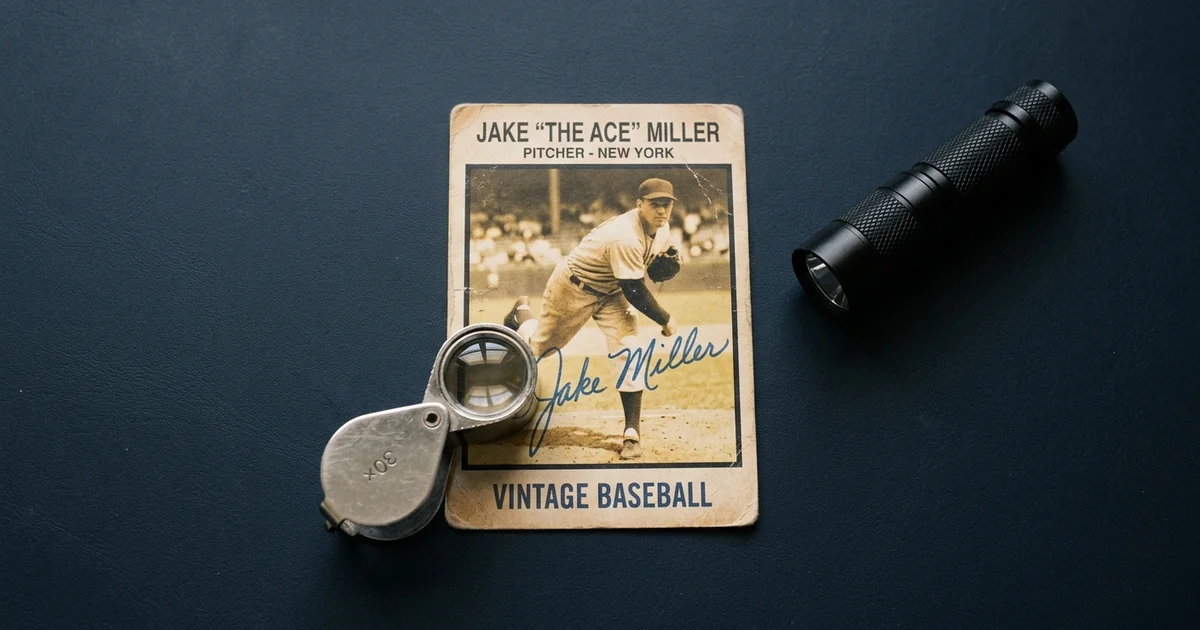
A facsimile autograph is a printed picture of a signature. Nobody signed the item. The signature was part of the artwork before the item was ever manufactured, which means there is no ink sitting on the surface and no hand ever touched it.
That is the whole definition, and it matters because the word gets used in listings as if it were a grade of authenticity. It isn’t one. A facsimile is a design element, the same category as the player’s name or the team logo.
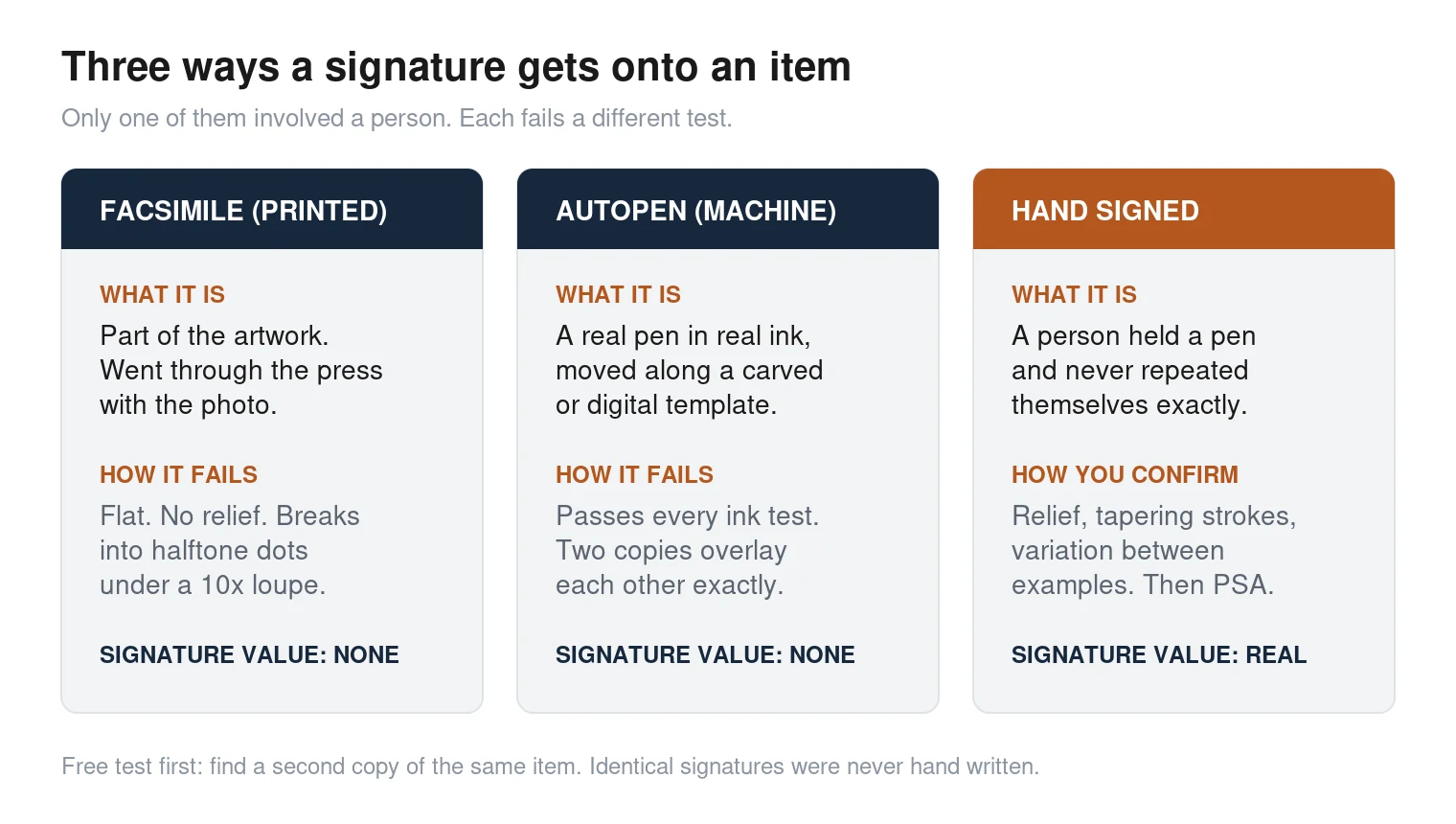
Three ways a signature ends up on an item
Every signature you will ever look at came from one of three places, and the differences are physical rather than philosophical.
Printed. The signature is part of the image. It went through the press with everything else, so it sits in the same ink layer as the photo. This is the facsimile. Topps put facsimile signatures in card designs going back to the 1950s, which is why so many vintage cards look signed at a glance and none of them are.
Machine written. A real pen, loaded with real ink, moved by a machine. This is the autopen, and it produces genuine ink on a genuine surface. It is the hardest of the three to catch.
Hand signed. A person held a pen.
Sellers blur the first and the third constantly, sometimes on purpose and often not. “Signed card” on a 1955 Topps means the design has a facsimile on it. The seller may believe otherwise.
Is a facsimile autograph worth anything?
Not as an autograph. It adds nothing on top of what the item is already worth.
A 1956 Topps card with a facsimile on it is priced as a 1956 Topps card. The printed signature is baked into the value of the design the same way the border color is, and no grader assigns it a signature grade, because there is no signature to grade.
Where a facsimile does have value is as a piece of design history. Some of those printed signatures are the only version of a player’s handwriting that ever reached a mass audience, and collectors who chase the sets care about them for that. That is a real reason to own one. It is not a reason to pay a signed-card premium for one.
The practical rule: if a listing shows a signature and the price is close to the unsigned book value of the item, that is usually the seller quietly telling you what it is.
The tests that separate printed ink from real ink
None of this requires a lab. It requires looking at the item instead of the photo.
Look for relief. Real ink sits on top of the surface. Tilt the item under a light at a low angle and a hand-signed line will catch that light differently from the paper around it, sometimes with a faint ridge you can feel with a fingernail on thicker inks. A facsimile is flat, because it is the same ink layer as the photograph.
Look for dots. Printed images are made of dot patterns. Under enough magnification, a facsimile signature breaks into the same halftone or rosette pattern as the rest of the card, and it will often share the exact registration of the image behind it. A real signature is a continuous stroke of ink with none of that structure.
Look at how the stroke starts and ends. A pen held by a person accelerates and slows down. Lines get thicker in the middle of a fast stroke, taper at the exit, and pool slightly wherever the writer paused. Printed signatures reproduce whatever the original stroke did, but they reproduce it as a shape, so under magnification the edges are crisp and uniform in a way ink on a surface rarely is.
Compare two copies. This one is free and it is the strongest single test available. Find another example of the same item online. If two signatures are identical, down to a stray dot and a broken line, neither of them was made by a hand. People cannot repeat themselves that precisely. Machines and presses cannot do anything else.
For Reading Ink at Magnification

Nikon 10x Jewelry Triplet Loupe
- 10x triplet optic, which is the magnification where halftone dot patterns in a printed signature become obvious
- 13mm lens, and the housing swings shut over the glass so it survives being carried to a show in a pocket
- 1.65″ x 0.945″ x 0.63″ retracted, small enough to keep in the same case as your sleeves
What’s good: a triplet corrects the color fringing and edge distortion that makes cheap single-lens loupes useless at the edges of the field, and at 10x the dot structure of a printed signature is unmistakable rather than a judgment call. It is also the one tool on this page that answers the facsimile question outright.
What’s not: it costs several times what a generic 10x loupe costs, and for the narrow job of spotting halftone dots the cheapest loupe in the search results gets you most of the way there. The 13mm lens gives you a small field, so you are moving the item constantly to read a full signature. And it has a hard limit. A loupe tells you whether ink was printed or laid down by a pen. It tells you nothing about whether the hand holding that pen belonged to the player. A loupe is a forgery tool, not a verdict, and treating it as one is how people talk themselves into bad buys.
Autopen is the one that will actually fool you
The autopen is older than most people assume. It was patented in the United States in 1803, Thomas Jefferson used one, and the mechanism that matters to collectors arrived later: a plastic template with the signature carved into it as a channel, with a real pen dragged along that channel. Modern units drive the pen digitally instead. Either way the output is a pen stroke in real ink on the real item.
So every physical test above fails. There is relief. There are no halftone dots. The ink pools and the surface accepts it exactly the way it would from a person, because it is coming from a person’s pen.
What gives an autopen away is the thing it cannot avoid being, which is repeatable. Two autopen signatures from the same template are identical in every dimension. Line lengths match, spacing matches, the angle of every ascender matches. Overlay two examples and they sit on top of each other perfectly.
Two other tells worth knowing. The machine sometimes leaves a small pool of ink where the pen dropped onto the surface or lifted off it, because it does not approach the paper the way a hand does. And autopen signatures are frequently more legible than the person’s real signature, since the template was usually made from a careful, deliberate sample rather than the scrawl someone produces on their four hundredth item of the afternoon.
If you collect political or presidential material, this stops being trivia. Autopen use in the White House has been documented for decades, up to and including bills signed into law by machine starting in 2011.
Where a UV light does and does not help
UV is the tool people reach for next, and it answers a different question than the one they are asking.
For Spotting Surface Work

ALONEFIRE SV003 10W 365nm UV Flashlight
- 365nm, which is the wavelength that reads paper and coating differences instead of just making everything glow purple
- Black filter lens that cuts the visible light leaking out of the LED, so what you see is the item reacting and not the torch
- Aluminum body with a USB-rechargeable cell and charger included
What’s good: 395nm lights, which is what most cheap “UV” flashlights actually are, flood the item with visible violet and wash out the differences you are looking for. A filtered 365nm unit shows trimmed edges, patched surfaces, added coatings and optical brighteners in replacement paper. On a card being sold as untouched, that is worth knowing before you buy.
What’s not: it does not authenticate anything. A forger’s ink and a player’s ink can fluoresce identically, and a facsimile printed in 1956 will look no more suspicious under UV than the photo it sits inside. There is also a handling cost. UV exposure is not free for the item, and 365nm output at this power is not something to point at your own eyes or anyone else’s. Use it in short looks, not as a display light.
When to stop guessing and buy an opinion
There is a cheap middle step between staring at a listing photo and shipping an item across the country.
PSA sells a QuickOpinion at $10 per item. You submit an eBay listing number and their authenticators look at the seller’s own photos, then send back “likely genuine” or “likely not genuine” in roughly a day or two. It is a preliminary read on images, not a certification, and PSA is direct about that.
The numbers PSA published on the service are the part collectors should sit with. In 2017 the program handled 7,838 cases. Of those, 2,080 came back likely genuine and 4,410 came back likely not genuine. Twice as many failures as passes, on items people were seriously considering buying.
For a full examination the item has to physically go in. PSA’s stated process is ink analysis, autograph structure analysis, evaluation of the object itself, and side-by-side comparison against known examples, with a video spectral comparator when a signature warrants it. That is the part you cannot replicate at a kitchen table with a loupe, and it is the reason third-party authentication exists at all.
Spend the $10 before a purchase. Spend the shipping after one, and only on items where the answer changes what the piece is worth.
Common questions
Is a facsimile autograph legal to sell? Yes, as long as it is described accurately. The facsimile itself is a printed design element, which is why it appears on mass-produced cards and photos without issue. What creates a problem is selling one as a hand-signed autograph, which is a misrepresentation regardless of what the printed signature is called in the listing.
What is the difference between a facsimile and an autopen? A facsimile is printed as part of the image, so there is no ink sitting on the surface. An autopen is written by a machine with a real pen, so there is. Both are reproductions and neither is worth signature money, but they fail completely different tests.
Can a certificate of authenticity settle this? Only if the certificate came from someone whose opinion carries weight independently. A COA printed by the seller is a piece of paper describing the item the seller wants to sell. What a real certificate should contain is a narrower list than most sellers pretend.
Does a facsimile hurt the value of the card? No. It is part of the original design, so the market has always priced it in. It only costs you money if you paid a signed premium for it.
What I would actually do
Assume printed until proven otherwise. That is not cynicism, it is arithmetic. Mass-produced items with signatures on them outnumber hand-signed ones by an enormous margin, and the sellers who know the difference price accordingly.
Then run the free test first. Find a second copy of the same item and compare the signatures. Identical means printed or machine written, and you are done without spending anything. Only after that does a loupe earn its keep, by telling you which of the two it was.
Buy tools for the questions they actually answer. A loupe answers “was this printed.” A UV light answers “has this surface been worked on.” Neither one answers “did the player sign this,” and the $10 that does answer it is cheaper than both.
Related guides
- Best UV Flashlight for Spotting Fake Autographs and Card Restoration (start here)
- How to Tell If a Sports Autograph Is Real or Fake
- What a Jeweler’s Loupe Reveals on a Forged Signature
- What an Autograph Certificate of Authenticity Is Actually Worth
- Autograph Authentication Services: Who to Use and Cost
- Longwave vs. Shortwave UV: Which One Is Safe to Use on Autographs Over and Over