
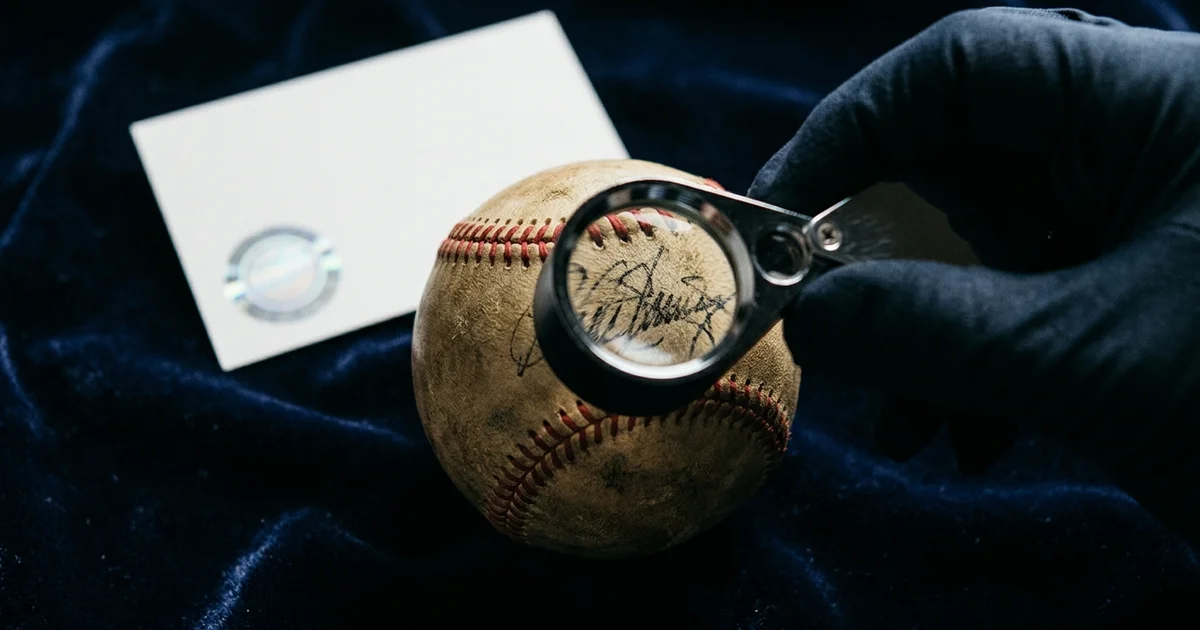
Every collector has the same moment eventually. You’re staring at a signed baseball, a jersey, a photo, and asking yourself the one question that actually matters: is this real?
Most fakes don’t fail because the forger can’t draw the right letters. They fail on the things nobody thinks to check. Here’s what actually separates a genuine signature from a good guess.
What real authenticators look at first
Professional authenticators like PSA/DNA and JSA don’t eyeball a signature and call it a day. They compare it against an exemplar database, meaning a library of confirmed-genuine signatures from that same athlete, often across different points in their career. JSA’s exemplar library alone runs close to 500,000 files.
A signature gets checked against several things at once:
- Ink flow and pressure. A real autograph has natural speed variation. Forgers who trace a signature move slower and more evenly than someone signing on instinct, and that shows up under magnification.
- Stroke structure. Real signatures have consistent letter formation even when they look sloppy. Fakes often nail the shape but get the stroke order wrong.
- Ink chemistry and age. For older items, authenticators can check whether the ink is period-correct. A “vintage” signature written in a pen formula that didn’t exist yet is a dead giveaway.
- Consistency with known career timeline. A player’s signature changes over the years. An autograph that doesn’t match the way that player signed during the actual season stamped on the item is a problem.
None of this is something you can do at home with a magnifying glass and confidence, and even experienced collectors disagree with each other constantly on forums trying to eyeball it. That’s the point.
Autopen signatures are their own category of fake
An autopen is a machine that physically reproduces a signature using a real pen and real ink, guided by a mechanical arm. It’s not a forgery in the criminal sense. Teams and athletes use them for fan mail and bulk requests. But an autopen signature sold as hand-signed is still a fake, and it’s one of the harder ones to catch by eye because the ink is real ink, not a printed image.
The tell is usually in the consistency. Autopen signatures are mechanically identical every time. If you can find two “signed” items with strokes that match down to the pixel, you’re not looking at two autographs. You’re looking at one template.
What a real certificate of authenticity should actually include
A COA is only as good as the company standing behind it. A legitimate certificate from PSA, JSA, or Beckett includes a unique serial number, a tamper-evident hologram or label physically attached to the item, and an online verification database where you can look up that serial number and confirm it matches a real submission.
A COA printed on card stock with no serial number, no hologram, and no way to verify it online isn’t authentication. It’s a piece of paper the seller made.

Red flags that should make you walk away
A few patterns show up constantly with fakes: a price that’s noticeably below what the same item sells for with real third-party authentication, a seller who won’t provide close-up photos of the signature itself, “authentication” from a company that doesn’t have a public verification database, and a signature that looks suspiciously clean and uniform for an athlete known for a rushed, sloppy autograph style in person.
If you already own something you plan to display long-term, our guide on paint pen vs. Sharpie for autographs covers which tools actually hold their ink over time, since a real signature written in the wrong pen can fade or smear in ways that make it look questionable years later even when it was never fake to begin with.
When it’s worth paying for third-party authentication
If an item is worth more than a couple hundred dollars, or you’re planning to sell it eventually, submit it. PSA and JSA both charge a per-item fee based on declared value and turnaround speed, and the cost is small compared to what an unauthenticated item loses at resale. Buyers pay a real premium for a slabbed, verifiable signature, and that premium usually covers the submission fee many times over.
Skip authentication on low-value items you’re keeping for yourself. There’s no financial case for a modest fee on a photo you’re never selling. Save the submission budget for anything you’d actually regret losing.