
As an Amazon Associate we earn from qualifying purchases. This post contains affiliate links, and we may earn a commission at no extra cost to you.
A Beckett sticker means a Beckett expert looked at the signature and formed an opinion that it is genuine. That is the whole claim. It is not a guarantee, it is not a chain of custody, and it is not proof the signer was ever in the room.
Understanding that gap is the difference between using Beckett Authentication well and overpaying for a small oval label.
What Beckett actually checks
Beckett Authentication Services, usually shortened to BAS, is the autograph arm of Beckett. The examination is narrower than most buyers assume.
Beckett’s own services page describes the process in three parts. Experts analyze the ink and the structure of the autograph. When it helps, they pull exemplars from an internal database and run a side-by-side comparison. If a signature needs a closer look, they reach for a Pro-Scope or a VSC machine.
Notice what is not on that list. Nobody is checking whether the item itself is real. Nobody is confirming where it came from. The opinion covers the signature and stops there.
That distinction has a practical consequence. Beckett will encapsulate an autographed trading card even when the card is deemed counterfeit or inconclusive, as long as the signature passes and the card fits the holder. Their FAQ says so plainly, and it says customers will not be contacted first. A real signature on a fake card still gets a BAS cert.
The label, and why it matters more than the letter
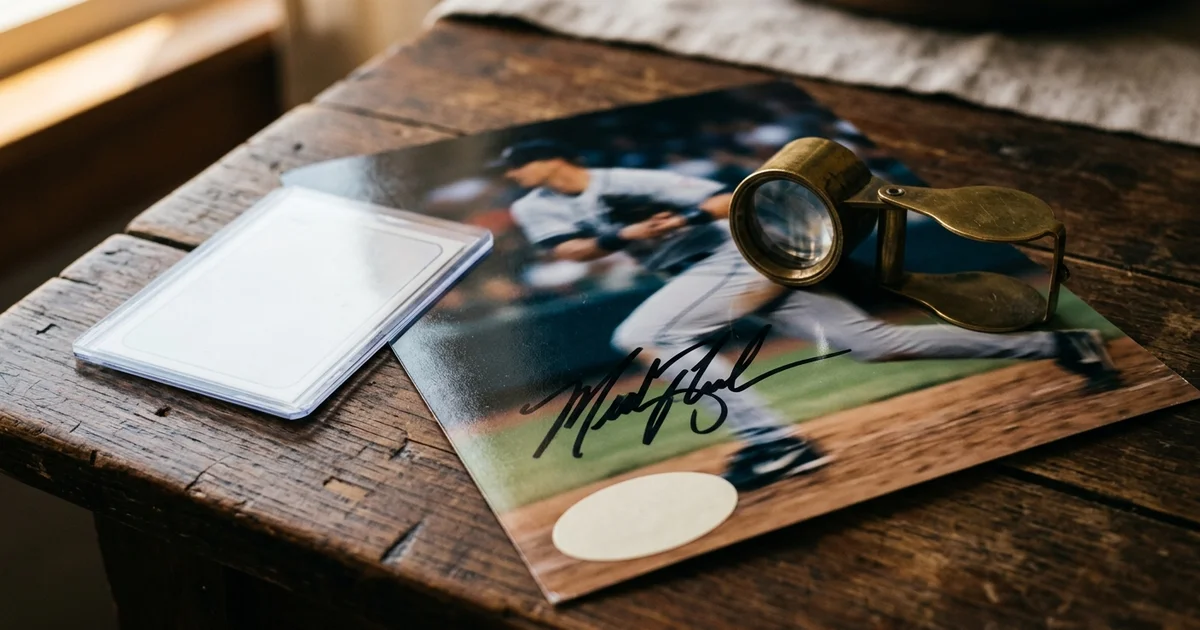
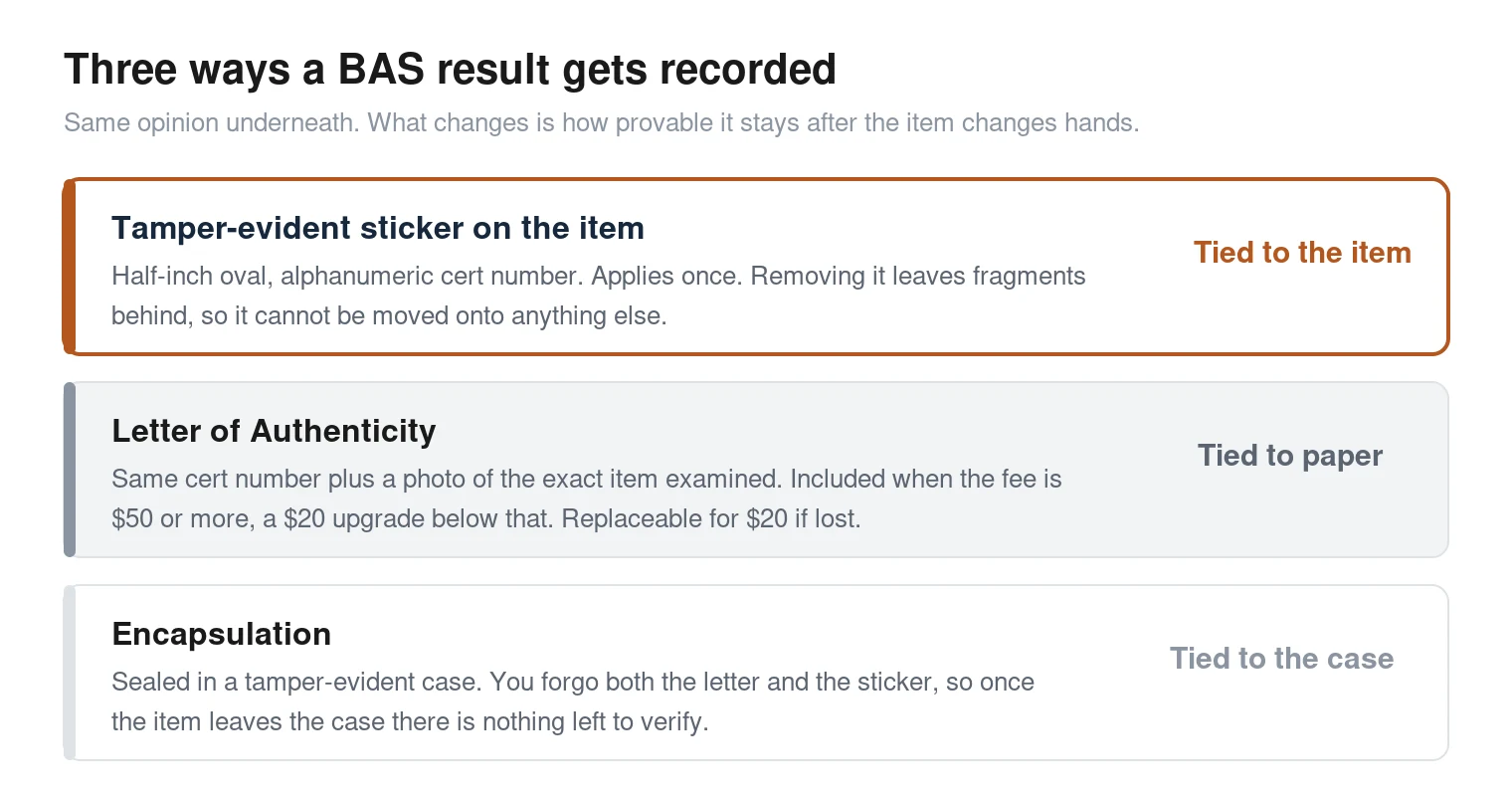
Once a signature passes, a half-inch oval tamper-evident label carrying an alphanumeric BAS certification number goes onto the item. Beckett notes that the label can be applied once and only once. Remove it and it leaves fragments behind, so it cannot be moved onto something else.
That one-way design is the actual security mechanism. It ties a specific opinion to a specific physical object.
The Letter of Authenticity is a separate product. Items with authentication fees under $50 get the sticker on the item unless you pay $20 to upgrade to a full LOA. Beckett has also stopped replacing lost Certificates of Authenticity entirely, though you can still print a certificate straight from their verification page, and a lost LOA can be replaced for $20.
Worth knowing if you go the encapsulation route: choosing autograph encapsulation means you forgo both the letter and the sticker. Pop the item out of the case and there is no way left to show Beckett ever saw it.
Witnessed versus authenticated, and why collectors care
BAS certs come from two different paths, and they are not equally strong.
Beckett Witness Certification means a BAS representative was physically present when the item was signed. Beckett’s own wording is that this “guarantees it is 100% authentic,” which is language they use nowhere else, because there is no opinion involved. Somebody watched it happen. These items get a special tamper-evident sticker that identifies them as witness certified, and the database reflects it.
Standard authentication means an expert examined the signature after the fact and gave an opinion. Skilled, informed, backed by exemplars, still an opinion.
Both carry a cert number and both verify in the same database, so a listing photo will not always tell you which you are looking at. If you are paying a premium specifically for certainty, witness certification is the one that delivers it. For everything else, you are buying a professional judgment call, which is genuinely valuable and genuinely fallible.
Verifying a Beckett certification number
The check takes under a minute and costs nothing.
Find the 6-digit alphanumeric certification number on the oval label, or on the COA or LOA if the label went there instead. Enter it at Beckett’s cert verification page or in the Beckett app. The record should match the item in front of you, not just return a valid hit.
That last part is where people get burned. A cert number is only meaningful attached to its own object. A number lifted from a real Yogi Berra photo and printed on a different photo still verifies. The lookup confirms the number exists in Beckett’s database and describes what it was issued for. Comparing that description to the item is your job.
Beckett is blunt about this on the verification page itself. The printed certificate you can generate there carries a disclaimer that it is for display purposes only and is not considered authentication for your item. The database record is the record. The printout is a souvenir.
If you get “no record found” and you believe the cert is genuine, Beckett asks you to email customer service with the number, a description, and a photograph so they can look into it. Do that before assuming fraud, and before assuming it is clean.
The same logic applies across every authenticator, which is why verifying a cert number is a separate skill from trusting one.
What Beckett authentication costs
There is no flat rate, and any site quoting you one is guessing.
Fees vary by the signer. For a multi-signed item, you find the fee for the premier signer, then use Beckett’s chart to adjust for the total number of signatures. Their pricing page has a signer lookup, and if a name does not populate, they ask you to email so they can confirm whether they will authenticate that signature at all.
A few fixed numbers from Beckett’s own pages are worth carrying around:
- Signature Review runs $10. A quick expert opinion on whether an autograph would likely pass full authentication, with results by email in 24 to 48 hours. This exists for buyers evaluating an item they do not own yet, and it is the single most underused service Beckett offers.
- The LOA upgrade is $20 on items with fees under $50, and $20 again to replace a lost letter.
- Items with authentication fees of $50 or more include a Letter of Authenticity at no extra charge.
- Autograph grading is half the normal authentication rate, charged on top of the authentication fee.
- A declared value of $5,000 or more triggers a Premium Item Fee.
- 50 items or more qualifies you to ask about bulk pricing.
Turnaround is not guaranteed. Beckett says it strives to finish authentication orders within 30 business days and warns that conventions and holidays stretch that. Expedited processing exists for an additional fee.
Sending items in without wrecking them
Submissions go to Beckett Authentication Services, 2700 Summit Ave, Ste 100, Plano, TX 75074. If BAS is running onsite authentication at an event near you, taking items in person saves the shipping fee and the shipping risk in one move.
For autographed cards, ship the way graders expect to receive them. Card in a clear penny sleeve, sleeved card in a semi-rigid holder, holders banded and boxed. This is not Beckett-specific etiquette, it is the handling standard the whole industry built its process around.
For Shipping Signed Cards

Cardboard Gold Card Saver 1 (100 ct)
- Slightly oversized so a sleeved card loads and unloads without force, which is exactly why graders handle cards in these
- The semi-rigid standard PSA names in its own shipping guide, and the same holder BAS submissions arrive in
- Also takes the larger pre-1957 cards that will not go into a standard 3″ x 4″ holder
What’s good: it is the holder every major authenticator built its handling process around, and the 100 count drops the per-unit cost to pocket change against what you are paying for authentication.
What’s not: it is floppy, and people coming from toploaders are always caught off guard. The lip creases if you are careless, a bent holder can press a corner, and an unbanded stack lets cards slide right out in transit. It also does not fit most storage boxes, which is a real annoyance if you thought you were buying storage. Card savers and toploaders solve different problems, and confusing the two costs cards.
The Layer Underneath

Ultra Pro Soft Card Sleeves, Clear (100 ct)
- Fully clear polypropylene, so the signature stays visible without anyone handling the card to see it
- Acid-free and PVC-free, which matters when the sleeve sits against signed ink for years
- 2 5/8″ x 3 5/8″, sized to take a standard card and still slide inside a semi-rigid holder
What’s good: the cheapest protection in the hobby, and buying the plain clear version avoids the opaque-sleeve processing delays graders complain about.
What’s not: they tear. They are thin on purpose, they split at the seam if you load a card at an angle, and a torn sleeve inside a holder is worse than none because you will not spot it. Buy more than you need and discard the damaged ones. Skip anything with a pull tab for submissions.
Checking an autograph before you pay anyone
Beckett’s $10 Signature Review exists because buyers keep spending hundreds on items nobody has looked at. That is the right tool for a serious purchase. For everything below that threshold, a look with decent magnification does most of the work.
Real ink sits on a surface with variable pressure, ragged starts and stops, and pen skips. A printed or stamped signature has uniform edges, a dot pattern under magnification, and no pressure variation anywhere in the stroke. Under 10x that difference is not subtle.
The same magnification is what lets you read a BAS label properly. Check that the oval is intact, that nothing under it looks disturbed, and that the number on the label matches the number on the letter.
For Reading Ink and Labels

Nikon 10x Jewelry Triplet Loupe
- 10x triplet optics, enough to separate hand-laid ink from a printed dot pattern
- 13mm lens that retracts into its own housing, so it survives a pocket or a show bag
- 1.65″ x 0.945″ x 0.63″ closed, small enough to carry to every card show without thinking about it
What’s good: the optics are genuinely good, the retracting housing means it does not get scratched into uselessness, and 10x is the right power for ink structure without the shake problems higher magnification brings.
What’s not: it costs several times what a generic loupe costs, and a budget triplet will show you a print dot pattern perfectly well. The short focusing distance also means getting close to the item, which is awkward on a framed or encapsulated piece. Buy this if you are looking at signatures regularly. Buy the cheap one if you are not. There is more on what a loupe reveals on a forged signature if you want the technique rather than the tool.
Is Beckett authentication legit
Yes, with a caveat that gets skipped in most answers.
BAS is one of the three third-party authenticators the market actually prices in, alongside PSA/DNA and JSA. Major auction houses and eBay’s authenticity programs recognize it. A BAS cert reliably moves an item’s sale price. That is the practical definition of legitimate in this hobby.
The caveat is that legitimate does not mean infallible. Every one of the big three has issued opinions that later got argued over, and the collector forums are full of people whose genuine items came back as unable to authenticate. An expert opinion is exactly that.
Two things follow from it. Do not treat a BAS sticker as the end of your own diligence, and do not treat a failed submission as proof an item is fake. Both are the same mistake in opposite directions.
If you are still deciding which company to send to, the comparison lives in the autograph authentication services rundown.
FAQ
How authentic is Beckett Authentication? Beckett issues expert opinions, not guarantees. Signatures are examined for ink and structure and compared against a database of exemplars, with Pro-Scope or VSC analysis when a case needs it. The opinion is well informed and it is still an opinion.
How do I check if a Beckett cert is real? Enter the 6-digit alphanumeric certification number from the label or letter at Beckett’s cert verification page or in the Beckett app, then confirm the returned record actually describes the item in your hands. A valid number attached to the wrong object is the common fraud.
Is Beckett Authentication better than PSA? Neither dominates. Both are recognized by major auction houses and both move sale prices. Beckett’s Signature Review at $10 is a real advantage for pre-purchase checks. Choose based on the signer, the fee for that signer, and which cert the buyers in your category prefer.
How much does Beckett authentication cost? It depends entirely on the signer, looked up on Beckett’s pricing page, with multi-signed items priced off the premier signer plus a count-based chart. Fixed extras include the $10 Signature Review, the $20 LOA upgrade on items under $50, and a Premium Item Fee on declared values of $5,000 or more.
What does Beckett authenticate? Autographs across sports, entertainment and historical categories, vintage and modern. Items from 8×10 photographs to trading cards, checks, cuts, index cards, postcards and documents can be encapsulated, and baseballs have their own patented holder.
Does a Beckett cert mean the item is real? It means the signature is judged real. Beckett will encapsulate an autographed card even when the card itself is counterfeit or inconclusive, so the item and the autograph are two separate questions.
What I’d actually do
For an item you already own and intend to sell, look up the signer’s fee first. If the fee is a meaningful fraction of what the item sells for, authentication is not worth it, and that math turns out badly more often than people expect on common signers.
For an item you are considering buying, the $10 Signature Review is the best value Beckett sells. Ten dollars and two days against a few hundred at risk is not a close call.
And whichever way you go, verify the cert number yourself and read what the record says. The label is the beginning of the check, not the end of it.
Sources
- Beckett Authentication Services, Autograph Authentication
- Beckett Authentication Services, Frequently Asked Questions
- Beckett Authentication Services, Signature Review
- Beckett Authentication Services, Certificate Verification
Related guides
- Best UV Flashlight for Spotting Fake Autographs and Card Restoration (start here)
- Autograph Authentication Services: Who to Use and Cost
- PSA Cert Verification: How to Check a Cert Number
- What an Autograph Certificate of Authenticity Is Actually Worth
- Longwave vs. Shortwave UV: Which One Is Safe to Use on Autographs Over and Over
- What a Jeweler’s Loupe Reveals on a Forged Signature
- Reading a UV Light Result: Original Ink vs. Restoration