Tag: autographs

  • What a Jeweler’s Loupe Reveals on a Forged Signature

    What a Jeweler’s Loupe Reveals on a Forged Signature

    As an Amazon Associate we earn from qualifying purchases. This post contains affiliate links, and we may earn a commission at no extra cost to you.

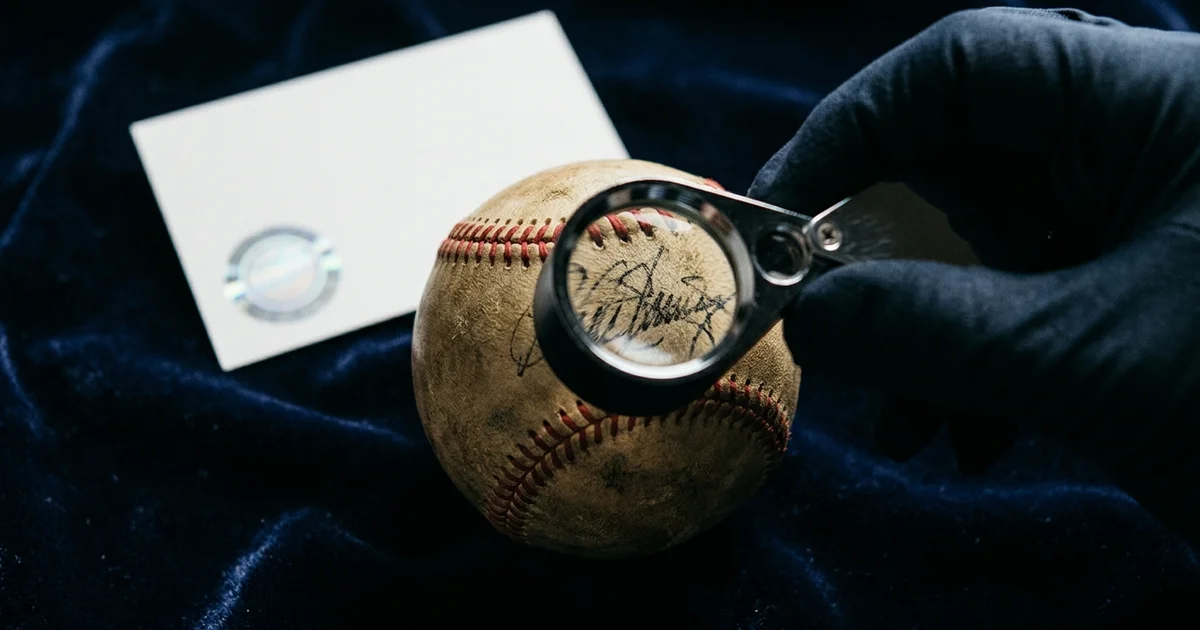
    Most collectors own a jeweler’s loupe for something else entirely: checking a diamond, reading a hallmark, squinting at a coin. Turn that same 10x lens on a signature and it does something the naked eye can’t. It shows you the ink itself, not just the shape of the name.

    That distinction matters more than any “does the signature look right” comparison you’ll find online. A skilled forger can copy a shape. Copying how ink actually sits on paper is a different problem.

    The magnification you actually need

    A standard 10x loupe is enough. You don’t need a lab microscope, and a lot of guides overstate this. 10x gets you close enough to see ink texture and stroke edges clearly, while still letting you move the lens across a full signature without losing your place.

    Go higher, 20x or 30x, and you’re often too zoomed in to read the stroke as a whole. You end up examining a single fiber of paper instead of the signature. Stick with 10x unless you’re chasing one specific detail a first pass already flagged.

    Good light matters as much as magnification. Raking light, angled low across the surface instead of straight down, throws shadows that make texture and raised ink stand out. A loupe under flat overhead light will miss things the same loupe under a raking desk lamp catches easily.

    What to look for in the ink

    This is where the loupe earns its keep. Under 10x, ink stops being a flat line and becomes a physical thing with texture.

    • Pooling at stroke ends. A real signature, written at normal speed with a normal pen, leaves small pools of ink where the pen slows down or lifts, usually at the end of a letter or a flourish. Traced or slowly-drawn forgeries often lack this because the forger is drawing carefully rather than writing naturally, so the ink lays down evenly instead of pooling.
    • Consistent pressure variation. Genuine handwriting speeds up and slows down within a single word. That shows up under the loupe as strokes that thicken and thin naturally. A traced signature tends to hold one width for too long, because the forger is following an outline instead of writing.
    • A single, unbroken layer of ink. One pen, one pass, one layer. If part of a letter looks like it has a second coat of ink sitting slightly off from the first, something was added or retouched after the fact.
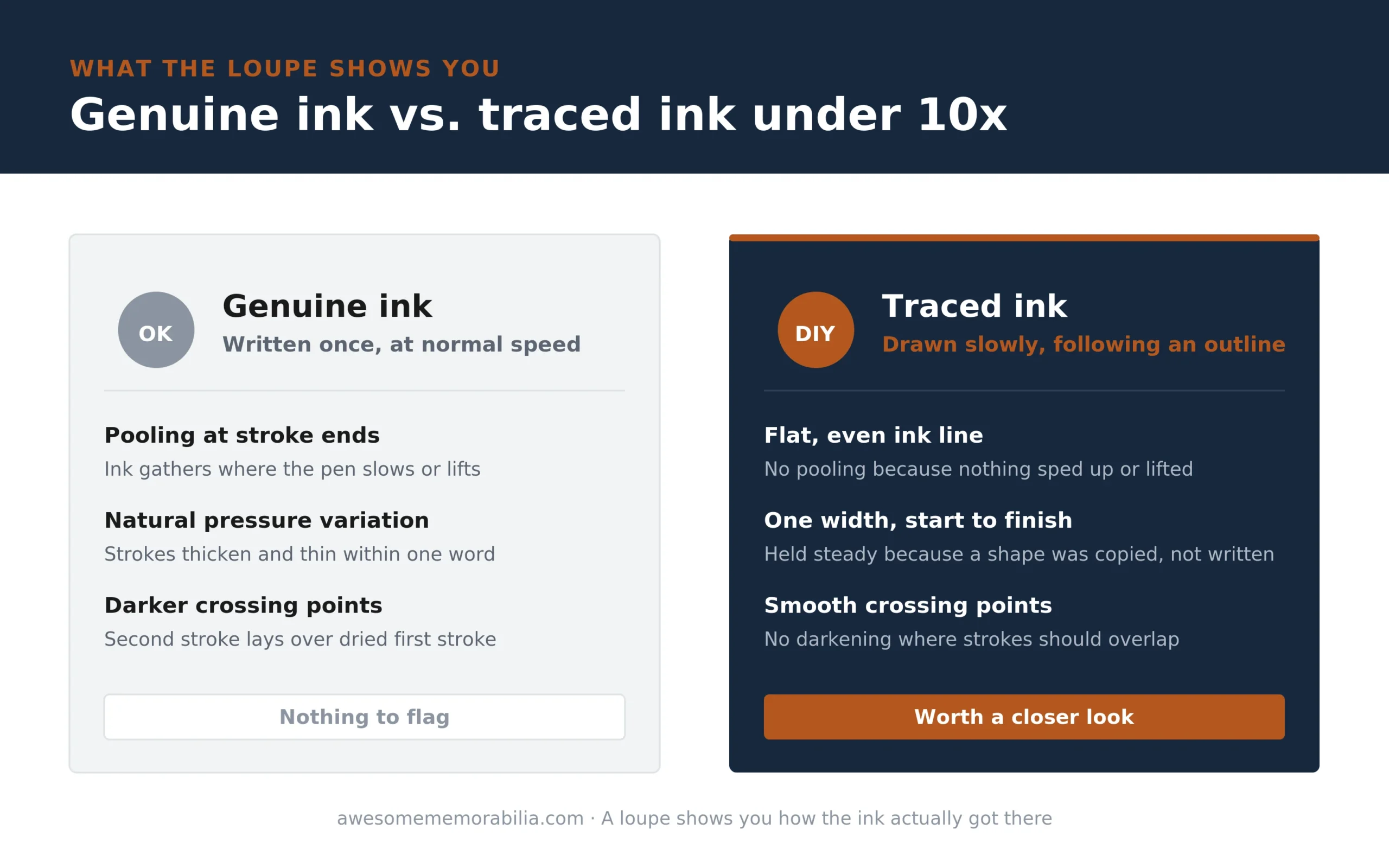
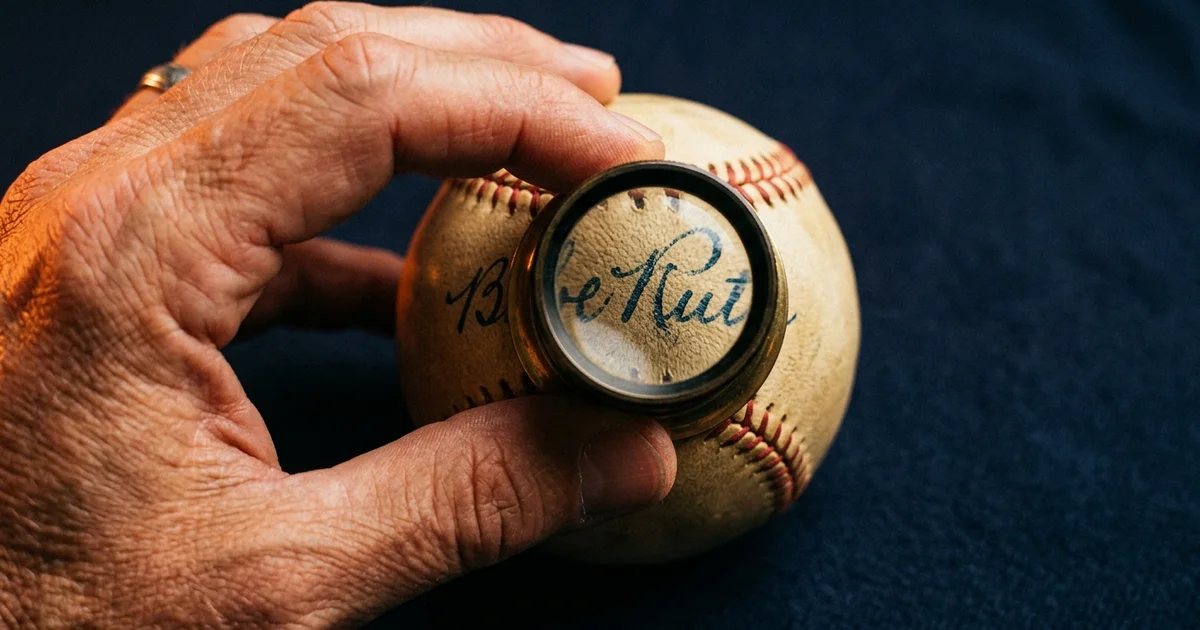
    Genuine ink under a jeweler's loupe pools at stroke ends and darkens at crossing points, while traced or forged ink stays flat and even with no darkening where strokes overlap

    Crossing points: the most reliable single tell

    If you learn to check one thing with a loupe, make it this. Most signatures have at least one spot where a stroke crosses over another stroke, the cross of a “t,” the loop of an “l” overlapping a neighboring letter, a flourish that doubles back on itself.

    At a crossing point, ink from the second stroke lays down on top of ink that’s already dry from the first. Under 10x, that shows up as a slightly darker, denser spot where the two layers overlap. It’s genuinely hard to fake, because a forger tracing a signature usually lifts the pen or slows down at exactly the point a real signer wouldn’t have thought twice about.

    No darkening at a crossing point, or a crossing point that looks suspiciously smooth and even, is worth a second look. It doesn’t prove anything by itself. It’s one data point, and a strong one.

    Loupe vs. magnifying glass

    A magnifying glass is fine for reading small print. It’s a weaker tool for this specific job. Most magnifying glasses run 2x to 4x, which is enough to see a shape more clearly but not enough to resolve ink texture or catch a crossing point cleanly.

    A loupe also forces you close to the surface, usually an inch or less, which cuts glare and stray light that a magnifying glass held at arm’s length lets in. That closeness is part of why jewelers use loupes instead of magnifying glasses for anything that requires real detail.

    If you don’t have one yet, get a true optical triplet rather than the cheap single-lens loupes sold as “10x” that blur badly toward the edges. The Nikon below is a straightforward pick.

    Good: genuine achromatic triplet glass, folds into a metal case that survives a bag or pocket, and the Nikon name means it’ll still be sharp in ten years.
    Not great: no built-in light, so you’ll still want that raking desk lamp for the ink work above. It also costs more than the LED-and-UV loupes that show up first in most searches, which are built for gemstones and add lighting you don’t need here.

    Recommended Loupe

    Nikon 10x jewelry triplet loupe

    Nikon 10x Jewelry Triplet Loupe

    • True 10x achromatic triplet lens, 13mm diameter
    • Folds into a protective metal case for a pocket or kit
    • No built-in light. Pair it with a raking desk lamp for the ink and stroke detail this guide covers
    Check current price on Amazon

    If you already own a loupe for grading or hallmark work, it’ll do this job too. No need to buy a second one.

    What a loupe can’t tell you

    A loupe shows you technique. It doesn’t identify a signer. Even a textbook-perfect crossing point and natural pooling only tell you the signature was likely written at normal speed by a real hand, not whose hand it was.

    Pair what you see under the loupe with a known exemplar of the signer’s autograph, and treat anything genuinely valuable the same way you’d treat a card under UV light: as a first filter, not a final verdict. When real money is on the line, get a reputable third-party opinion.

    Related guides


  • Reading a UV Light Result: Original Ink vs. Restoration
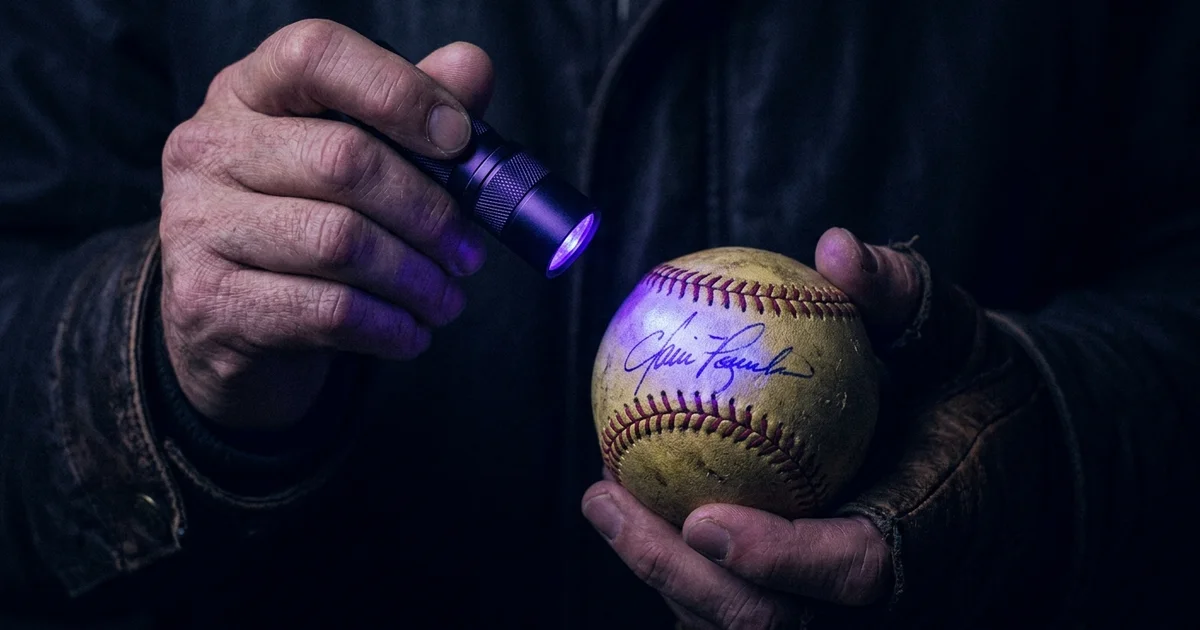
    Reading a UV Light Result: Original Ink vs. Restoration
    As an Amazon Associate we earn from qualifying purchases. This post contains affiliate links, and we may earn a commission at no extra cost to you.

    Fresh ink and old ink don’t glow the same way under a 365nm light. Once you’ve seen the difference side by side, you can’t unsee it.

    If you already own a 365nm UV flashlight, you have the tool. This is the part nobody explains well: what you’re actually looking at once the light comes on.

    Why ink glows under UV in the first place

    Most inks, ballpoint, Sharpie, gel, contain compounds that fluoresce under ultraviolet light because of how their pigments and binders absorb and re-emit light outside what your eyes normally catch. Old ink that’s had years to oxidize and settle into paper or a card’s surface fluoresces differently than ink laid down last week. Paper and card stock age the same way.

    That’s the whole trick a UV light exploits. Two materials that look identical in daylight age and react to UV differently once you stop trusting your eyes alone.

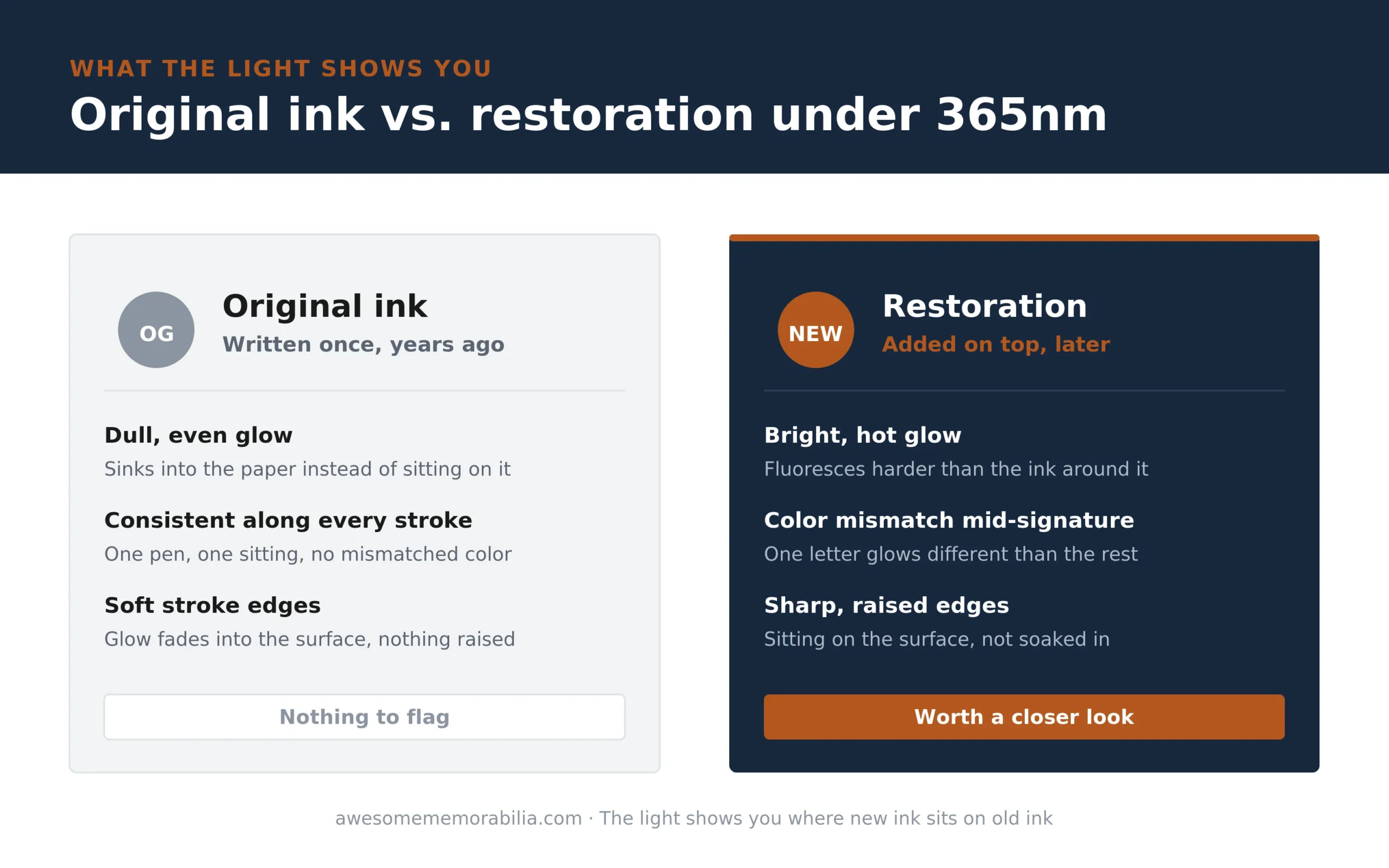
    Original autograph ink under UV glows dull and even; restoration or forged ink glows brighter, hotter, with sharp raised edges

    What original ink looks like

    Genuine, aged autograph ink reads dull and even. It sinks into the surface instead of sitting on top of it. Move the light across a real signature and the glow, if there’s any at all, stays consistent along every stroke, because the whole thing was written in one sitting with one pen at one point in time.

    What restoration or a forgery looks like

    Added ink stands out because it doesn’t share that history. A retraced signature, a “touched up” fade, or ink laid over a printed surface tends to fluoresce brighter, hotter, or a noticeably different color than the material around it. Look for:

    • A glow that jumps at the stroke edges. Original ink fades into the paper. Added ink often has a slightly raised, sharper edge because it’s sitting on the surface, not soaked into it.
    • Color mismatch inside a single signature. One letter glowing blue-white next to letters that stay dull isn’t a coincidence. Someone touched up part of a fading autograph and left the rest alone.
    • A signature that’s uniformly hot everywhere. A whole autograph lighting up bright and even, with none of the natural variation a real pen stroke leaves, points to the entire thing being added at once, not written years ago the ordinary way.

    Why autographs fade in the first place

    Light exposure is the biggest cause, especially UV from windows and old fluorescent bulbs. It breaks down ink pigment over years, which is exactly why a UV-blocking display case matters if you want a piece to last. A faded autograph isn’t automatically less authentic. It’s just old and poorly displayed.

    The problem starts when someone “fixes” that fade with new ink instead of living with it, or disclosing it.

    Can a faded autograph be restored honestly?

    Conservators can stabilize paper and ink without adding new pigment, and that kind of work doesn’t hide anything under UV because nothing new went on the surface. What actually tanks a piece’s value is undisclosed retracing: someone going over faded strokes with a fresh pen to make it look sharp, then selling it as if that never happened.

    The UV light doesn’t care about intent. It shows you where new material sits on old material. What you do with that information is the real authentication step.

    One read isn’t enough

    A single UV pass tells you where to look closer, not a final verdict. Cross-check anything questionable against a known exemplar of the signer’s autograph. If real money is on the line, get a reputable third-party opinion before you buy or sell.

    The light narrows the question. It doesn’t answer it by itself.

    Related guides

  • How to Tell If a Sports Autograph Is Real or Fake

    How to Tell If a Sports Autograph Is Real or Fake

    Every collector has the same moment eventually. You’re staring at a signed baseball, a jersey, a photo, and asking yourself the one question that actually matters: is this real?

    Most fakes don’t fail because the forger can’t draw the right letters. They fail on the things nobody thinks to check. Here’s what actually separates a genuine signature from a good guess.

    What real authenticators look at first

    Professional authenticators like PSA/DNA and JSA don’t eyeball a signature and call it a day. They compare it against an exemplar database, meaning a library of confirmed-genuine signatures from that same athlete, often across different points in their career. JSA’s exemplar library alone runs close to 500,000 files.

    A signature gets checked against several things at once:

    • Ink flow and pressure. A real autograph has natural speed variation. Forgers who trace a signature move slower and more evenly than someone signing on instinct, and that shows up under magnification.
    • Stroke structure. Real signatures have consistent letter formation even when they look sloppy. Fakes often nail the shape but get the stroke order wrong.
    • Ink chemistry and age. For older items, authenticators can check whether the ink is period-correct. A “vintage” signature written in a pen formula that didn’t exist yet is a dead giveaway.
    • Consistency with known career timeline. A player’s signature changes over the years. An autograph that doesn’t match the way that player signed during the actual season stamped on the item is a problem.

    None of this is something you can do at home with a magnifying glass and confidence, and even experienced collectors disagree with each other constantly on forums trying to eyeball it. That’s the point.

    Autopen signatures are their own category of fake

    An autopen is a machine that physically reproduces a signature using a real pen and real ink, guided by a mechanical arm. It’s not a forgery in the criminal sense. Teams and athletes use them for fan mail and bulk requests. But an autopen signature sold as hand-signed is still a fake, and it’s one of the harder ones to catch by eye because the ink is real ink, not a printed image.

    The tell is usually in the consistency. Autopen signatures are mechanically identical every time. If you can find two “signed” items with strokes that match down to the pixel, you’re not looking at two autographs. You’re looking at one template.

    What a real certificate of authenticity should actually include

    A COA is only as good as the company standing behind it. A legitimate certificate from PSA, JSA, or Beckett includes a unique serial number, a tamper-evident hologram or label physically attached to the item, and an online verification database where you can look up that serial number and confirm it matches a real submission.

    A COA printed on card stock with no serial number, no hologram, and no way to verify it online isn’t authentication. It’s a piece of paper the seller made.

    A hand holding a jewelers loupe over a certificate with a holographic authentication seal

    Red flags that should make you walk away

    A few patterns show up constantly with fakes: a price that’s noticeably below what the same item sells for with real third-party authentication, a seller who won’t provide close-up photos of the signature itself, “authentication” from a company that doesn’t have a public verification database, and a signature that looks suspiciously clean and uniform for an athlete known for a rushed, sloppy autograph style in person.

    If you already own something you plan to display long-term, our guide on paint pen vs. Sharpie for autographs covers which tools actually hold their ink over time, since a real signature written in the wrong pen can fade or smear in ways that make it look questionable years later even when it was never fake to begin with.

    When it’s worth paying for third-party authentication

    If an item is worth more than a couple hundred dollars, or you’re planning to sell it eventually, submit it. PSA and JSA both charge a per-item fee based on declared value and turnaround speed, and the cost is small compared to what an unauthenticated item loses at resale. Buyers pay a real premium for a slabbed, verifiable signature, and that premium usually covers the submission fee many times over.

    Skip authentication on low-value items you’re keeping for yourself. There’s no financial case for a modest fee on a photo you’re never selling. Save the submission budget for anything you’d actually regret losing.

    Related guides

  • Paint Pen vs. Sharpie for Autographs: Which One Actually Holds Up?

    Paint Pen vs. Sharpie for Autographs: Which One Actually Holds Up?

    Ask ten collectors which pen to use for an autograph and you’ll get ten different answers, half of them wrong for the item actually in front of you. Two pens dominate the debate: the oil-based paint pen and the classic Sharpie permanent marker. They’re not interchangeable, and picking the wrong one can cost you a signature that fades, bleeds, or smears before the ink even sets.

    As an Amazon Associate we earn from qualifying purchases. This post contains affiliate links, and we may earn a commission at no extra cost to you.

    One thing first: if you’re signing a baseball specifically, skip both of these. A blue ballpoint is the right call there, paint pens can smudge on a ball’s leather and Sharpies bleed into it. This comparison is for everything else, jerseys, bats, helmets, photos, plastic display pieces, anything with a flat or semi-flat surface.

    The quick comparison

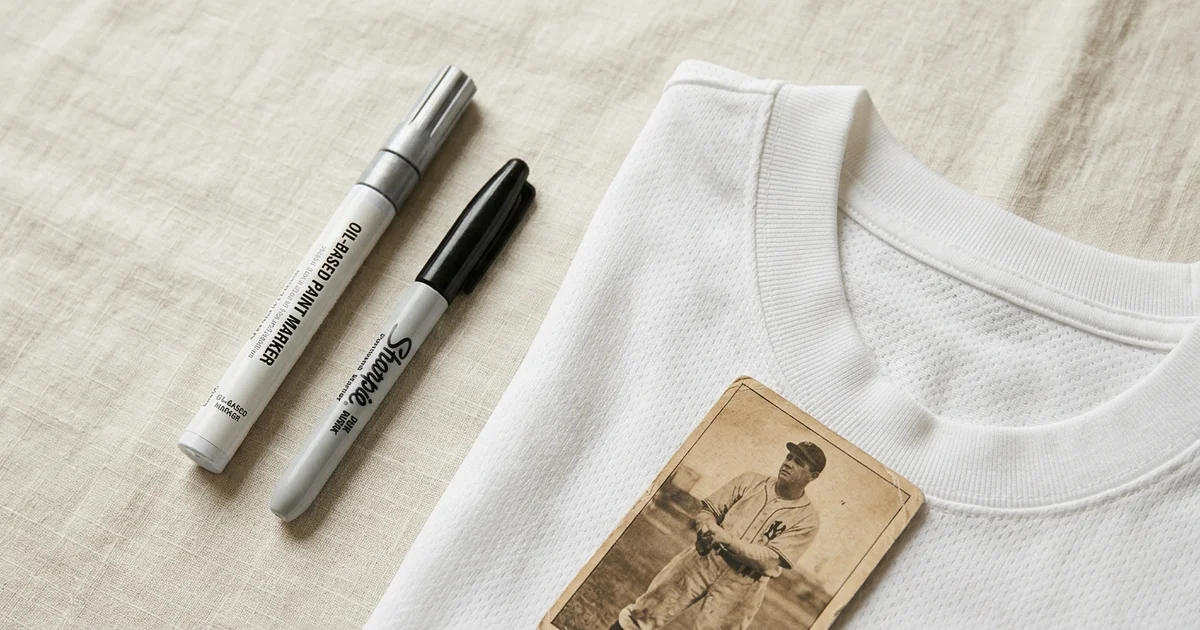
    Full comparison of paint pen vs Sharpie for signing memorabilia: best surfaces, fade resistance, dry time, line control, and cost

    The paint pen

    The Uchida DecoColor Fine Point Paint Marker is the one that shows up on autograph dealer tables more than any other brand, and there’s a real reason for that. The pigment is oil-based and acid-free, so it doesn’t yellow or fade the way dye-based ink does over a decade in a display case. It goes on opaque, which matters on a dark jersey or a black helmet where a Sharpie’s ink barely shows.

    None of that comes free. The pen needs a shake and a few presses on scratch paper before it flows right, and if the person signing rushes, the paint can’t keep up, you’ll get a streaky, thin line instead of a clean one. It’s also a few dollars more than a Sharpie, and if you’re buying a full set of colors, that adds up fast.

    Pros: archival pigment, opaque on dark surfaces, holds up for years without fading.
    Cons: needs priming before every signing, unforgiving with a fast signer, pricier per pen.

    Our Pick

    Uchida DecoColor Fine Point Paint Marker

    Uchida DecoColor Fine Point Paint Marker

    • Oil-based, acid-free pigment, won’t yellow in a display case
    • Opaque on dark jerseys and helmets where a Sharpie barely shows
    • Needs a shake and priming, not an instant-write pen
    Check current price on Amazon

    The Sharpie

    The Sharpie Permanent Marker, Fine Point is the one everyone already has a drawer full of, and for photos and smooth cards, that’s genuinely fine. It writes instantly, no priming, no shaking, no waiting for the ink to catch up with a fast signer at a crowded table.

    The tradeoff shows up years later, not on signing day. Sharpie ink fades under light over time, and on porous surfaces like certain jersey fabrics, it can feather or bleed slightly instead of sitting crisp on top. It’s also nowhere near as visible on dark materials, a black Sharpie on a navy jersey is asking for trouble.

    Pros: instant dry time, no prep needed, cheap, easy for any signer.
    Cons: fades over years of light exposure, can bleed on porous fabric, weak visibility on dark surfaces.

    Also Great

    Sharpie Permanent Marker 12-pack, Fine Point

    Sharpie Permanent Marker, Fine Point (12-pack)

    • Dries instantly, zero prep before signing
    • Best for photos, cards, and smooth paper
    • Skip it for dark jerseys or long-term display pieces
    Check current price on Amazon

    What about hats, Funko Pops, and other odd surfaces?

    Jerseys and photos get all the attention, but collectors sign plenty else. A Funko Pop’s vinyl is smooth and non-porous, closer to a photo than a jersey, so either pen writes cleanly, but the paint pen’s opaque pigment sits up on top and resists rubbing off during handling far better than a Sharpie line does. A ball cap is the trickier case: it’s curved, textured, and often dark, the same combination that makes jerseys hard. Same rule applies, paint pen for a dark cap, Sharpie is fine on a light one you’re not planning to display long-term.

    The material rule holds across all of it: smooth and light-colored favors the Sharpie’s speed, dark or textured favors the paint pen’s opacity and staying power. When in doubt, test the pen on an inconspicuous spot first, a pump or a tag, not the signature itself.

    Why do autographs actually fade?

    Light does the damage, not age by itself. UV exposure and even ordinary room light break down dye-based pigments over years, which is the real reason a Sharpie signature on a jersey hanging near a window looks noticeably weaker after a decade while one kept out of direct light barely changes. Collectors comparing notes on forums like collectSPACE have been flagging the same pattern for years: it’s not the pen alone, it’s what happens to the piece after the ink dries.

    Two things help regardless of which pen you used. Keep the piece out of direct sunlight, and if it’s going in a display case, use UV-filtering acrylic or glass rather than the plain kind. Neither costs much next to what a graded, framed piece is worth, and both matter more to long-term fading than the few dollars separating a paint pen from a Sharpie.

    A vintage signed baseball jersey hanging near a sunlit window, illustrating how light exposure fades ink over time

    Which one to actually buy

    If the item is going in a display case for the next twenty years, jersey, bat, helmet, use the paint pen. The extra few dollars and the slower prep are worth it for ink that won’t fade before your kid inherits the thing.

    If it’s a photo, a card, or you’re at a signing where the athlete is moving fast and there’s no time for priming a pen, the Sharpie is the better call. It’s not the archival choice, but it’s the realistic one when speed matters more than permanence.

    Bottom line

    Buy both. Keep a Sharpie in the bag for photos and quick signings. Keep a paint pen for anything going into long-term display. The pen that “always works” for autographs doesn’t exist, the right pen depends entirely on what you’re putting in front of the person signing it.