
As an Amazon Associate we earn from qualifying purchases. This post contains affiliate links, and we may earn a commission at no extra cost to you.
Four companies matter: PSA, SGC, Beckett, and CGC. PSA slabs resell for the most money on almost every card, which is why most people should use PSA and stop researching, but as of August 2026 PSA has its four cheapest tiers switched off, so the honest answer for a $40 card is currently somebody else.
That pause is the single biggest thing that has changed about this question in years, and most of the guides ranking for it were written before it happened.
What PSA shut off, and why it matters to you
On May 28, 2026, PSA announced it was temporarily pausing four Value service tiers effective June 2. Value Bulk, Value, Value Plus and Value Max all closed to new submissions. Regular, Express, Super Express and Walk-Through stayed open.
The reason PSA gave was a backlog approaching 10 million cards after a 20% spike in submissions. PSA also extended estimated Regular turnaround to 40 to 50 business days, and 50 to 60 for dual-service authentication.
It has not gone the way PSA hoped. Their own Backlog Tracker put the active backlog at 12.4 million units on July 28, up from 11 million two weeks earlier. The target for reopening the Value tiers is 5 million units. PSA’s own June 2 projection was five to six months to get there.
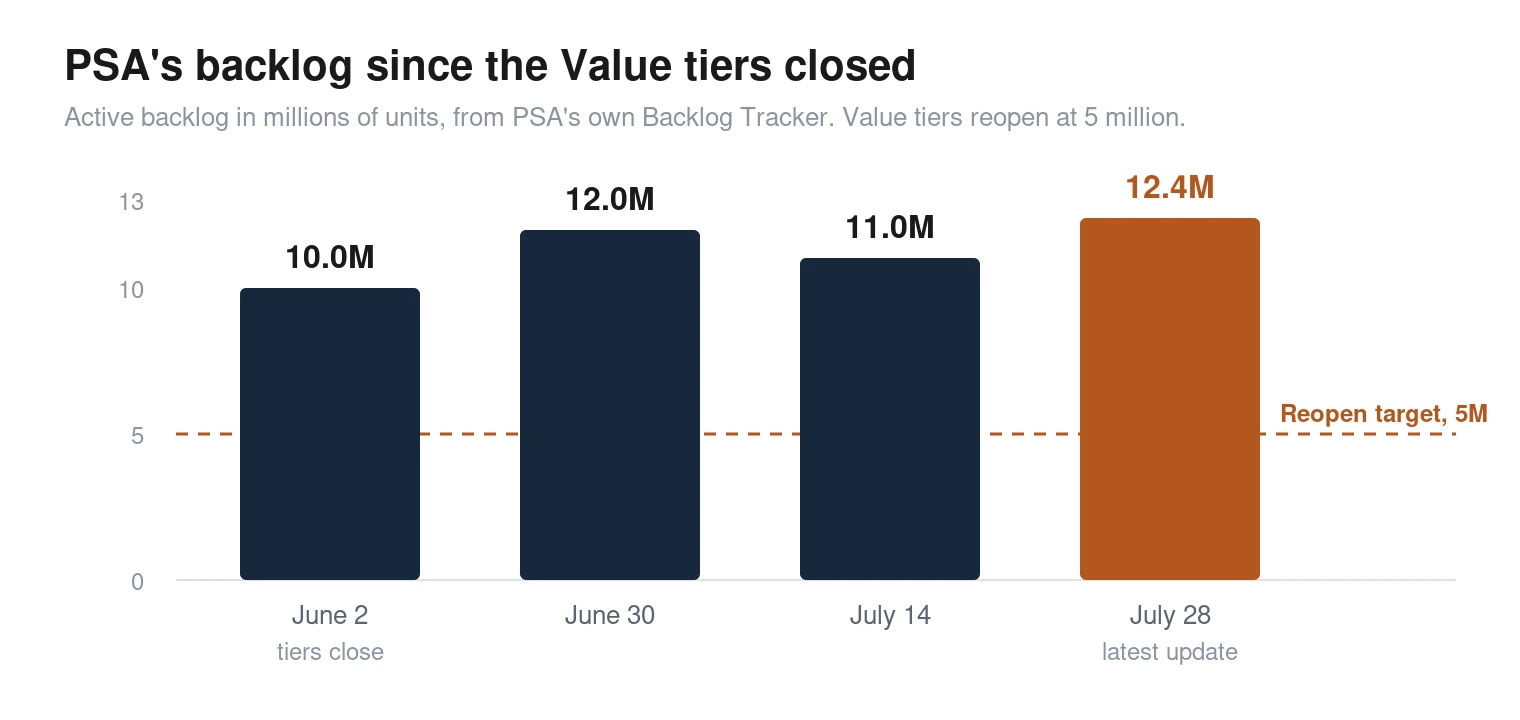
Read that plainly. The cheapest way to get a card into a PSA slab is closed, the backlog is moving the wrong direction, and the entry point that remains is Regular at $79.99 per card.
That does not make PSA the wrong answer. It makes PSA the wrong answer for a specific kind of card, which is exactly the distinction the “who is the best grading company” question usually flattens.
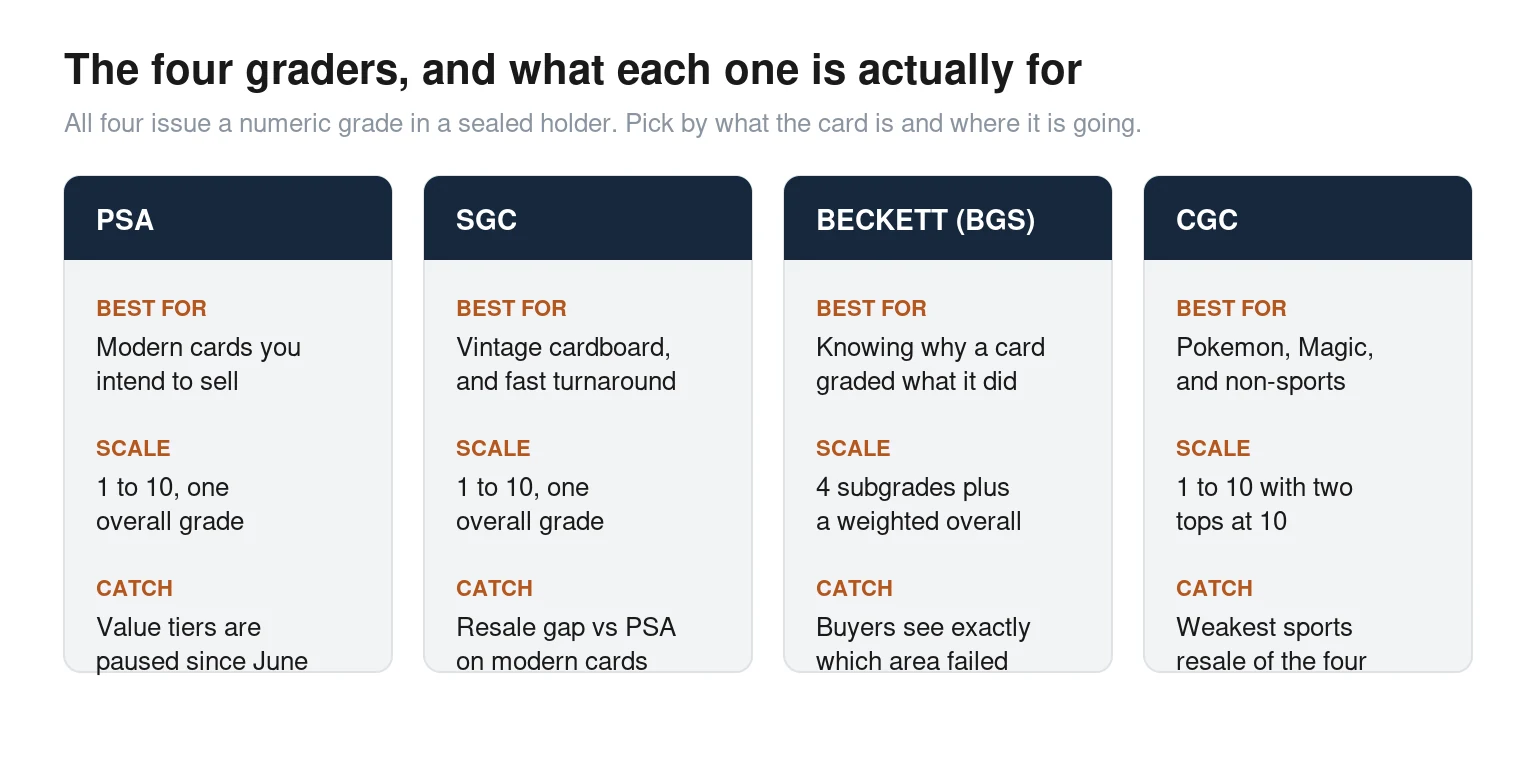
PSA
The market leader, and it is not close. A PSA 10 sells for more than any other company’s 10 on the vast majority of cards, and that premium is the whole reason to use them. You are not buying a better opinion, you are buying the label collectors bid on.
PSA uses a 1 to 10 scale with a single overall grade and no subgrades. Their grading standards page is worth reading before you submit, particularly the section admitting that centering and eye appeal involve a judgment call. Graders can allow a slightly off-center card into a clean grade if the eye appeal carries it, and they can hold a technically qualifying card back if the market would read it as off-center. Anyone selling you a purely mechanical model of grading is overselling it.
What’s good: the resale premium, the Set Registry, the population report, and the largest pool of buyers who know what the slab means.
What’s not: as of August 2026 the entry price is $79.99 per card and the queue is 12.4 million deep. Regular service is estimated at 40 to 50 business days, which in practice means months, and PSA’s own tracker shows the backlog growing. There are no subgrades, so a 9 tells you nothing about which of the four areas cost you the 10.
SGC
The one most experienced submitters name when the card is vintage. SGC’s tuxedo slab, black matting around the card, is the reason. On a 1955 Topps with a dark border, that presentation genuinely helps the card look like what it is.
SGC turnaround has historically been the fastest of the four by a wide margin, and their pricing tiers sit well below PSA’s Regular. Check the current numbers on SGC’s own services and pricing page rather than trusting any blog’s table, including this one, because grading pricing has moved three times this year across the industry.
What’s good: speed, price, and a slab that suits vintage cardboard better than anything else on the market. With PSA’s Value tiers closed, SGC is the obvious landing spot for mid-value cards.
What’s not: the resale gap is real. An SGC 10 and a PSA 10 on the same modern card do not sell for the same money, and on high-end modern the difference can be large enough to swamp the fee savings. SGC is also the smallest operation of the four, so a demand surge hits their turnaround harder.
Beckett (BGS)
Beckett is the subgrade company. BGS grades four areas, centering, corners, edges and surface, and prints all four on the label alongside the overall grade. The overall is not an average, it is weighted, and the lowest subgrade pulls hardest.
That is genuinely useful information. A BGS 9.5 with a 9 in centering tells you the card was cut poorly and nothing else went wrong. A PSA 9 tells you it is a 9.
The Black Label is a BGS Pristine 10 with all four subgrades at 10. It is rare enough that Black Label cards trade at a large premium over ordinary 10s, and it applies to modern cards only.
What’s good: subgrades, the Black Label ceiling, and a slab that has historically been the sturdiest of the group. For modern chrome and autographed rookies, BGS is a real competitor to PSA rather than a fallback.
What’s not: the subgrades cut both ways, since a buyer can see exactly what is wrong with your card. Beckett’s vintage business is a fraction of PSA’s, and on pre-1980 cardboard a BGS slab usually costs you money at resale.
CGC
The newest of the four in cards, though the parent company has been grading comics for decades. CGC merged its card operation with CSG to form what it describes as the second-largest card grading service.
Their scale runs 1 to 10 with half grades, and it has two tops. Gem Mint 10 and Pristine 10 are separate grades, with Pristine reserved for cards that are flawless under 10x magnification and given a gold label. CGC no longer offers subgrades, and the old Perfect 10 grade is retired, with those cards reholdered as Pristine 10.
What’s good: deep roots in TCG and non-sports, and if you are grading Pokemon or Magic rather than baseball, CGC is a serious option with a following that PSA does not entirely own.
What’s not: on sports cards the resale premium is the weakest of the four, and the grading scale has been revised enough times that older CGC and CSG slabs now carry legacy grades that need a lookup table to interpret. That churn is not what you want from a company whose whole product is a stable opinion.
What the slab actually buys you
Three things, and it helps to keep them separate.
Authentication, meaning the card is real and unaltered. Encapsulation, meaning it is sealed in a tamper-evident holder that stops the condition from changing. And a grade, which is one company’s opinion of the condition on a 1 to 10 scale.
Resale value comes from the third one, and only at the top. A Gem Mint 10 is worth a large multiple of the same card raw. A 7 usually is not worth the fee you paid, because a buyer looking at a 7 can see the card is worn without needing a slab to tell them. That is the calculation people skip. Grading a card does not add value, it reveals value that was already there, and it charges you either way.
The turnaround time matters for the same reason. If you are grading a modern card that is hot right now, a five-month queue means you sell into a different market than the one you were aiming at. TCG submissions have been hit hardest by this, since Pokemon volume is what drove the current backlog in the first place.
Check the card yourself before you pay anyone
Most cards that come back a 9 instead of a 10 were always a 9. You could have seen it at home.
Both CGC and Beckett define their top grades in terms of what a card looks like under magnification. CGC’s Pristine 10 is explicitly “flawless under 10-times magnification.” Beckett’s 10 requires corners that are Mint under magnification and edges virtually free of flaws under magnification. A 10x loupe puts you at the same magnification the grader is using.
Pull the card, look at all four corners, then run the edges under the light. If you find whitening on a corner at 10x, you are not sending in a 10, and paying an Express fee to be told that is an expensive way to learn it.
Pre-Submission Inspection

Nikon 10x Jewelry Triplet Loupe
- 10x, the exact magnification CGC cites for its Pristine 10 standard
- Triplet lens, so the edge of the field stays sharp instead of smearing where corner whitening shows up
- Folding metal housing that covers the optic when it is in a box with cards
What’s good: a triplet holds focus across the whole field, which matters because the flaw you are hunting is usually at the edge of what you are looking at. It is small enough to live in a card box.
What’s not: it costs several times what a generic hobby triplet costs, and a cheap triplet will find corner whitening perfectly well. Buy the Nikon if you are going to use it constantly, not to check six cards once. A 13mm lens is also small, so you are inspecting one corner at a time rather than taking in a whole edge at once.
What every submission needs, whichever company wins
The prep is the same for all four. Card into a clear penny sleeve, sleeved card into a semi-rigid holder. Not a toploader, which every grader rejects.
PSA’s shipping guide specifies semi-rigid holders at 3 5/16″ x 4 7/8″ for standard cards, which is the Card Saver 1 dimension. SGC, BGS and CGC all take the same holder. Buying for the grader you might switch to later costs nothing extra.
The downside of this prep is that it is fiddly and it is where most people damage a card. Sliding a bare card into a sleeve, or forcing a sleeved card into a holder at an angle, grinds wear into the surface and edges. Surface is one of the four things being graded. Go slow, and throw out any sleeve that splits.
Accepted By All Four Graders

Cardboard Gold Card Saver 1 (100 ct)
- 3 5/16″ x 4 7/8″ including the lip, matching PSA’s stated submission dimension
- Slightly oversized by design, so a sleeved card loads without forcing a corner
- Also fits the larger pre-1957 cards that will not go into a standard 3″ x 4″ holder
What’s good: it is the holder the entire industry built its handling process around, and the 100 count drops the per-card cost to almost nothing.
What’s not: it is floppy, and people coming from toploaders are always surprised by how floppy. The lip creases if you are rough with it, and an unbanded stack lets cards slide straight back out. Amazon stock also runs thin on this item, so check availability before you plan a submission date around it.
The Layer Underneath

Ultra Pro Clear Standard Trading Card Sleeves (100 pk)
- Fully clear polypropylene, which is what PSA asks for, since opaque sleeves slow processing
- Acid-free and PVC-free, safe sitting against the card face long term
- Fits standard cards up to 2 5/8″ x 3 5/8″, sized to still slide inside a semi-rigid holder
What’s good: the cheapest insurance in the hobby, and the plain clear version sidesteps the opaque-sleeve delay entirely.
What’s not: penny sleeves tear. They split at the seam if you load a card at an angle, and a torn sleeve inside a holder is worse than no sleeve because you will not see it. Buy more than you need. Skip anything with a pull tab, since PSA lists pull tabs alongside tape and sticky notes as things to keep off a submission.
So which one
Modern card worth over a few hundred dollars, and you plan to sell it: PSA, and pay the Regular fee. The resale premium covers it.
Vintage: SGC. The slab suits the card, the turnaround is faster, and the vintage market has never punished an SGC holder the way the modern market does.
Modern card where you want to know why it graded what it graded, or you are chasing a Black Label: BGS.
Pokemon, Magic, or non-sports: CGC deserves a real look rather than a default to PSA.
A stack of $20 to $50 cards: none of them, for now. At $79.99 a card, PSA Regular costs more than the cards. Wait for the Value tiers to reopen, or send them to SGC, or accept that most cards are worth more raw than they are worth graded. That last option gets skipped a lot and it is the right answer more often than the hobby admits.
Common questions
Which card grading company is best? PSA, measured by resale value, on nearly every sports card. That has not changed. What changed in June 2026 is that PSA’s cheap tiers are closed, so “best” and “available at a sane price” are currently different companies for low-value cards.
How much does it cost to grade a card? It depends on the card’s declared value and how fast you want it, and every one of the four has moved pricing in 2026. PSA’s Regular tier is $79.99 per card as of this writing. Check each company’s own pricing page before you budget, since the numbers in most guides are already stale.
How long does grading take? PSA estimates 40 to 50 business days for Regular right now, extended because of the backlog. SGC has historically been fastest. Treat every published turnaround as an estimate that starts when the grader logs your order in, not when you mail it.
Are subgrades worth it? They are worth it if you are trying to understand your own collection or chasing a Black Label. They can work against you at resale, because a buyer sees precisely which area failed.
Can I check a grade after the fact? Yes. All four run public cert lookup tools, and checking a cert number against the company’s own database is the single fastest way to catch a counterfeit slab.
Related guides
- Card Saver vs. Toploader: Which One Your Card Should Actually Be In (start here)
- How to Submit Cards to PSA: The Full 2026 Process
- Card Saver 1 vs. 2: Which One PSA Actually Accepts