Tag: psa submission

  • How to Submit Cards to PSA: The Full 2026 Process

    How to Submit Cards to PSA: The Full 2026 Process

    As an Amazon Associate we earn from qualifying purchases. This post contains affiliate links, and we may earn a commission at no extra cost to you.

    Submitting cards to PSA means five things in order: build the order online, sleeve and holder every card, stack them in the exact sequence on your form, pack them between cardboard in a new box, and ship to the address that matches your carrier. The part almost nobody tells you is that four of PSA’s service levels have been closed to new submissions since June 2, 2026, so the tier you read about last year may not be available to you today.

    That last detail changes the answer to “should I submit right now,” which is why it goes first.

    What changed in June 2026, and why it matters before you start

    PSA paused new submissions on four tiers: Value Bulk, Value, Value Plus, and Value Max. Regular, Express, Super Express, and Walk-Through and above stayed open.

    The reason is volume. PSA’s own service level update says a 20% spike in submissions added 1.6 million cards to a backlog approaching 10 million. Their stated target is to bring that down to 5 million, with a projection of up to four months to get there, and they publish a Backlog Tracker on that same page monthly.

    Regular service turnaround was temporarily extended to 40 to 50 days, and 50 to 60 days for dual-service authentication.

    So the cheap bulk route most people plan around is gone for now. If you were counting on Value Bulk through a Collectors Club membership, PSA is extending every membership that was active on May 14, 2026 for free through the length of the pause. Check current tier availability on PSA’s site before you build an order, because this is a fluid situation tied to backlog milestones rather than a fixed reopening date.
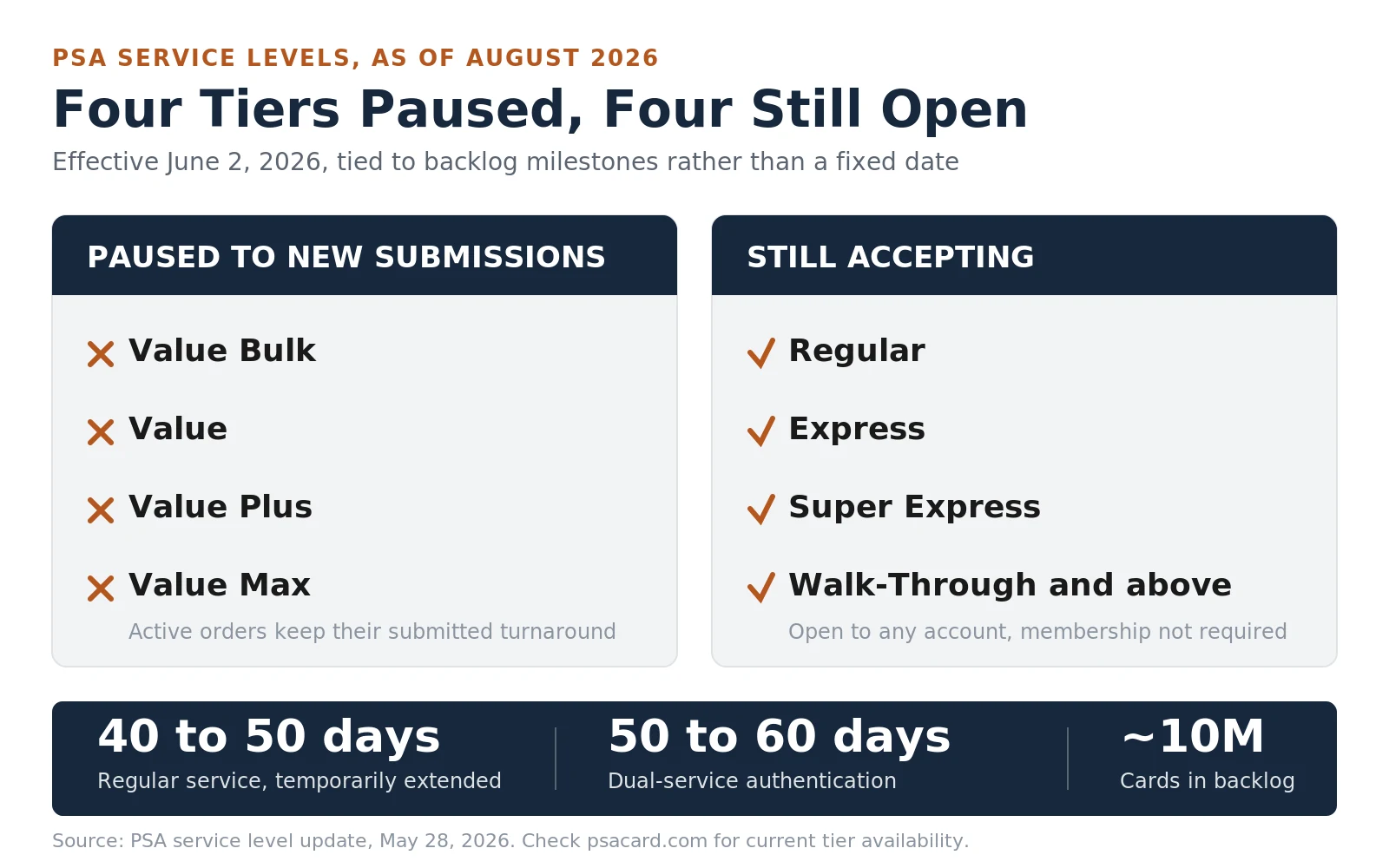
    PSA service tier status as of August 2026 showing four paused Value tiers and four open tiers with turnaround times

    Step 1: Build the submission online first, not last

    Everything downstream depends on the order existing already. You pick a service level, enter each card, and declare a value for each one, then print the confirmation pages.

    Declared value is your estimate of what the item will be worth after PSA grades it, not what you paid. It drives which service level you’re eligible for and it drives the price. Overstating it costs you money on every card. Understating it caps what PSA’s guarantee covers if something goes wrong.

    The submission form order is not a formality either. Your cards have to physically arrive stacked in the sequence the form lists, item #1 on top. Get this wrong and you have created a hand-sorting job for someone in receiving, which is exactly the kind of thing that adds days.

    Step 2: Screen the cards before you pay to grade them

    This step isn’t in PSA’s guide because it isn’t PSA’s job. It’s the one that saves the most money.

    Grading fees are per card and non-refundable regardless of what comes back. A card with a soft corner, a surface scratch under raking light, or a print line you didn’t notice still costs full price to receive a 6. Fifteen minutes with a magnifier and a bright light before you commit is the highest-return work in the whole process.

    Look at four things, because those are the four PSA subgrades: centering, corners, edges, surface. Tilt the card under a single light source and move it. Surface flaws hide until the light rakes across them at a low angle, and they are invisible under flat overhead light.

    Before You Pay to Grade It

    Nikon 10x jewelry triplet loupe pocket magnifier for inspecting trading card surfaces and corners

    Nikon 10x Jewelry Triplet Loupe

    • 10x triplet optic, corrected so a straight print line stays straight instead of bending at the edge of the field
    • 13mm lens with a 25mm focusing distance, close enough to read surface texture rather than just magnify it
    • Folds into its own case, so the glass isn’t collecting grit in a box of supplies
    Check current price on Amazon

    What’s good: a triplet lens is the real dividing line in magnifiers, and this is a genuine one. Cheap doublets and single lenses distort toward the edges, which on a card means you spend a minute deciding whether you’re looking at a print defect or an artifact of the glass. A small field of view is fine here because you’re inspecting one corner at a time anyway.

    What’s not: it costs many times what a basic plastic loupe costs, and for pure corner-and-edge checks a cheap one gets you most of the way. 10x is also more magnification than the job strictly needs. At 10x, every card looks bad, and new submitters routinely talk themselves out of cards that would have graded 9 because the fibers of the cardboard are visible. If you only own one magnifier, something in the 5x to 7x range is easier to calibrate your eye against. This is the buy for someone who already knows what a 9 looks like, not for someone learning.

    Step 3: Sleeve every card, and use clear sleeves

    PSA’s shipping guide is specific: each card goes into a clear penny sleeve, and solid or opaque sleeves cause delays.

    The reason is boring and mechanical. A grader has to see the card without removing it from anything. An opaque back means handling the card an extra time, and every extra handling is both a delay and a risk.

    Skipping the sleeve entirely is worse. Semi-rigid plastic is harder than card stock. Sliding a bare card in and out of a holder puts fine wear into the surface and edges, and surface is one of the four things being graded.

    Required, and Clear Not Opaque

    Ultra Pro clear standard trading card penny sleeves 100 pack for PSA submissions

    Ultra Pro Clear Standard Card Sleeves (100 pk)

    • Fully clear polypropylene, which is what PSA asks for, since opaque sleeves slow processing
    • Acid-free and PVC-free, safe sitting against the card face in long-term storage
    • Fits standard cards up to 2 5/8″ x 3 5/8″, so the sleeved card still drops into a semi-rigid holder
    Check current price on Amazon

    What’s good: it’s the cheapest step in the entire process and it protects the subgrade that’s hardest to recover. Buying the plain clear version sidesteps the opaque-sleeve delay problem without having to think about it.

    What’s not: the real downside of penny sleeves is that they split. They’re thin on purpose, they tear at the seam if you load a card at an angle, and a torn sleeve inside a holder is worse than no sleeve because you won’t see it once the card is in. Buy well past the count you need. Also skip any sleeve with a pull tab for a submission, since PSA lists pull tabs next to tape and sticky notes as things to keep off the holder.

    Step 4: The semi-rigid holder, and the size PSA actually requires

    The stated requirement is a measurement, not a brand. For standard trading cards, PSA’s shipping guide says semi-rigid holders must be 3 5/16″ x 4 7/8″. Both sides of the card have to be fully visible. No toploaders, no tape, no pull tabs, no sticky notes.

    That dimension is the Card Saver 1 spec. Card Saver 2 is a smaller holder and misses it in both directions, which is worth knowing because the naming misleads almost everyone. If you’re deciding between the two, Card Saver 1 vs. 2 covers which one PSA accepts in detail.

    One quirk worth flagging, since it confuses people who click through from PSA’s own guide. The “semi-rigid card holders” link on the shipping guide points to a store URL ending in card-saver-2, but the product on that page is titled Card Saver 1. It’s a leftover slug, not a change in the requirement. Follow the measurement printed on the guide, not the URL.

    Toploaders are the single most common mistake here, and PSA is blunt about the consequence. Submissions arriving in toploaders, hard acrylic cases, or screw-down holders get processing delays, and the cases don’t come back with the order.

    Matches the 3 5/16″ x 4 7/8″ Spec

    Cardboard Gold Card Saver 1 semi-rigid trading card holders 100 count for PSA grading submissions

    Cardboard Gold Card Saver 1 (100 ct)

    • 3 5/16″ x 4 7/8″ including the lip, matching PSA’s stated submission dimension
    • Slightly oversized around the card, so a sleeved card loads without being forced
    • Also takes the larger pre-1957 cards that won’t fit a standard 3″ x 4″ holder
    Check current price on Amazon

    What’s good: it’s the holder PSA and its dealers built their handling around, the 100 count drops the per-card cost to pocket change, and the oversized fit means loading a sleeved card doesn’t take force.

    What’s not: it’s floppy, and anyone coming from toploaders finds that alarming. The lip creases if you’re careless, a creased holder can press a corner, and an unbanded stack lets cards slide back out. It’s also awkward to store, since Card Saver 1s don’t sit in deck boxes or most row boxes. Amazon stock on the 100 count runs thin in stretches, so if a submission has a deadline, order supplies before you build the order rather than after.

    Step 5: Pack it the way PSA’s guide describes

    Nine of the ten steps on PSA’s shipping guide are packing, and the failure modes are all mundane.

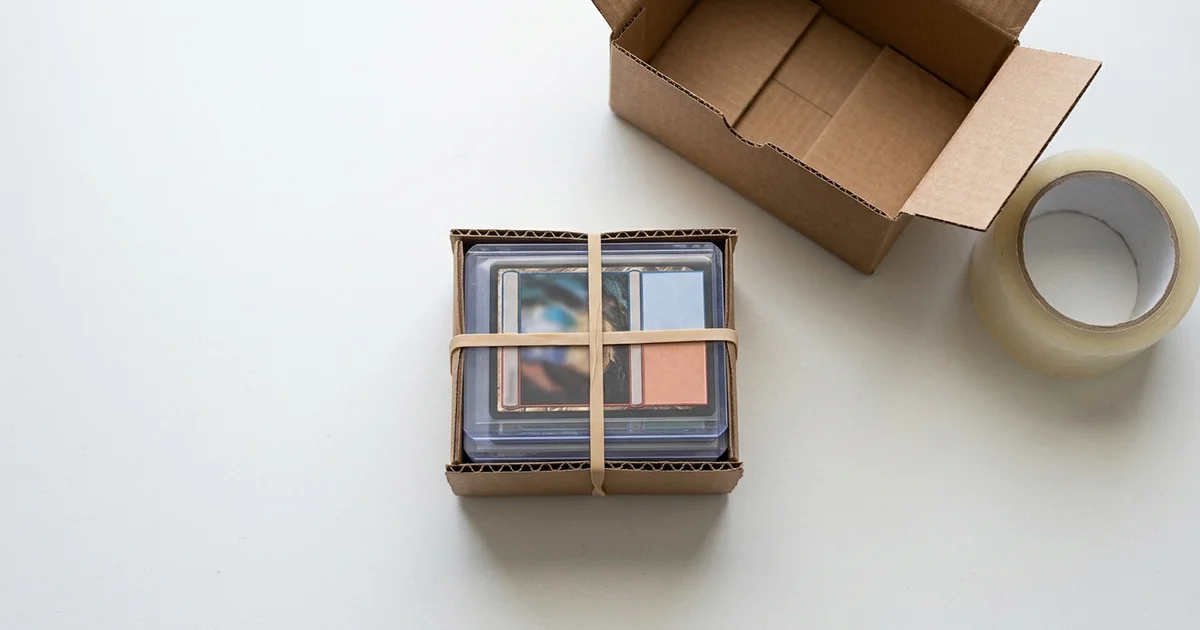
    Stack the holdered cards in submission-form order, item #1 on top. Put that stack between two cardboard dividers slightly larger than the holders. Secure it with two or three rubber bands, tight enough that nothing shifts and loose enough that nothing gets pressed.

    Wrap the bundle and put it in a new shipping box. PSA says new specifically, not a reused one. Fill the empty space so the bundle can’t move in transit. Put the printed submission form inside the box, and if you’re shipping more than one submission, keep each bundled separately.

    Seal every seam with packing tape. Not painter’s tape, not scotch tape, not tape peeled off something else.

    Then the step people skip: attach the tracking label ID from your confirmation page to the outside of the box, with the barcodes fully visible under clear tape or on a sticker label. PSA’s guide says outright that skipping this or applying it wrong can cause order entry and processing delays. Secure the label flat to the box, no label pouches.

    Step 6: Ship to the address that matches your carrier

    PSA uses different addresses for different carriers, and for different kinds of items. Cards go to one of two places.

    USPS goes to CU Receiving, P.O. Box 6180, Newport Beach, CA 92658. UPS, FedEx, and DHL go to CU Receiving, 1600 E. St Andrew Place, Santa Ana, CA 92705. A PO Box will not accept a UPS delivery, which is how packages end up sitting.

    Autographs, tickets, original photographs, and comics all have their own destinations, so check the shipping addresses section against what you’re actually sending rather than reusing an address from a previous order.

    Insure it and use tracking. PSA states plainly that they take responsibility for items once the items are in their possession, and that they are not liable for loss or damage during shipping to them. That gap is yours to cover.

    Is it worth sending cards to PSA right now?

    Depends on two numbers you can actually check, and one you can’t.

    The checkable ones: the grading fee at the service level available to you, and what the card sells for raw versus graded. Look up recent sales for the same card in a PSA 9 and a PSA 10 and compare against raw sales. If the spread doesn’t clear the fee plus shipping both ways with margin, the card isn’t a submission candidate.

    The number you can’t check is the grade you’ll get, and that’s where most of the disappointment lives. A card you’re confident is a 10 comes back a 9 often enough that any plan requiring a 10 to break even is a bad plan. Run the math on a 9.

    Current turnaround makes this sharper than usual. Regular sitting at 40 to 50 days with the Value tiers closed means the cheap slow lane isn’t available, so cards that only penciled out at bulk pricing don’t pencil out at all this month. That’s a real reason to hold a stack rather than force it.

    Common questions

    How much does it cost to send a card to PSA? It’s set by declared value and service level, both of which you choose when building the order. PSA changed pricing in February 2026 and adjusted service levels again in June, so check their current authentication and grading page rather than a figure quoted in an older guide. Add outbound shipping with insurance and the return shipping PSA charges per order.

    Can I still use Value Bulk? Not for new submissions as of June 2, 2026. Value Bulk, Value, Value Plus, and Value Max are paused. Submissions already in the system keep the turnaround they were submitted under.

    Can I send cards in toploaders? No. PSA advises against toploaders, hard acrylic cases, and screw-down holders, and says those submissions get delayed and the cases aren’t returned. Use a semi-rigid holder at the stated dimension.

    Do I need a Collectors Club membership? Only for the member-exclusive tiers. Regular and above are open to anyone with an account. Memberships that were active on May 14, 2026 are being extended free for the length of the Value Bulk pause.

    How many cards can go in one submission? Service levels set their own minimums and maximums, and bulk tiers carry the higher minimums. Since the bulk tiers are paused, plan around the open levels instead.

    What I’d actually do this month

    Buy Card Saver 1s and clear penny sleeves, because those are required and cheap. Screen the cards hard before committing, since fees don’t care what grade comes back.

    Then look at the calendar honestly. With Regular at 40 to 50 days and the Value tiers closed, this is a good month to build the pile and a bad month to rush it out the door. PSA is publishing the backlog number monthly on its own site, so the reopening is something you can watch rather than guess at.

    The one thing not worth waiting on is supplies. Holder stock is the part that goes thin without warning.

    Related guides


  • Card Saver 1 vs. 2: Which One PSA Actually Accepts
    Card Saver 1 vs. 2: Which One PSA Actually Accepts
    As an Amazon Associate we earn from qualifying purchases. This post contains affiliate links, and we may earn a commission at no extra cost to you.

    If the card is going to PSA, buy Card Saver 1. That’s the whole answer, and the rest of this post is why the question keeps getting asked anyway.

    The confusion comes from the name. A “2” sounds like a newer, better version of a “1,” the way it works with every other product on earth. It isn’t. The number is a size code, and Card Saver 2 is the smaller one.

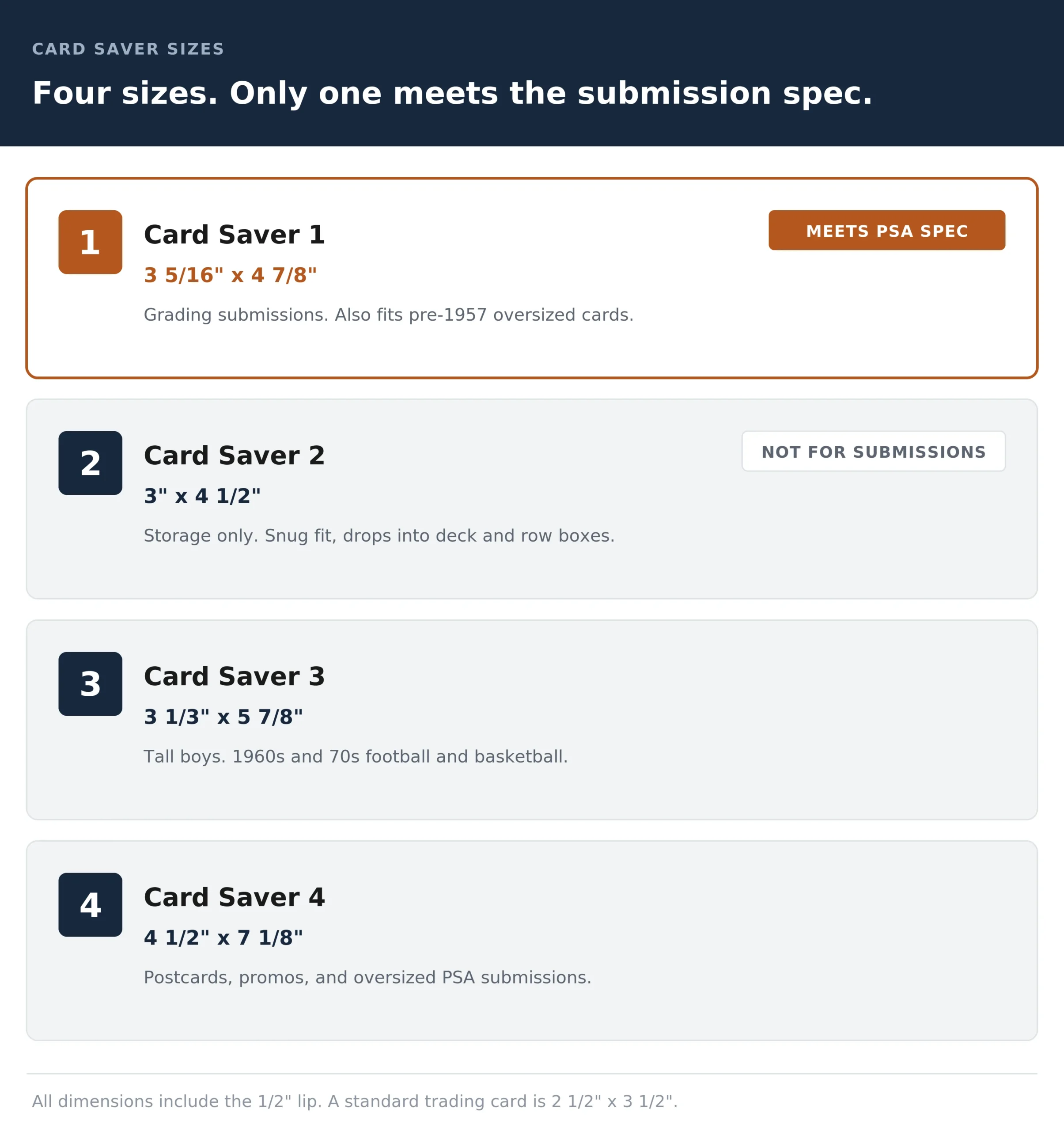
    Card Saver 1, 2, 3 and 4 size comparison showing which semi-rigid holder meets the PSA submission spec

    The size difference is the entire story

    Card Saver 1 measures 3 5/16″ by 4 7/8″, lip included. Card Saver 2 measures 3″ by 4″ plus a 1/2″ lip, so about 3″ by 4 1/2″ overall.

    That’s roughly 5/16″ narrower and 3/8″ shorter. Sounds like nothing. It decides everything.

    A standard trading card is 2 1/2″ by 3 1/2″. Both holders fit it. But Card Saver 1 is deliberately oversized around that card, which leaves room for a sleeved card to slide in and out under thumb pressure. Card Saver 2 is cut close, so the fit is snug and the card stays put.

    Neither one is a defect. They’re solving opposite problems. One is built for a grader pulling hundreds of cards a shift, the other is built for a collector who wants a card to stay where it was put.

    Which card saver does PSA recommend?

    Card Saver 1, and PSA is specific enough about it that there’s no room to argue.

    PSA’s shipping guide states the requirement as a measurement rather than a brand name: for standard trading cards, semi-rigid holders must be 3 5/16″ x 4 7/8″. That is the Card Saver 1 spec to the sixteenth of an inch. Card Saver 2 misses it in both directions.

    Cardboard Gold, the company that actually makes these, says the same thing from the other side. Their own product page for Card Saver 2 states plainly that it is not for grading company submissions. When the manufacturer tells you their product is wrong for a job, believe them.

    Two more rules from that same PSA page that cost people time every week. Do not use pull tabs, tape, or sticky notes on the holder. And use clear penny sleeves, not solid or opaque ones, because those slow processing down.

    Toploaders are off the table completely, which is a separate argument worth understanding on its own. Card savers and toploaders do different jobs, and picking between those two matters more than picking between Card Saver 1 and 2.

    For PSA, BGS, and SGC Submissions

    Cardboard Gold Card Saver 1 semi-rigid trading card holders, 100 count

    Cardboard Gold Card Saver 1 (100 ct)

    • 3 5/16″ x 4 7/8″ including the 1/2″ lip, matching PSA’s stated submission dimension exactly
    • 9 mil acid-free polypropylene, slightly oversized so a sleeved card loads without forcing
    • Also fits the larger pre-1957 cards that won’t go into a standard 3″ x 4″ holder
    Check current price on Amazon

    What’s good: it’s the holder every major grader built their handling process around, the 100 count brings the per-unit cost down to almost nothing, and acid-free polypropylene won’t yellow or leach the way old vinyl pages did.

    What’s not: it’s floppy, and people who’ve only handled toploaders are always surprised by how floppy. The lip creases if you’re rough with it, a bent holder can press on a corner, and an unbanded stack will let cards slide right back out. It’s also too big for a lot of storage. Card Saver 1s don’t sit neatly in deck boxes or most row boxes, which is exactly the problem Card Saver 2 exists to solve.

    When Card Saver 2 is actually the right call

    There’s a real use case here, and it gets buried under all the PSA talk.

    Card Saver 2 fits storage containers that Card Saver 1 doesn’t. Deck boxes, smaller row boxes, anything sized around the 3″ by 4″ footprint that toploaders also use. If you’re organizing a working collection rather than prepping a submission, the smaller holder drops into more places.

    The snug fit is the other half of it. Thin-stock cards, junk wax era commons, anything that rattles in an oversized holder sits tighter in a Card Saver 2. A card that doesn’t move is a card that isn’t slowly rounding its own corners.

    So the honest split: Card Saver 1 for anything leaving your house, Card Saver 2 for cards staying home in a box that Card Saver 1 won’t fit.

    For Standard-Card Storage

    Cardboard Gold Card Saver 2 semi-rigid card holders for standard size trading cards, 200 count

    Cardboard Gold Card Saver 2 (200 ct)

    • 3″ x 4″ plus a 1/2″ lip, sized to drop into deck boxes and standard row boxes
    • Snug fit that holds thin-stock and vintage commons still instead of letting them shift
    • The same semi-rigid material as Card Saver 1, in production since 1989
    Check current price on Amazon

    What’s good: it solves a storage-fit problem that no toploader and no Card Saver 1 solves, and the semi-rigid material still means you’re not prying a card out of hard plastic every time you want to look at it.

    What’s not: two real problems. It’s useless for the thing most people are buying a card saver for in the first place, so if you buy it by mistake you’re buying twice. And Amazon stock on Card Saver 2 is genuinely unreliable. Several listings sit unavailable for stretches and the ones that are live tend to be backordered, so check availability before you plan around it. Card Saver 1 is stocked far more consistently.

    What about Card Saver 3 and 4?

    Both exist, both are size codes, neither is an upgrade.

    Card Saver 3 runs 3 1/3″ by 5 7/8″ and exists for tall boys. Vintage football and basketball from the 60s and 70s, Gameboy cards, anything taller than a modern card.

    Card Saver 4 is the big one at 4 1/2″ by 7 1/8″, holding items up to 4″ by 6″. Promo cards, postcards, and per PSA’s own guidelines, larger or thicker submissions that a Card Saver 1 can’t take.

    If you own standard modern cards, you will never need either. Buy them when you have a specific card that doesn’t fit, not before.

    Don’t skip the sleeve underneath

    The holder is only half of what PSA asks for. The card goes into a clear penny sleeve first, then the sleeved card goes into the semi-rigid holder.

    Skipping it is the most common submission mistake there is. Semi-rigid plastic is still harder than card stock, and sliding a bare card in and out grinds microscopic wear into the surface and edges. Surface is one of four subgrades. That wear is worth real money on a card that would otherwise grade clean.

    Load the card into the sleeve, then the sleeve into the holder. Never try to feed a card into a sleeve that’s already sitting inside the holder.

    The Layer Underneath

    Ultra Pro ultra clear soft penny sleeves for standard size trading cards, 100 count

    Ultra Pro Soft Card Sleeves, Clear (100 ct)

    • Fully clear, which is what PSA asks for, since opaque sleeves cause processing delays
    • Acid-free and PVC-free polypropylene, safe for long-term storage against the card face
    • 2 5/8″ x 3 5/8″, sized to take a standard card and still fit inside a semi-rigid holder
    Check current price on Amazon

    What’s good: it’s the cheapest insurance in the hobby by a wide margin, and buying the plain clear version sidesteps the opaque-sleeve delay problem entirely.

    What’s not: penny sleeves tear. They’re thin by design, they split at the seam if you load a card at an angle, and a torn sleeve inside a holder is worse than no sleeve because you won’t see it. Buy more than you think you need and throw out the damaged ones. Also skip any sleeve with a pull tab for submissions, since PSA lists pull tabs alongside tape and sticky notes as things to keep off the holder.

    What I’d actually buy

    One box of Card Saver 1 in the 100 count, and a stack of clear penny sleeves. That covers grading submissions and it covers most storage well enough that nothing else is urgent.

    Add Card Saver 2 only after you’ve hit the specific wall it fixes, which is a storage box that Card Saver 1 won’t sit in. Add 3 or 4 only when a card physically doesn’t fit anything else.

    The mistake worth avoiding is assuming the higher number is the better product. Card Saver 2 is smaller, not newer, and sending one to PSA gets your submission handled slower for no reason at all.

    Related guides

  • Card Saver vs. Toploader: Which One Your Card Should Actually Be In

    Card Saver vs. Toploader: Which One Your Card Should Actually Be In

    As an Amazon Associate we earn from qualifying purchases. This post contains affiliate links, and we may earn a commission at no extra cost to you.

    Most of the argument online treats these as rivals. They aren’t. A card saver is a submission tool and a toploader is a storage tool, and once you sort out which job you’re doing, the answer stops being a debate and starts being obvious.

    The confusion is understandable. They’re both flat plastic sleeves that cost pennies, they sit next to each other on the same shelf at the card shop, and both of them will technically hold a card. But put a card in the wrong one and you either delay a grading submission by weeks or leave a card rattling loose in a box for three years.

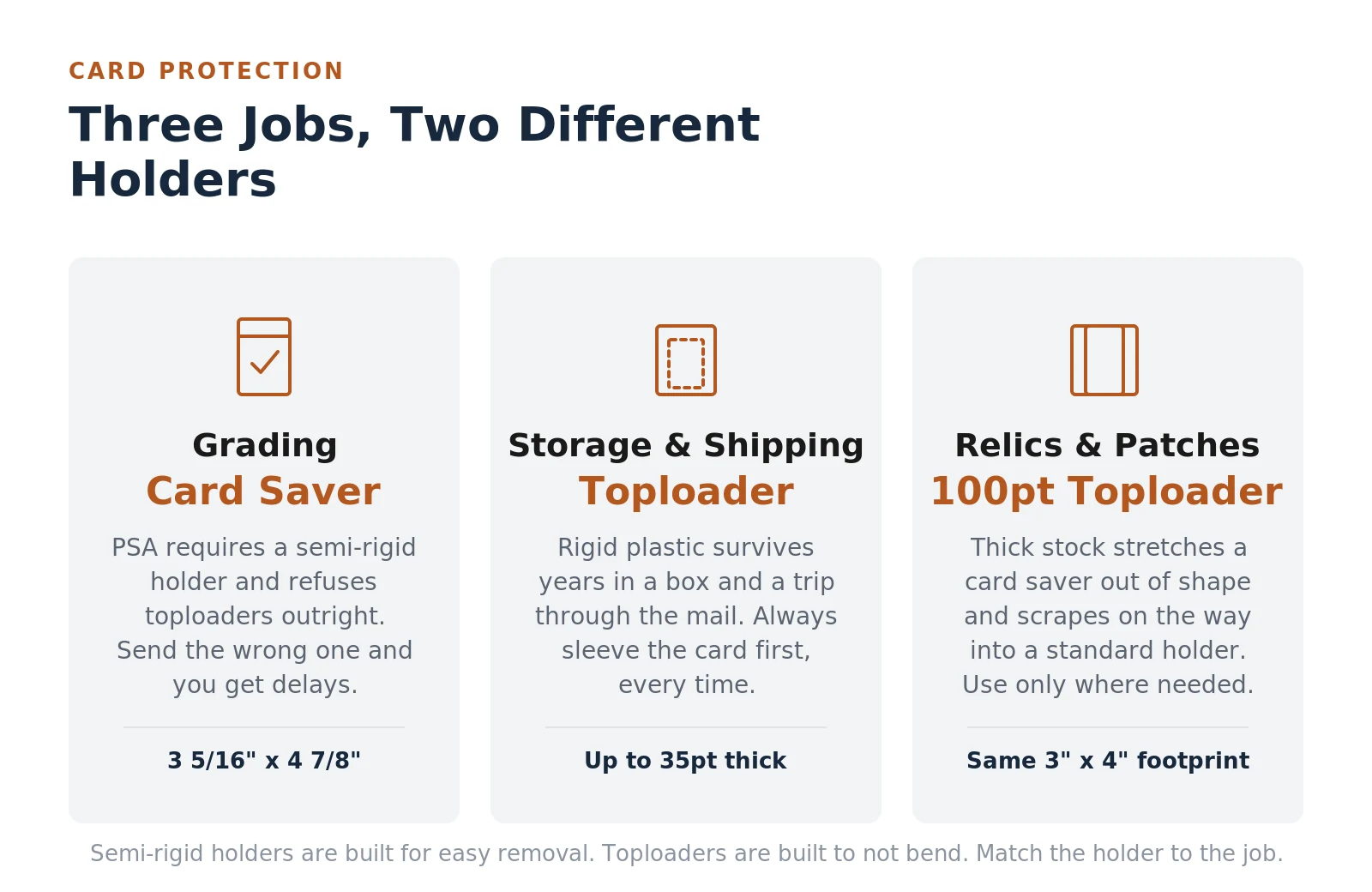
    Card saver vs toploader: which holder to use for grading submissions, storage and shipping, and thick relic or patch cards

    What they actually do differently

    A toploader is rigid. Hard PVC, closed on three sides, and it does not flex. Drop a boxed toploader on a hard floor and the card inside is fine. That rigidity is the entire point of the product.

    A card saver is semi-rigid on purpose. It’s thin polypropylene with a half-inch lip at the opening, and it bends. You can flex one between two fingers without any effort at all. That sounds like a downside until you understand who it’s built for: a grader who has to slide hundreds of cards out of holders per shift without touching the card surface. A rigid holder means prying. A semi-rigid one means the card walks out under thumb pressure.

    Card Saver 1s run 3 5/16″ by 4 7/8″, noticeably taller than the 3″ by 4″ of a standard toploader. That extra length is what gives you the lip to grab.

    If you’re submitting for grading, this isn’t a choice

    PSA’s shipping guide is unambiguous. Sleeve each card in a clear penny sleeve, slide it into a semi-rigid holder, and do not use toploaders. They also spell out the dimension: semi-rigid holders for standard trading cards have to be 3 5/16″ x 4 7/8″, which is the Card Saver 1 spec exactly.

    Send toploaders anyway and two things happen. Your submission gets pulled aside and processed slower, and the toploaders don’t come back. You’ve paid for grading and thrown away a stack of holders to make a point nobody asked you to make.

    There’s a practical reason underneath the policy, not just a preference. Graders handle enormous volume, and every card that has to be worked out of a stiff holder is a chance to touch a corner or scrape a surface. A card that slides out cleanly is a card that keeps its grade. The rule protects your card more than it protects PSA.

    Beckett and SGC land in the same place for the same reason. If your card is going anywhere for grading, the holder question is already settled.

    For Grading Submissions

    Cardboard Gold Card Saver 1 semi-rigid card holders, 100 count

    Cardboard Gold Card Saver 1 (100 ct)

    • 3 5/16″ x 4 7/8″ with a 1/2″ lip, matching PSA’s stated submission dimension
    • Acid-free semi-rigid polypropylene, slightly oversized for clean insertion and removal
    • Fits the larger pre-1957 cards that won’t go into a standard 3″ x 4″ holder
    Check current price on Amazon

    What’s good: it’s the holder the grading companies designed their process around, it’s cheap per unit at 100 count, and the acid-free polypropylene won’t yellow or leach onto a card the way old vinyl pages did.

    What’s not: these are genuinely flimsy, and that’s not a manufacturing complaint, it’s the design. The lip creases if you’re careless, a bent card saver can put pressure on a corner, and a card will slide right back out if the stack isn’t banded properly. They’re also a poor fit for anything thick. Try a jersey patch card in one and you’ll stretch the holder permanently. Treat them as a consumable for submissions, not as storage.

    For everything that isn’t a submission, use a toploader

    Here’s where most collectors get it backwards. They buy card savers because PSA uses them, decide card savers must therefore be the better holder, and store their whole collection in bendy plastic.

    A card sitting in a box for years needs the opposite of easy removal. It needs rigidity, corner protection, and something that survives being shuffled through by hand a hundred times. That’s a toploader, and it isn’t close.

    Shipping is the same story. A card saver inside a bubble mailer is one careless sorting machine away from a bent corner. A toploader (sleeved card inside, taped at the top, sandwiched between two pieces of cardboard) is what actually arrives intact. The only exception is a card going to a grader, where you follow their rules instead.

    For Storage and Shipping

    Ultra Pro 3x4 regular toploaders bundled with soft penny sleeves, 100 pack

    Ultra Pro Regular Toploaders + Penny Sleeves (100 pk)

    • Rigid 3″ x 4″ holders for standard 2.5″ x 3.5″ cards up to 35pt thick
    • Comes with the soft inner sleeves, so you’re not buying the second half separately
    • Ultra Pro has been making these since 1952, and the tolerances are consistent pack to pack
    Check current price on Amazon

    What’s good: buying the toploaders and sleeves together removes the most common mistake in card storage, which is skipping the sleeve. The 35pt rating covers the overwhelming majority of modern base and insert cards.

    What’s not: 35pt is a real ceiling, and thick cards will not go in no matter how much you want them to. Forcing one scrapes the card edge on the way in, which is exactly the damage you bought the holder to prevent. The clear plastic also scuffs over years of handling, so a toploader you’ve pulled in and out of a box since 2019 looks it. They’re cheap for a reason. Replace them rather than babying them.

    The thick card problem, which is where people actually get burned

    Relic cards, patch autos, thick-stock inserts, anything with a swatch or a chunk of bat in it. These blow past 35pt fast, and both a standard toploader and a card saver are the wrong tool.

    The card saver stretches out and stops holding its shape. The regular toploader either won’t accept the card or scrapes it going in. You need a thicker toploader rated for the stock, and this is one of the few places where buying the specific product genuinely matters instead of making do.

    For Relics, Patches, and Thick Stock

    Ultra Pro 3x4 super thick 100pt toploaders, 25 count

    Ultra Pro Super Thick 100PT Toploaders (25 ct)

    • Rated to 100pt, which covers most relic, patch, and thick-stock cards
    • Same 3″ x 4″ outer footprint, so it still fits standard storage boxes and rows
    • Rigid enough to protect a heavy card that a semi-rigid holder can’t support
    Check current price on Amazon

    What’s good: it solves a problem nothing else on this list solves, and it does it without changing the outer dimensions, so your box organization stays intact.

    What’s not: put a normal 20pt card in one and it rattles. Loose movement inside a holder is its own slow damage, especially at the corners, and it defeats the purpose entirely. These are single-purpose. Buy a small count, use them only for cards that need them, and don’t let them become your default because they feel sturdier.

    The sleeve underneath matters more than the holder

    The most common storage mistake isn’t picking the wrong holder. It’s putting a bare card directly into plastic.

    Toploader plastic is harder than card stock. Sliding a raw card in and out grinds microscopic wear into the surface and edges, and after enough repetitions that’s a visible difference on a grading scale where surface is one of four subgrades. A penny sleeve costs a fraction of a cent and eliminates the problem completely.

    Two details worth getting right. Use clear sleeves, not colored or opaque ones, since PSA calls those out as a source of processing delays. And load the card into the sleeve, then load the sleeved card into the holder. Never try to slide a card into a sleeve that’s already inside a toploader.

    What I’d actually buy

    If you’re grading, buy card savers. Not because they’re better holders, but because they’re the required ones, and the requirement exists for a reason that benefits your card.

    If you’re storing or shipping, buy toploaders with sleeves included and stop thinking about it. Add a small pack of 100pt toploaders for the handful of thick cards in your collection, which is probably fewer than you think.

    The wrong move is picking one and using it for everything. That’s how a submission gets delayed and a shoebox of cards develops soft corners at the same time.

    Once the holder is sorted, the next thing that quietly ruins cards is the air around them. Humidity works differently on cards than it does on jerseys, and a sealed storage box needs a completely different approach than a hanging display.

    Related guides