
As an Amazon Associate we earn from qualifying purchases. This post contains affiliate links, and we may earn a commission at no extra cost to you.
Search for a hand-signed Endgame poster and you’ll get two very different things on the same results page, priced about twenty times apart, described with almost identical words.
One is a piece of paper that Robert Downey Jr. actually touched. The other is a photograph of that piece of paper. Both listings will say “signed.” Only one of them is telling you the whole story, and the cheap one is not automatically the dishonest one.
The ten-second test that settles it
Before anything else, look at the price. A genuine Endgame poster carrying multiple principal-cast signatures with third-party authentication generally starts around $200 and runs past $950 depending on who signed it and how many of them there are. SWAU’s auction listing for a 27×40 signed by Downey, Hemsworth, Pratt, Brolin, Boseman and others sits in that upper band. Single-signature authenticated pieces land lower, but they don’t land at forty bucks.
So if a framed poster shows eight Avengers signatures and costs less than a nice dinner out, the math has already answered your question. Eight A-list actors did not sit down and sign a thousand identical posters for a seller to move at gift-shop pricing.
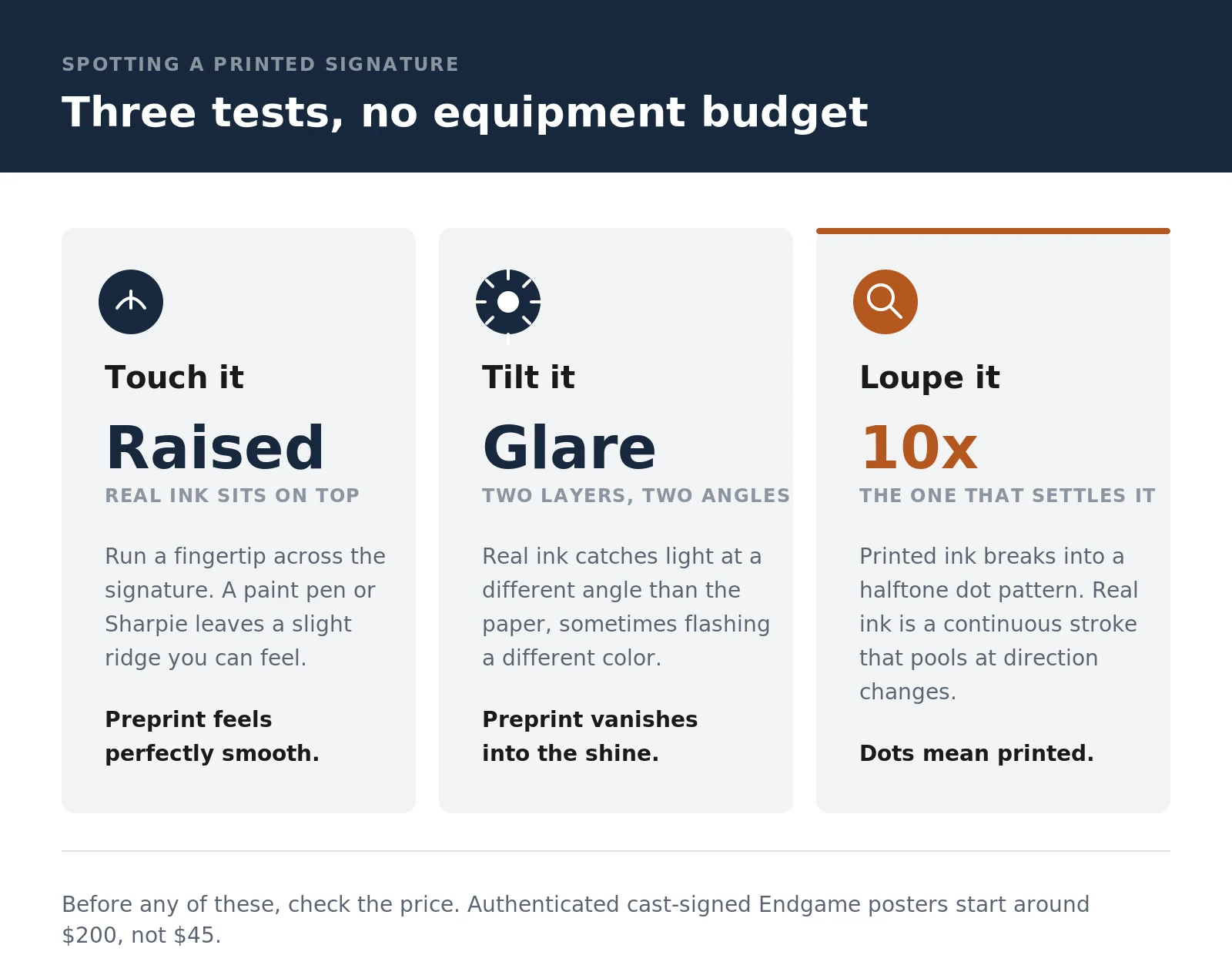
That’s the shortcut. If you already own the thing, or you want to check something before you buy it in person, there are three physical tests worth running.
Touch it. Real ink from a paint pen or Sharpie sits on top of the surface and you can feel it, a slight raised edge under a fingertip. A printed signature is perfectly smooth because it’s part of the image.
Tilt it under a light. A real signature and the printed poster underneath it reflect light differently. Tilt the piece and the ink will catch the light at a different angle than the paper, sometimes flashing a slightly different color. A preprint disappears into the glare uniformly, because it’s the same layer of ink as everything else on the sheet.
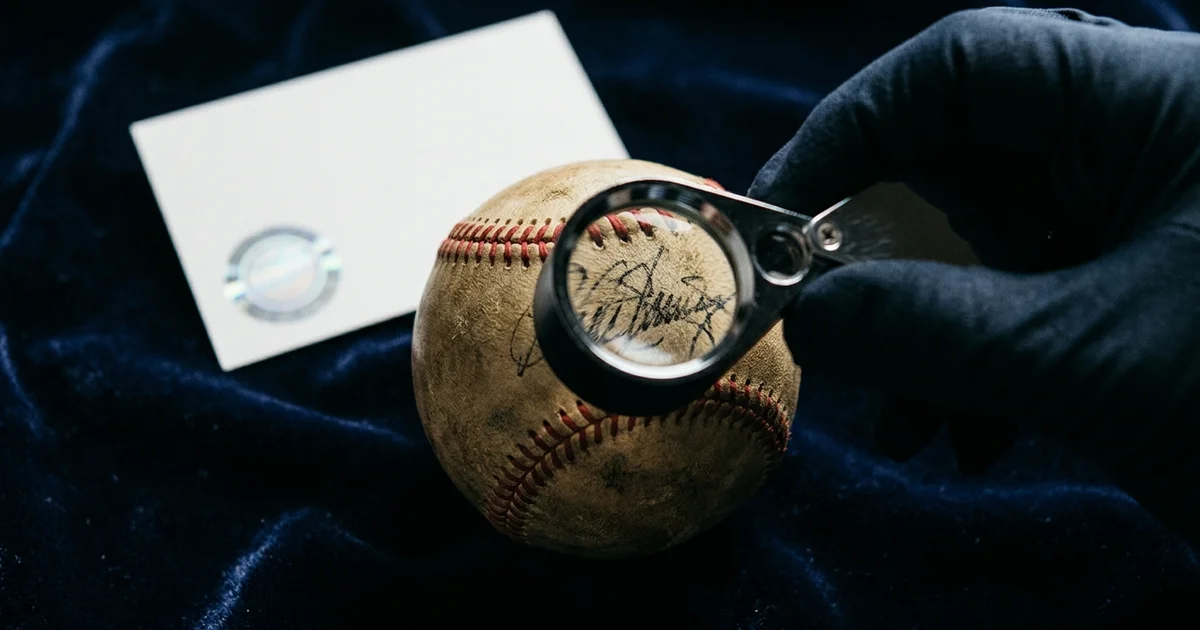
Put a loupe on it. This is the one that ends the argument. Under 10x magnification a printed signature breaks into the same halftone dot pattern as the rest of the poster. Real ink is a continuous stroke with visible pooling where the pen slowed down or changed direction. Same technique that works on a forged signature on a baseball card, and it works here for the same reason.
What the $45 Avengers poster actually is
The widely sold version is a framed print from HWC Trading, a 16 x 12 inch piece in a black polycarbonate frame with a matte mount. Its own listing is refreshingly blunt about what it is, describing itself as “just like the real thing but without the cost” and an “authentic-looking display.” That’s a reproduction. The signatures are part of the printed image.
Nothing about that is a scam. The seller says what it is in their own product bullets. The problem is that the search term people type is “hand signed,” the listing title includes the words “signed autograph,” and a shopper skimming on a phone can absolutely walk away believing they bought an autograph.
Best as wall art, not memorabilia

HWC Trading Avengers Endgame 16 x 12 Framed Printed Signature Poster
- Signatures are part of the printed image, not real autographs
- Arrives framed in black polycarbonate with a matte mount, ready to hang
- 16 x 12 inches, sized for a desk shelf or a gallery wall gap
- No collectible or resale value, buy it for the wall and nothing else
Who this is right for: someone who wants an Endgame piece on a wall. A kid’s room, a home theater, a dorm, an office. It arrives framed and ready to hang, which is worth more than people give it credit for, since custom framing a 16 x 12 print alone typically costs more than this entire item.
What’s not: it has zero collectible value and it always will. It will never appraise, never authenticate, and never resell for meaningfully more than you paid. The frame is polycarbonate rather than glass, which is fine for durability and bad if you were hoping for UV protection on a print you plan to keep in a sunny room for a decade. And the “signed autograph” language in the title does real work confusing people, which is the whole reason this post exists.
Buy it as decor and it’s a fair deal. Buy it as memorabilia and you’ve bought a poster.
What a real one costs, and what makes the price move
Authenticated Endgame material spans a wide range, and the spread is driven by four things.
Who signed it. Downey Jr. carries the most weight, followed by Evans and Hemsworth. Chadwick Boseman’s signature appreciated sharply after his death and now pulls a premium on any piece that carries it.
How many signed it. A full principal-cast poster is a different asset from a single-signature piece. Coordinating that many actors on one sheet usually means it came from a premiere, a licensed signing event, or a charity lot, and those origins carry their own documentation.
Who authenticated it. PSA/DNA, JSA, Beckett, and SWAU are the names that move the number. A certificate printed by the seller who sold you the item is not third-party authentication, no matter how official the seal looks. If the COA and the invoice come from the same company, it’s a receipt.
What the poster itself is. A signature on an original theatrical one-sheet is worth more than the same signature on a modern reprint. Counterfeiters routinely pair a forged signature with a cheap reprint, so you’re really authenticating two things at once, the ink and the paper.
The listing pattern that should stop you cold
Here’s the one habit worth building if you ever shop for signed movie posters seriously.
Search the exact item and look at how many identical copies exist. If a dozen sellers are offering the same poster with the same signatures in the same positions, you’re looking at a print run. Real signed material is one-of-one by definition, because the actor’s hand moved differently every single time. Two genuinely signed posters never match.
That single check catches more bad listings than any amount of squinting at signature shapes.
The honest recommendation
If you want an Avengers: Endgame poster on your wall for gift money, the printed version does that job and does it framed. Just call it what it is.
If you want memorabilia, budget two hundred dollars minimum, buy from a dealer who lets a third party vouch for the piece, and be more suspicious of a COA than you are of the signature.
The gap between those two purchases isn’t quality. It’s category. Confusing them is how people end up disappointed years later when they find out what they own.