As an Amazon Associate we earn from qualifying purchases. This post contains affiliate links, and we may earn a commission at no extra cost to you.
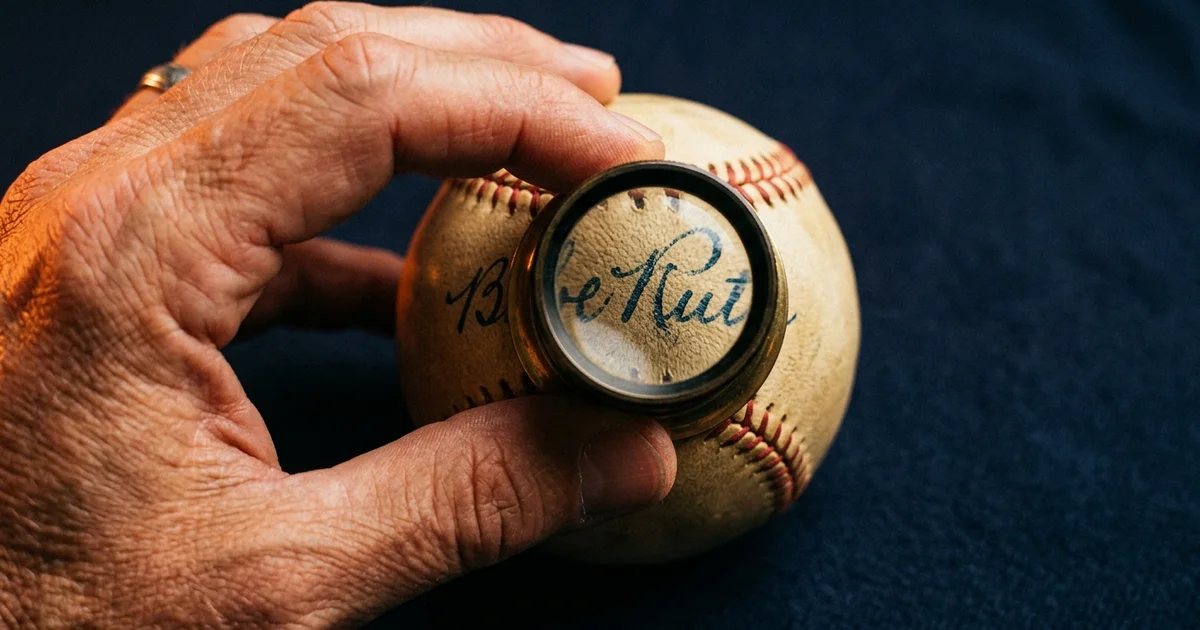
Most collectors own a jeweler’s loupe for something else entirely: checking a diamond, reading a hallmark, squinting at a coin. Turn that same 10x lens on a signature and it does something the naked eye can’t. It shows you the ink itself, not just the shape of the name.
That distinction matters more than any “does the signature look right” comparison you’ll find online. A skilled forger can copy a shape. Copying how ink actually sits on paper is a different problem.
The magnification you actually need
A standard 10x loupe is enough. You don’t need a lab microscope, and a lot of guides overstate this. 10x gets you close enough to see ink texture and stroke edges clearly, while still letting you move the lens across a full signature without losing your place.
Go higher, 20x or 30x, and you’re often too zoomed in to read the stroke as a whole. You end up examining a single fiber of paper instead of the signature. Stick with 10x unless you’re chasing one specific detail a first pass already flagged.
Good light matters as much as magnification. Raking light, angled low across the surface instead of straight down, throws shadows that make texture and raised ink stand out. A loupe under flat overhead light will miss things the same loupe under a raking desk lamp catches easily.
What to look for in the ink
This is where the loupe earns its keep. Under 10x, ink stops being a flat line and becomes a physical thing with texture.
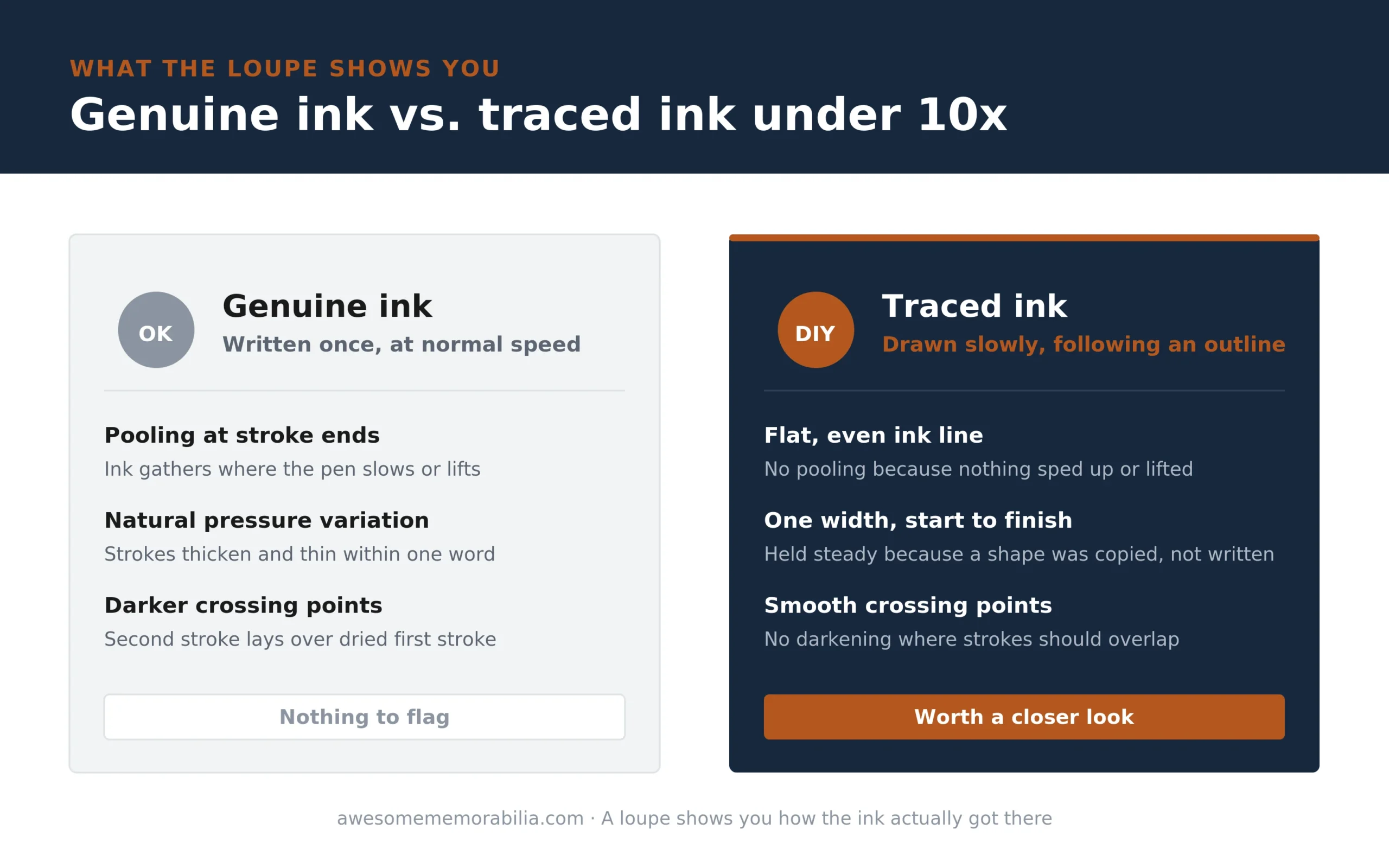
- Pooling at stroke ends. A real signature, written at normal speed with a normal pen, leaves small pools of ink where the pen slows down or lifts, usually at the end of a letter or a flourish. Traced or slowly-drawn forgeries often lack this because the forger is drawing carefully rather than writing naturally, so the ink lays down evenly instead of pooling.
- Consistent pressure variation. Genuine handwriting speeds up and slows down within a single word. That shows up under the loupe as strokes that thicken and thin naturally. A traced signature tends to hold one width for too long, because the forger is following an outline instead of writing.
- A single, unbroken layer of ink. One pen, one pass, one layer. If part of a letter looks like it has a second coat of ink sitting slightly off from the first, something was added or retouched after the fact.
Crossing points: the most reliable single tell
If you learn to check one thing with a loupe, make it this. Most signatures have at least one spot where a stroke crosses over another stroke, the cross of a “t,” the loop of an “l” overlapping a neighboring letter, a flourish that doubles back on itself.
At a crossing point, ink from the second stroke lays down on top of ink that’s already dry from the first. Under 10x, that shows up as a slightly darker, denser spot where the two layers overlap. It’s genuinely hard to fake, because a forger tracing a signature usually lifts the pen or slows down at exactly the point a real signer wouldn’t have thought twice about.
No darkening at a crossing point, or a crossing point that looks suspiciously smooth and even, is worth a second look. It doesn’t prove anything by itself. It’s one data point, and a strong one.
Loupe vs. magnifying glass
A magnifying glass is fine for reading small print. It’s a weaker tool for this specific job. Most magnifying glasses run 2x to 4x, which is enough to see a shape more clearly but not enough to resolve ink texture or catch a crossing point cleanly.
A loupe also forces you close to the surface, usually an inch or less, which cuts glare and stray light that a magnifying glass held at arm’s length lets in. That closeness is part of why jewelers use loupes instead of magnifying glasses for anything that requires real detail.
If you don’t have one yet, get a true optical triplet rather than the cheap single-lens loupes sold as “10x” that blur badly toward the edges. The Nikon below is a straightforward pick.
Good: genuine achromatic triplet glass, folds into a metal case that survives a bag or pocket, and the Nikon name means it’ll still be sharp in ten years.
Not great: no built-in light, so you’ll still want that raking desk lamp for the ink work above. It also costs more than the LED-and-UV loupes that show up first in most searches, which are built for gemstones and add lighting you don’t need here.
Recommended Loupe

Nikon 10x Jewelry Triplet Loupe
- True 10x achromatic triplet lens, 13mm diameter
- Folds into a protective metal case for a pocket or kit
- No built-in light. Pair it with a raking desk lamp for the ink and stroke detail this guide covers
If you already own a loupe for grading or hallmark work, it’ll do this job too. No need to buy a second one.
What a loupe can’t tell you
A loupe shows you technique. It doesn’t identify a signer. Even a textbook-perfect crossing point and natural pooling only tell you the signature was likely written at normal speed by a real hand, not whose hand it was.
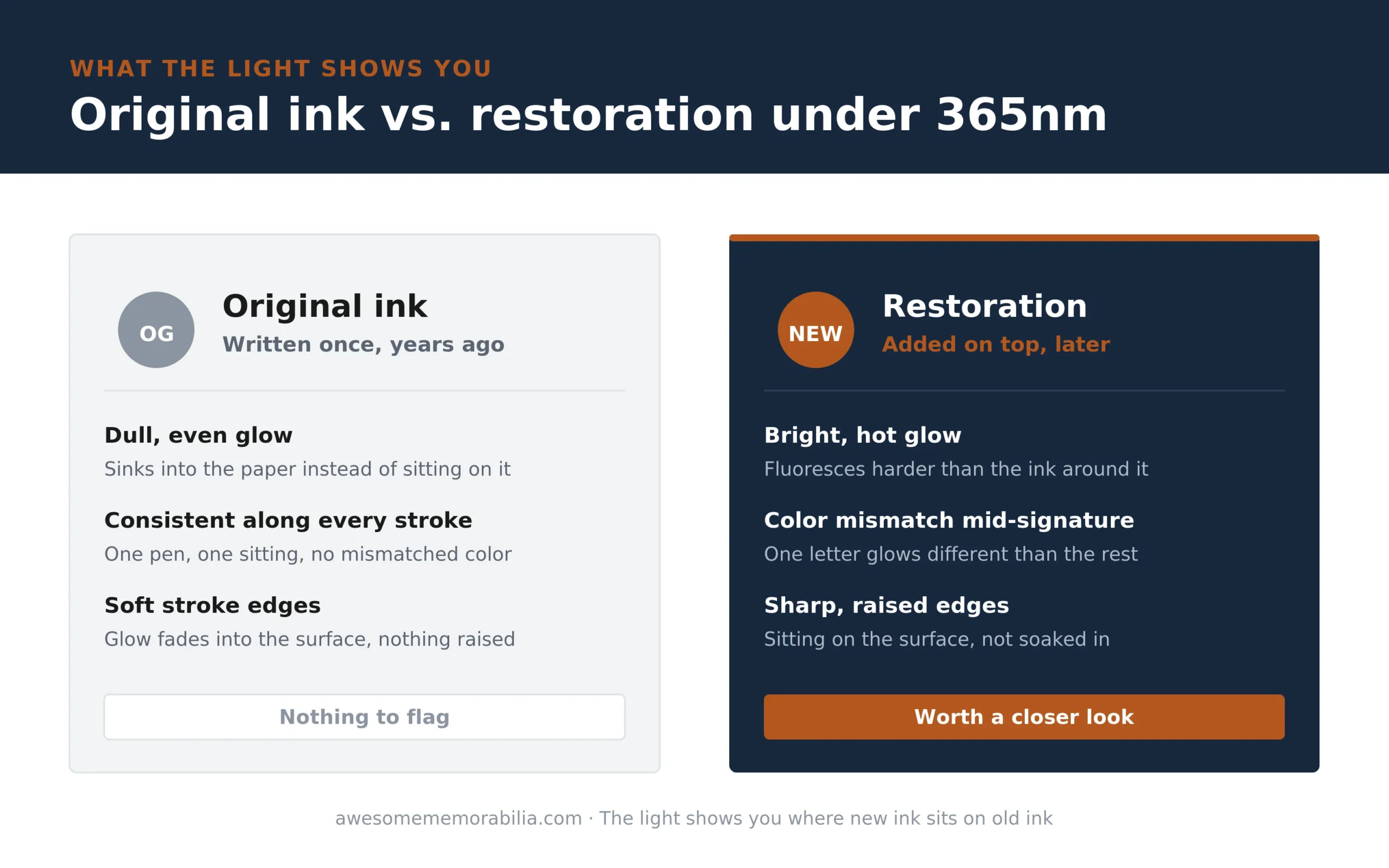
Pair what you see under the loupe with a known exemplar of the signer’s autograph, and treat anything genuinely valuable the same way you’d treat a card under UV light: as a first filter, not a final verdict. When real money is on the line, get a reputable third-party opinion.
Related guides
- Best UV Flashlight for Spotting Fake Autographs and Card Restoration
- Reading a UV Light Result: Original Ink vs. Restoration