
As an Amazon Associate we earn from qualifying purchases. This post contains affiliate links, and we may earn a commission at no extra cost to you.
Collectors ask “what humidity should I keep my collection at” like it’s one number for everything. It isn’t. A signed jersey and a signed card fail in different ways when moisture gets involved, so the fix for one is close to the opposite of the fix for the other.
Get this backwards and you can do real damage. Sealing a jersey in plastic the way you’d seal a card in a toploader is one of the more common mistakes we see, and it’s the kind of mistake that shows up as mildew a year later, not immediately.
Why humidity matters at all
Moisture is the thing that turns a stable collectible into a slowly deteriorating one. Too much humidity and you get mold, mildew, and fabric or paper that stays damp long enough to weaken. Too little and materials dry out, fabric gets brittle, adhesive on some cards can crack. Most guidance lands on 40-50% relative humidity as the target range, and that part is genuinely the same for both jerseys and cards.
Where it splits is what you do to hold that range.
Jerseys need airflow, not a seal
Fabric traps moisture against itself. Fold a jersey and seal it in plastic, even good plastic, and any humidity already in the fabric has nowhere to go. That’s how you get a musty smell or a mildew spot on a piece that was fine when you packed it away.
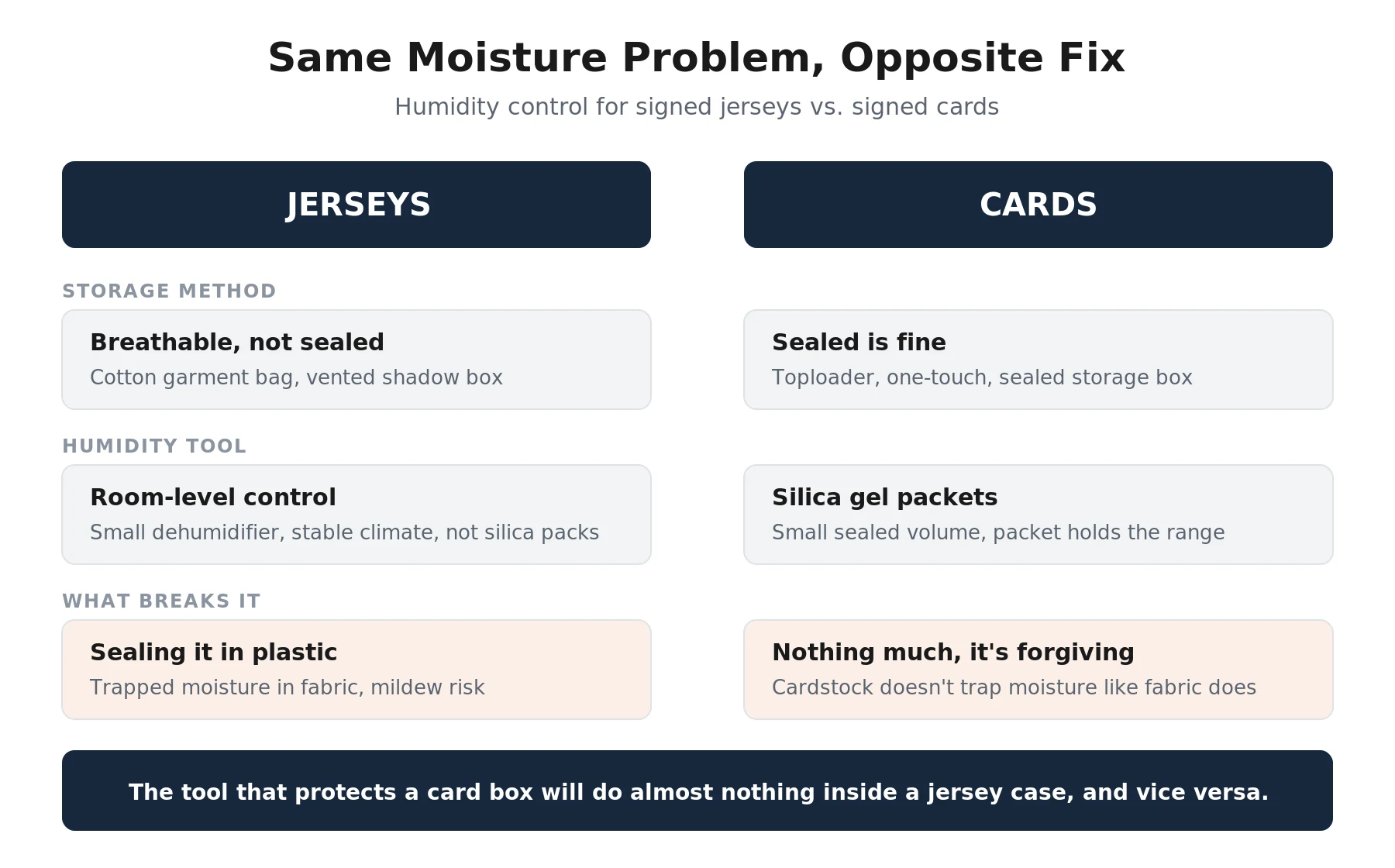
The fix is a breathable environment, not a sealed one. A cotton garment bag over a plastic one. A shadow box display case with real air gap behind the acrylic, which is the whole reason a proper jersey display case beats a flat frame or a folded closet shelf. Keep the room itself in a normal, stable range, and skip the attic, garage, or basement, since those swing in temperature and humidity more than almost anywhere else in a house.
A small room dehumidifier helps in genuinely humid climates. What doesn’t help is stacking silica gel packets into a sealed jersey case and calling it solved. There’s too much air volume in a shadow box for a few packets to do much, and if the case isn’t breathable to begin with, you’ve just recreated the sealed-bag problem inside a nicer box.
Cards work the opposite way
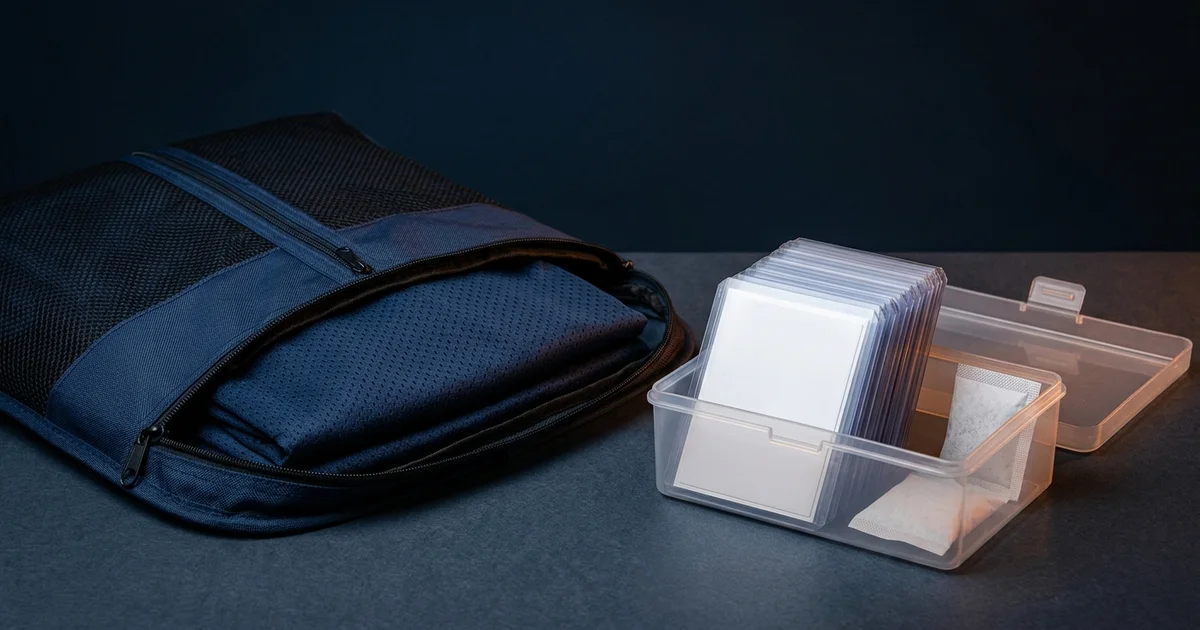
A card in a toploader or one-touch holder is already close to a sealed environment, and that’s fine. Cardstock and thin plastic don’t trap moisture against themselves the way fabric does. A sealed, enclosed space is actually where humidity control tools do their best work, because the volume is small enough for something like a silica gel packet to meaningfully hold a stable range inside the box.
For Storage Boxes and Binders

Premium Silica Gel Desiccant Packets (100-pack)
- 2-gram packets, each rated for about 0.14 cubic feet of enclosed space
- Reusable: reactivate in an oven at 200°F or a microwave on defrost
- Breathable nonwoven packet, safe in direct contact with cards and sleeves
Good: cheap, reusable for years, small enough to tuck into a card box or binder pocket without taking up real space.
Not great: no built-in humidity indicator, so you’re reactivating on a schedule rather than a clear visual cue, and at 2 grams each you’ll want several per box rather than one and done for anything larger than a single row of toploaders.
The same tool, two different results
Put those silica packets in a sealed card box and they hold the space at a stable range for months. Put the same packets in a jersey shadow box and they’re mostly decorative, because the volume of air is too large and, more importantly, the fabric itself is the thing holding moisture, not the air around it. The packet treats a symptom the jersey doesn’t have.
That’s really the whole rule. Cards live in small sealed spaces, so a small sealed-space tool works. Jerseys need to breathe, so anything that stops them from breathing works against you, no matter how good the moisture-absorbing material inside it is.