
As an Amazon Associate we earn from qualifying purchases. This post contains affiliate links, and we may earn a commission at no extra cost to you.
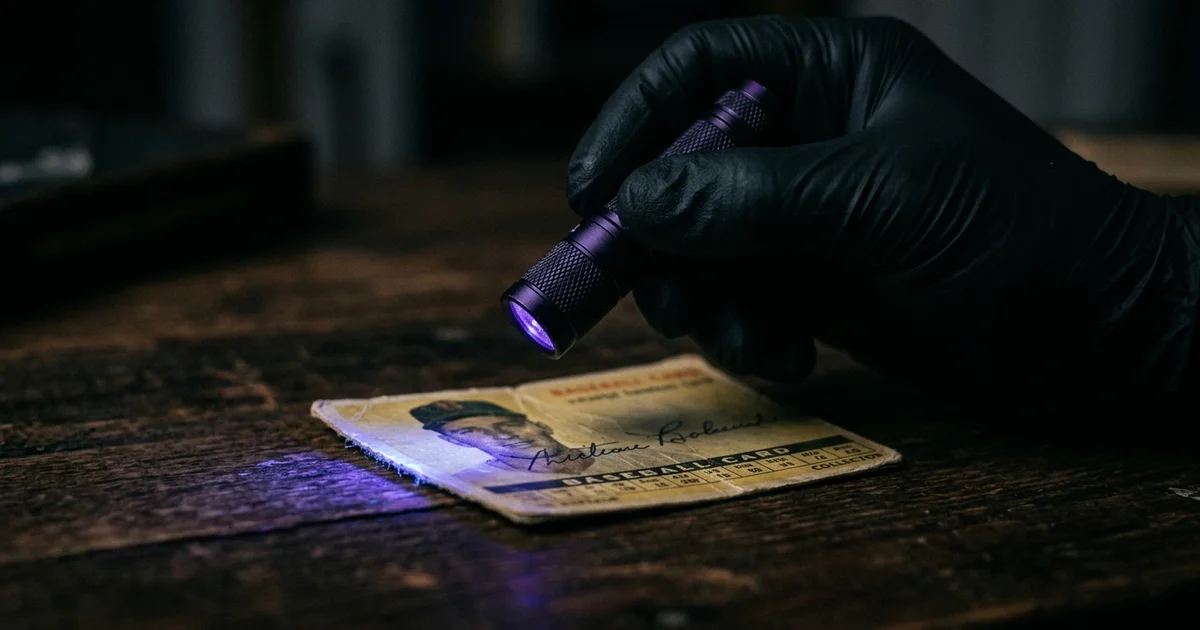
You bought a 365nm UV flashlight to check cards before you buy them. Good move. But if you’re checking the same signed ball or the same box of cards every few weeks, a fair question comes up: is the light itself doing any damage?
The answer depends entirely on which UV you’re using. Longwave and shortwave are not two flavors of the same thing. They’re different tools with a real gap in risk between them.
Longwave and shortwave aren’t the same light
UV covers a range, and where you sit in that range changes what the light does.
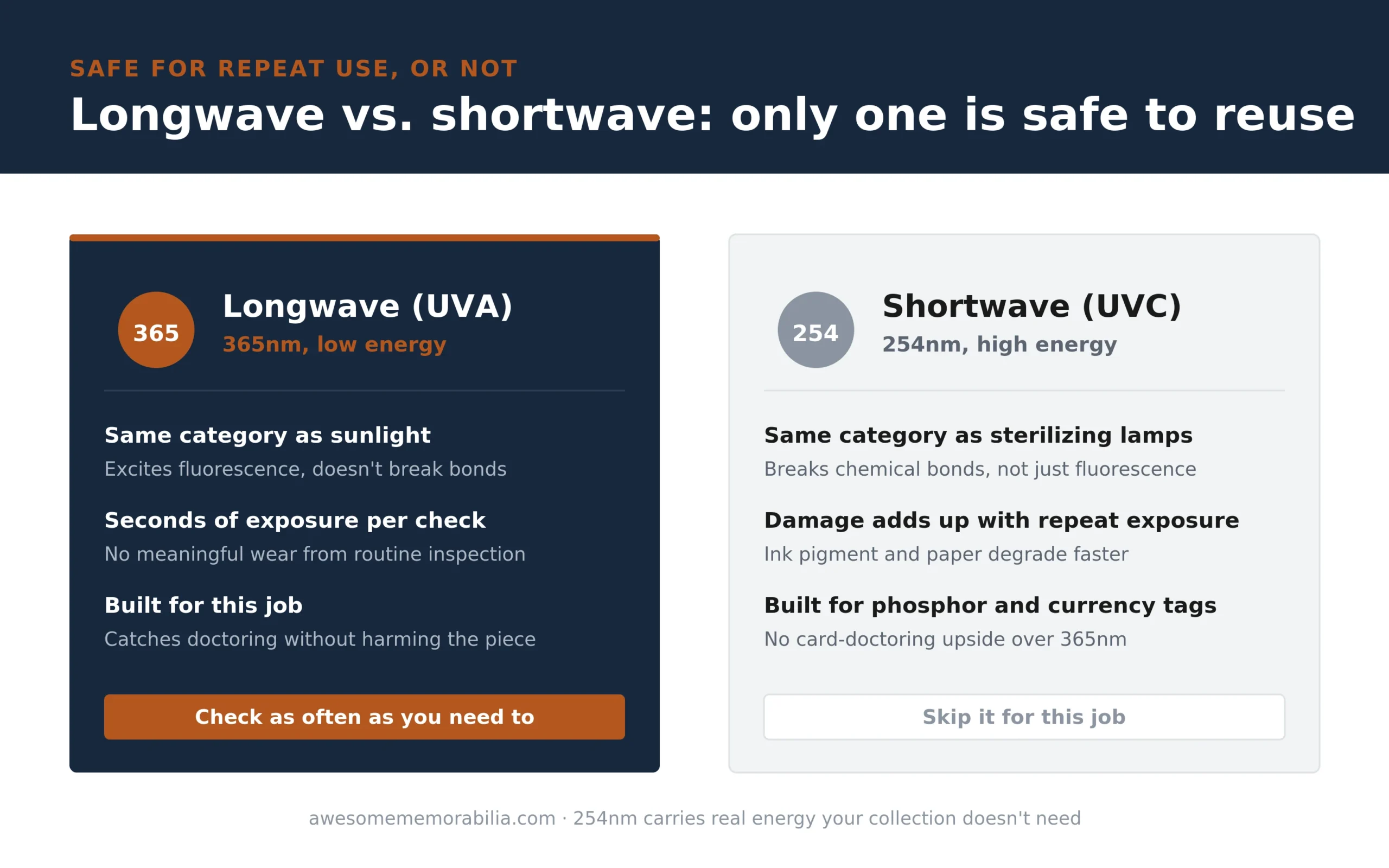
Longwave UV (UVA) runs roughly 315 to 400nm. This is the “black light” range, the one your 365nm flashlight lives in. It’s low energy as UV goes. You’ve been exposed to it every time you’ve stood in the sun.
Shortwave UV (UVC) runs roughly 100 to 280nm, with 254nm as the common output for shortwave lamps. It’s high energy, the kind used for sterilizing water and killing bacteria in hospital equipment. Your atmosphere blocks essentially all of it from reaching you outdoors, which tells you something about how your body and your collectibles are built to handle it. They aren’t.
Some UV lamps sold to collectors are dual-wave, switchable between 365nm and 254nm for stamp collectors checking phosphor tagging. That’s a legitimate use case for stamps. It’s the wrong feature to go looking for if autographs and cards are what you’re checking.
Why 254nm is the one to leave alone
Shortwave UV carries enough energy to break chemical bonds, not just excite fluorescence. That’s exactly why it’s used to sterilize things: it damages organic material at the molecular level. Paper, ink binders, and card stock are organic material.
A single accidental exposure isn’t going to ruin a card. But repeated, deliberate shortwave exposure adds up the same way sun exposure adds up on a couch left by a window. Ink pigments break down faster. Paper yellows and gets brittle sooner. You’d be authenticating the piece today while quietly aging it for tomorrow.
There’s no upside that offsets this for autograph and card work. Shortwave’s real use is phosphor and security-tagging detection, a stamp-collecting and currency-authentication niche. It doesn’t show you doctoring, retracing, or trimming any better than longwave does. You’d be taking on real risk for zero extra information.
Why 365nm doesn’t carry the same risk
Longwave UV is the same general category of light you get walking outside on a cloudy day, just concentrated and without the visible light diluting it. It excites fluorescence without the bond-breaking energy shortwave carries.
That doesn’t mean unlimited exposure is free. Any UV, including sunlight through a window, degrades ink and paper over years of constant exposure, which is the whole reason a UV-blocking display case matters for anything you keep on a wall. But a few seconds of 365nm during an inspection is a different order of magnitude from years of ambient light hitting a displayed piece. Checking a card under a 365nm light once before you buy it, and again if you ever want to re-verify it, isn’t going to measurably age it.
So how often is too often
For practical purposes, there isn’t a meaningful ceiling on 365nm inspection frequency for a collector. Dealers running boxes of cards under a light for hours a day, every day, for years are the edge case where cumulative exposure theoretically starts to matter, and even that risk is small compared to what shortwave does in seconds.
What actually matters more than frequency:
- Keep the exposure brief. Seconds per item, not minutes. You’re reading a reaction, not tanning the card.
- Skip anything sold as a shortwave or dual-wave “UV lamp” for this job. If a listing mentions phosphor tagging or currency verification as the primary use case, it’s built for stamps and cash, not cards and autographs.
- Don’t confuse UV output with brightness. A dim-looking 365nm beam can still be doing its job. You’re not supposed to see the UV itself, only what it makes glow.
The real takeaway
Buy 365nm. Skip anything shortwave. Check as often as you need to. The wavelength that catches doctoring and the wavelength that’s safe to use over and over turn out to be the same one, which makes this an easy call once you know the difference.